
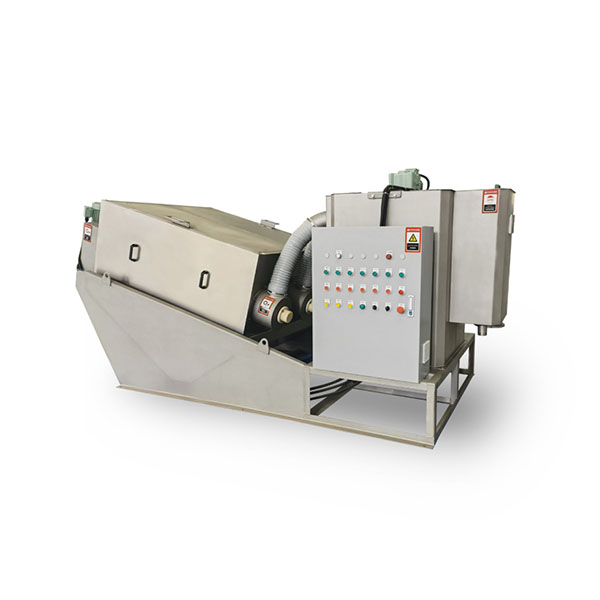
A screw press dewatering machine is one of the most practical pieces of equipment in modern wastewater treatment. It is also one of the most frequently misapplied. Specified correctly, it runs unattended for years, dewatering sludge at low energy cost with minimal operator involvement. Specified incorrectly — wrong model for the sludge type, undersized polymer system, inadequate feed conditioning — it produces wet cake and high polymer consumption. In that case, the operations team ends up blaming the machine for problems that started upstream.
This guide covers how a screw press dewatering machine works, how to size one correctly, what performance to expect from different sludge types, and how it compares to belt press and centrifuge alternatives. If you are specifying, procuring, or troubleshooting a screw press, this is the reference you need.
For industry standards on biosolids management and dewatering performance benchmarks, the Water Environment Federation (WEF) and IWA (International Water Association) publish regularly updated technical guidance.
What Is a Screw Press Dewatering Machine?
A screw press dewatering machine is a mechanical solid-liquid separation device. It removes water from sludge by applying continuous, progressive compression along a slowly rotating screw shaft. The result is a semi-dry cake of solids, typically 15–30% dry solids (DS) content. The separated liquid that drains away is called filtrate.
Unlike batch processes, a screw press runs continuously, 24 hours a day, with minimal operator attention. This makes it particularly attractive for plants that need uninterrupted throughput without dedicating staff to dewatering operations.
The Multi-Disk Design
The dominant design for wastewater applications is the multi-disk (lamella ring) screw press. In this configuration, the filter body consists of alternating fixed and moving stainless steel rings rather than a solid cylindrical screen. The relative motion between these rings provides continuous self-cleaning. As a result, multi-disk screw presses handle biological and oily sludge reliably where other designs blind and fail.
How a Screw Press Dewatering Machine Works: Step by Step
Understanding the mechanism is the fastest way to evaluate whether a screw press suits your application. It also helps diagnose problems when they occur.
Step 1: Polymer Conditioning
Raw sludge entering a screw press is typically 0.2–1.0% solids — mostly water. Before dewatering can occur, fine suspended particles must be flocculated into larger, heavier aggregates. This is done by dosing polyacrylamide (PAM) polymer into a conditioning tank upstream of the press.
In practice, this step is more important than most operators realise. In a 500 m³/day food processing plant I worked on in Southeast Asia, the screw press was producing 14% DS cake against a design target of 22%. The machine was not the problem. The polymer make-down unit was undersized, delivering under-dissolved polymer at half the required concentration. Fixing the polymer preparation system brought cake dryness to 23% within two weeks — without touching the press itself.
Typical PAM dosage: 3–8 kg active polymer per tonne of dry solids, depending on sludge type. Biological sludge from food processing typically requires the higher end of this range.
Step 2: Gravity Thickening Zone
Flocculated sludge enters the inlet of the screw press drum. In the early section, the screw moves sludge forward while free water drains out through the filter gaps under gravity. No pressure is applied yet. Sludge concentration rises from approximately 0.5% to 3–8% DS through this zone alone.
Step 3: Progressive Compression Zone
As sludge advances along the screw, two things happen simultaneously. First, the screw pitch decreases — the flights get closer together, reducing volume per turn. Second, the filtration gap between rings narrows. Both effects build internal pressure progressively, squeezing water through the filter gaps without shocking the floc structure that holds the solids together.
This is why screw presses handle fragile biological floc better than centrifuges. The pressure builds slowly and continuously, not instantaneously.
Step 4: Back Pressure and Cake Discharge
At the outlet end, an adjustable back pressure plate creates resistance against which compressed sludge is pushed. The operator adjusts this to control cake dryness:
- Higher back pressure → drier cake, lower throughput
- Lower back pressure → wetter cake, higher throughput
The dewatered cake discharges continuously from the outlet end into a conveyor or skip container.
Step 5: Self-Cleaning
The slow rotation of the screw shaft (1–5 RPM) and the relative motion between moving and fixed rings continuously scrape the filter surface clean. This is the defining advantage of the multi-disk design. It does not blind with biological, oily, or fibrous sludge the way fixed-screen designs do. Most units also include an intermittent external spray wash cycle.
Screw Press Performance by Sludge Type
Performance varies significantly by sludge type and conditioning quality. The benchmarks below assume correct polymer dosing and feed concentration within the design range.
| Sludge type | Feed concentration | Cake DS content | Solids capture rate |
|---|---|---|---|
| Municipal waste activated sludge (WAS) | 0.5–1.0% | 16–22% | 93–97% |
| Municipal mixed sludge (primary + WAS) | 1.0–3.0% | 20–28% | 94–98% |
| Digested municipal sludge | 2.0–4.0% | 22–30% | 95–99% |
| Slaughterhouse / meat processing | 0.5–2.0% | 18–26% | 90–96% |
| Dairy / food processing | 0.5–1.5% | 16–24% | 88–95% |
| Paper mill secondary sludge | 1.0–3.0% | 25–35% | 92–97% |
| Aquaculture (RAS fish farm) | 0.2–0.8% | 14–20% | 88–94% |
Why Cake Dryness Matters More Than You Think
Cake DS content is the number that drives your disposal cost per tonne. Every percentage point increase in DS content reduces the weight of cake sent to disposal by approximately 3–5%. On a plant processing 5,000 kg DS/day, the difference between 18% and 24% cake dryness is roughly 1,300 kg/day less material going to landfill. At landfill gate fees of $50–150/tonne, that is a significant annual saving.
Screw Press vs Belt Press vs Centrifuge: Full Comparison
This is the decision most project engineers and procurement teams actually need to make. The right answer depends on your sludge type, throughput, energy cost, disposal cost, and staffing level.
| Parameter | Screw press | Belt filter press | Decanter centrifuge |
|---|---|---|---|
| Cake DS content | 15–30% | 14–25% | 20–35% |
| Energy consumption | 0.01–0.04 kWh/kg DS | 0.02–0.06 kWh/kg DS | 0.3–0.8 kWh/kg DS |
| Polymer consumption | Low–medium | Medium | Medium–high |
| Throughput per unit | 5–500 kg DS/h | 100–1,000 kg DS/h | 200–3,000 kg DS/h |
| Footprint | Small | Medium | Small |
| Noise / vibration | Very low | Low | High |
| Wash water required | Low (intermittent spray) | High (continuous belt wash) | Minimal |
| Operator attention | Low (fully automatic) | Medium (belt adjustment) | Low–medium |
| Handles oily sludge | Good | Poor | Good |
| Handles fibrous sludge | Good | Good | Poor |
| Capital cost | Medium | Low–medium | High |
| Maintenance complexity | Low | Medium | High |
When to Choose Each Technology
Screw press wins clearly when: – Plant throughput is under 500 kg DS/h – No dedicated dewatering operators are available – Sludge contains high oil or grease content (food processing, industrial) – Enclosed operation matters for odor control or indoor installation – Energy cost is a priority
Choose belt press when: – Large throughput is required at minimum capital cost – Continuous wash water is readily available – Operators are available to monitor belt tension and polymer dose
Choose centrifuge when: – Plant is large, above 500 kg DS/h, where throughput per unit matters – Digested municipal sludge makes maximum cake dryness the priority – Disposal cost structure makes drier cake economically worthwhile despite higher energy use
How to Size a Screw Press Dewatering Machine
Correct sizing starts with three numbers: daily sludge volume, feed solids concentration, and desired operating hours per day.
Step 1 — Calculate Dry Solids Loading Rate
DS loading (kg/h) = Flow (m³/h) × Concentration (kg/m³)
Example: 200 m³/day sludge at 0.8% solids, operating 12 hours/day – Hourly flow during operation: 200 ÷ 12 = 16.7 m³/h – DS loading: 16.7 × 8 kg/m³ = 133 kg DS/h – Therefore, select a press rated for at least 133 kg DS/h — in practice, choose the next model up (e.g. 150 kg DS/h rated) for a 10–15% safety margin
Step 2 — Check Feed Concentration Range
Most screw presses are designed for feed sludge between 0.3% and 3% DS. Feed above 3% DS may cause torque overload on smaller units. Feed below 0.3% DS typically produces wet cake regardless of polymer dose — in that case, pre-thickening is needed upstream.
Step 3 — Specify the Filtration Gap
The gap between fixed and moving rings must match your sludge particle size: – 0.2 mm gap: fine biological sludge (municipal WAS, food processing) – 0.3 mm gap: mixed sludge, moderately fibrous sludge – 0.5 mm gap: coarser industrial sludge, paper mill fibre
Specifying the wrong gap is a common procurement error. For example, a 0.5 mm gap on fine biological sludge will pass fine particles through into the filtrate — reducing capture rate from 95%+ down to 70–80%.
Step 4 — Size the Polymer System to Match
Polymer make-down capacity and dosing pump range must be sized to match the screw press at peak throughput, not just average conditions. At maximum DS loading, polymer demand is at its highest. An undersized polymer system at peak load is the single most common cause of poor dewatering performance in plants that otherwise have correctly specified equipment.
Key Specifications When Buying a Screw Press Dewatering Machine
Not all screw press dewatering machines are equivalent. When evaluating suppliers, focus on the following specifications.
Ring Material and Thickness
Filter rings should be 304 or 316L stainless steel. For aggressive industrial sludge or corrosive environments, 316L is required. Ring thickness — typically 2.5–4 mm — directly affects wear life. Thicker rings last significantly longer on abrasive sludge.
Drive System
A variable-frequency drive (VFD) on the screw motor is worth specifying. Sludge quality varies with season and process upsets. Consequently, the ability to adjust screw speed lets operators optimise cake dryness and throughput without mechanical changes. Fixed-speed drives are cheaper but considerably less flexible.
Control System
A PLC-based control system with automatic polymer dosing adjustment, auto-start/stop, and remote monitoring capability (SCADA or Modbus) is the baseline for any installation where operators are not continuously present. Fault alarms for motor overload, polymer pump failure, and spray wash failure should be standard.
Performance Guarantee
A supplier confident in their equipment will commit to specific performance figures in the contract: minimum cake DS%, minimum solids capture rate, maximum polymer consumption. If a supplier qualifies every performance statement with “depending on conditions” without defining those conditions, that is a signal about their confidence in the machine.
Screw Press Operating Costs: What to Budget
For planning purposes, the ranges below cover most municipal and industrial applications.
| Cost item | Typical range | Notes |
|---|---|---|
| Energy | $0.5–2.0 per tonne sludge processed | Based on $0.10/kWh electricity |
| Polymer (PAM) | $8–25 per tonne DS removed | Active polymer basis |
| Wash water | 0.1–0.5 m³ per tonne DS | Plant service water acceptable |
| Maintenance parts | $1,500–5,000/year per press | Rings and bearings, 5–8 year replacement cycle |
| Labour | Less than 30 min/day inspection | For fully automated unit |
The energy cost advantage over centrifuge is the most significant factor. A plant processing 50 kg DS/h that switches from centrifuge to screw press typically saves $15,000–40,000/year in electricity alone at current energy prices.
Common Screw Press Problems and How to Fix Them
Problem 1: Wet Cake (Lower DS Than Expected)
Most likely cause: under-dosed or poorly dissolved polymer. Check the polymer make-down unit output concentration and age time before adjusting any press parameters.
Second most likely cause: back pressure plate set too low. Increase back pressure incrementally and measure cake DS after each adjustment.
Third cause: feed concentration too low, below 0.3% DS. In this case, pre-thickening is required upstream.
Problem 2: High Polymer Consumption
Most likely cause: incorrect polymer selection for the sludge type. Bench-scale jar testing with 3–4 polymer products will identify the optimal type and dose. This is usually worth doing before commissioning.
Second cause: polymer dilution water quality. Hard water or water with high iron content can interfere with polymer hydration.
Problem 3: Solids in Filtrate (Low Capture Rate)
Most likely cause: filtration gap too large for the sludge particle size. Verify that the installed gap matches the sludge specification.
Second cause: ring damage or wear. Inspect the filter body for worn or misaligned rings.
Problem 4: Ring Wear Faster Than Expected
Most likely cause: abrasive materials in the sludge — grit, sand, or inorganic particles. Verify that grit removal upstream is functioning correctly. Grit that bypasses the headworks accelerates ring wear dramatically.
Summary
A screw press dewatering machine offers continuous, low-energy sludge dewatering with a self-cleaning filter design suited to biological, oily, and fibrous sludge. When correctly sized and operated with proper polymer conditioning, it delivers 15–30% DS cake with 93–98% solids capture. Furthermore, energy costs are 10–20x lower than a decanter centrifuge.
The most important decisions in a screw press installation happen upstream: polymer system sizing, feed conditioning, and filtration gap specification. Get these right and the press runs reliably for years. Get them wrong and no amount of adjustment to the machine itself will compensate.
About the author: Marcus Webb is a water and environmental process engineer with over 20 years of experience on municipal and industrial wastewater projects across Southeast Asia, the Middle East, and Europe. He has specified and commissioned dewatering equipment for plants ranging from 500 m³/day package units to 150,000 m³/day regional treatment facilities.
We manufacture and export screw press dewatering machines in capacities from 5 to 500+ kg DS/h, with 304 and 316L stainless steel filter rings, VFD drive as standard, CE certification, and English O&M documentation. Contact us with your sludge flow rate, feed concentration, and target cake dryness — we will size the right model and provide a detailed technical proposal within 48 hours.