
A working engineer’s explanation — from polymer conditioning through cake discharge, including the design choices that separate good installations from ones that underperform.
How a screw press works sounds like a simple question. In practice, most people who ask it are actually trying to figure out something more specific: why their screw press isn’t producing the dryness they expected, whether the technology is right for their sludge type, or what’s happening inside the machine when things go wrong. This article covers the mechanism in enough detail to answer those questions — not just the textbook version, but the operational reality.
The dominant design for wastewater applications is the multi-disk screw press, sometimes called a lamella ring press. It replaced older solid-drum designs in most applications because the self-cleaning ring mechanism handles biological and oily sludge reliably where solid screens would blind. Understanding why the multi-disk design works is as useful as knowing how it works. For context on how screw presses fit within the broader dewatering equipment landscape, the Water Environment Federation publishes process selection guidance that covers the full range of sludge dewatering options.
What follows is the mechanism — step by step, with the details that actually matter for engineers and operators making real decisions.
The Basic Working Principle of a Screw Press
A screw press dewatering machine removes water from sludge by applying continuous, progressive compression along a slowly rotating screw shaft. The screw turns at 2–5 RPM — slow enough to avoid shearing the floc structure that conditioning has built. Sludge is conveyed forward as the screw rotates, and water is squeezed out through the filtration gaps as the available volume decreases along the shaft length.
The result is a semi-dry solid cake discharged at the outlet end, and a stream of separated liquid — called filtrate — that drains through the filter body. Cake dryness typically ranges from 15–28% total solids (TS) depending on sludge type and operating conditions. The machine runs continuously; there’s no batch cycle, no cleaning shutdown, no operator intervention required between adjustments.
What Makes the Multi-Disk Design Different
In a conventional solid-drum screw press, the filter body is a fixed cylindrical screen — similar in concept to a juice press. The problem with this design in wastewater applications is blinding: fine biological particles, oils, and fibrous material progressively clog the screen perforations, reducing filtration area and dropping throughput. Managing blinding requires frequent wash-down cycles or manual cleaning, which interrupts operation.
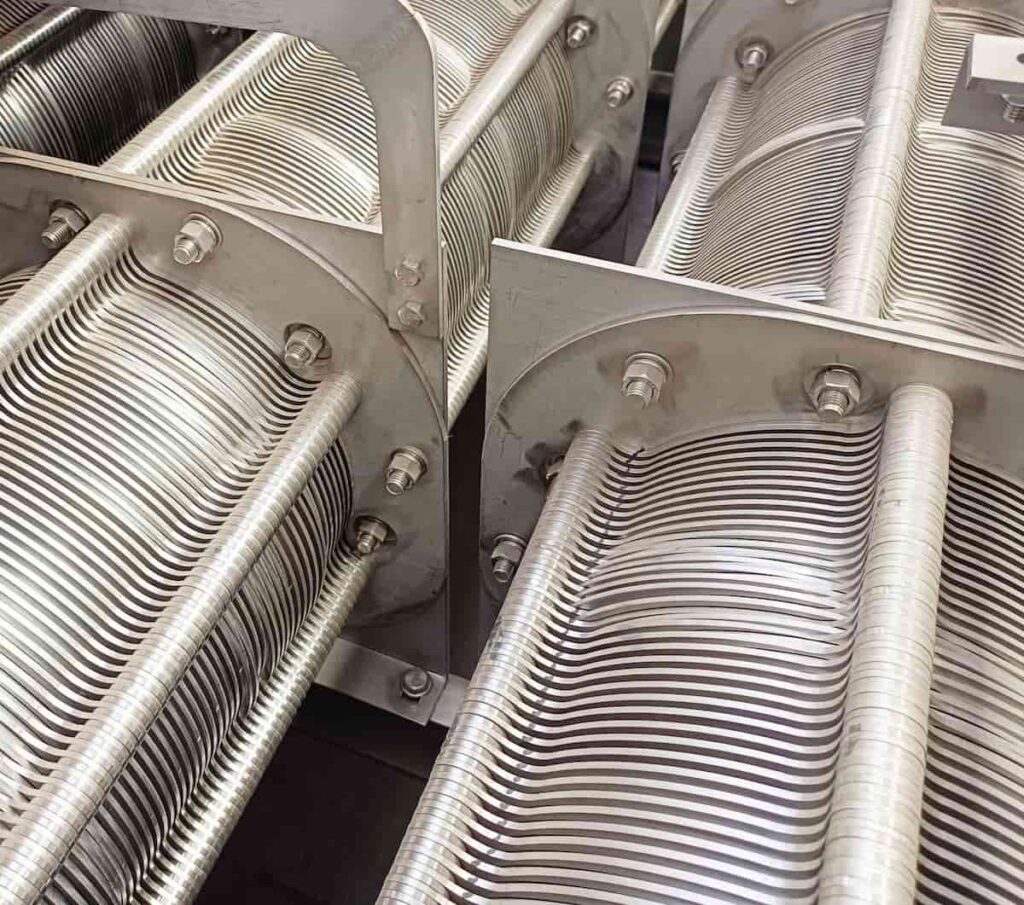
The multi-disk design solves this differently. Instead of a fixed screen, the filter body consists of alternating fixed rings and floating rings arranged along the screw shaft. The fixed rings are anchored to the frame; the floating rings move slightly in response to the rotating screw. This relative motion creates a continuous self-cleaning action — particles that would otherwise accumulate in the gaps are physically dislodged as the rings shift. In practice, this means a multi-disc screw press can run continuously on gelatinous activated sludge, high-FOG food processing waste, or mixed biological sludge without the blinding problems that limit solid-drum machines.
Why this matters operationally: The self-cleaning ring mechanism is the reason screw presses can operate unattended overnight or on low-staffing shifts. A solid-drum press on the same sludge would require operator attention every few hours to manage blinding. That operational difference is often more valuable than the dryness difference between technologies.
Step-by-Step: How Sludge Moves Through a Screw Press
The process has four distinct stages, each happening in a different zone of the machine. Understanding the zones helps diagnose underperformance — most problems trace back to one specific zone rather than the machine as a whole.
0.2–1% TS
→
PAM dosing
→
Free drainage
→
Progressive squeeze
→
Final dryness
→
15–28% TS
Stage 1: Polymer Conditioning
Raw sludge arriving at the screw press is typically 0.2–1.0% total solids — which means 99–99.8% water. Before mechanical dewatering can work effectively, the fine suspended particles need to be aggregated into larger, heavier flocs. Polyacrylamide (PAM) polymer is dosed into a conditioning tank or inline mixer upstream of the press inlet. The polymer causes particles to bridge together, forming flocs that are large enough to be retained by the filter gaps and compressible enough to yield water under pressure.
This stage is more critical than most equipment-focused discussions acknowledge. The screw press itself is essentially passive — it applies compression to whatever arrives at the inlet. If the floc structure is weak, fragile, or poorly formed, the compression zones will produce wet, poorly-structured cake regardless of how well the press is set up. More on why this matters in the troubleshooting section below.
Typical active PAM dosages range from 3 to 8 kg per tonne of dry solids, varying considerably with sludge type. Municipal waste activated sludge usually requires 4–7 g/kg DS. Food processing sludge with high FOG content tends toward the higher end. Well-digested biosolids often condition at 3–5 g/kg DS.
Stage 2: Gravity Thickening Zone
Conditioned sludge enters the press at the inlet end and immediately encounters the first zone: a section of relatively wide ring gaps where water drains freely under gravity. No pressure is applied here. The screw simply conveys the sludge forward while filtrate falls through the gaps below.
This zone is doing more work than it looks. On well-conditioned sludge, the gravity thickening zone raises solids concentration from roughly 0.5% to 3–8% TS — removing the majority of the free water before any compression begins. The downstream compression zone then works on a much more concentrated feed, which is why pre-thickening the sludge before it enters the press (using a gravity belt thickener or drum thickener) can push final cake dryness significantly higher.
Stage 3: Progressive Compression Zone
As sludge advances along the screw shaft, two geometric changes happen simultaneously. The screw pitch decreases — flights are spaced closer together, so each turn moves less volume forward. At the same time, the core diameter of the screw shaft increases, further reducing the cross-sectional area available to the sludge. Together, these changes create a continuously narrowing volume — the sludge is being compressed, and the bound water is forced out through the ring gaps under increasing pressure.
The ring gap dimension in this zone is typically 0.1–0.5 mm, controlled by manufacturing tolerances and adjusted by the floating ring tension. Finer gaps improve filtrate clarity — less solids pass through — but also increase the risk of gap clogging on sludge with fine particles or fibrous material. Selecting the right gap for a given sludge type is part of the commissioning process, and it’s not always obvious from the sludge data alone.
Stage 4: Back-Pressure and Discharge
At the discharge end of the screw shaft, a back-pressure device controls the resistance against which the conveyed sludge is compressed. Common designs use an adjustable cone, a spring-loaded plate, or an automated back-pressure cylinder. The sludge must build enough force to push past this resistance — and it’s that final compression against the back-pressure device that produces the driest section of cake.
Increasing back-pressure generally improves cake dryness, up to a point. Beyond the optimum, excessive back-pressure causes the cake plug to crack and fragment, which allows wet sludge to bypass the plug and discharge as slurry. Operators learn to identify this — the cake starts arriving in chunks rather than a continuous extrudate, and filtrate quality drops suddenly. It’s one of the more common operational problems on new installations, and it’s usually resolved by reducing back-pressure and re-establishing the plug.
New screw press installation on a 30,000 m³/day plant, mixed primary and secondary sludge. Commissioning produced acceptable filtrate clarity but cake dryness was stuck at 17% TS against a target of 21%. The operating team had increased back-pressure progressively trying to improve dryness, which was the logical response — but cake was fracturing intermittently and wet sludge was bypassing the plug. We reduced back-pressure by about 30% and simultaneously increased polymer dose from 4.5 to 6.2 g/kg DS, improving floc strength enough to hold a continuous cake plug. Dryness came up to 20–21% TS within two weeks. The back-pressure setting and polymer dose interact more than vendors typically describe in their commissioning documentation.
Key Components and What Each One Does
Most troubleshooting conversations eventually come back to one component. Knowing what each part does — and what its failure mode looks like — is more useful than a general understanding of the mechanism.
| Component | Function | Failure / Wear Indicator |
|---|---|---|
| Screw shaft | Conveys sludge forward; creates compression as pitch decreases | Wear on flight edges; usually 5–8 year replacement cycle on abrasive sludge |
| Fixed rings | Form the structural filter body; create the filtration gap with floating rings | Warping or pitting reduces gap consistency; affects filtrate clarity |
| Floating rings | Provide self-cleaning action through relative motion against fixed rings | Stuck or seized floating rings eliminate self-cleaning; blinding follows quickly |
| Back-pressure device | Controls discharge resistance; primary dryness adjustment | Worn seating surface allows cake bypass at lower-than-intended pressure |
| Drive unit | Rotates screw shaft at 2–5 RPM via gearbox + motor | High current draw indicates compression zone blockage or sludge overload |
| Polymer conditioning tank | Mixes PAM solution with sludge to form floc before pressing | Insufficient mixing time or poor dissolution produces weak floc |
| Wash nozzles (some models) | Periodic spray cleaning of ring gaps to remove fine accumulation | Blocked nozzles cause progressive performance decline; often overlooked |
The Ring Gap: Small Dimension, Large Consequence
The filtration gap between fixed and floating rings is physically small — typically 0.1 to 0.5 mm — but it controls two competing outcomes: filtrate clarity and throughput capacity. A narrow gap produces clear filtrate (low suspended solids in the return stream) but is more susceptible to clogging on sludges with fine or fibrous content. A wider gap passes more fine solids into the filtrate, which increases the solids load returned to the plant headworks, but tolerates more difficult sludge types.
Manufacturers typically set gap dimensions for the expected sludge type during commissioning. The problem is that sludge characteristics change — seasonally, with upstream process changes, or as the plant catchment evolves. A gap setting that worked well at commissioning may underperform two years later on noticeably different sludge. This is worth checking when performance has drifted and there’s no obvious explanation.
Operating Parameters: What to Monitor and Why
A screw press is relatively straightforward to operate, but the parameters interact in ways that aren’t always obvious. Understanding the relationships helps operators tune performance rather than just reacting to problems.
Polymer Dose and Floc Quality
Polymer dose is the most sensitive variable in screw press operation — more so than any mechanical adjustment. Underdo it and the floc is too weak to hold together under compression; cake is wet and filtrate is cloudy. Overdo it and excess unbound polymer coats the ring surfaces, reducing filtration area and progressively dropping throughput. The optimum is usually a narrower range than the dosing system’s control range suggests.
Beyond dose, polymer dissolution quality matters enormously. A well-made polymer solution at 3 g/kg DS will outperform a poorly dissolved solution at 6 g/kg DS. Dissolution depends on dilution water flow rate, mixing intensity, and — critically — the aging time between dissolution and dosing. Most PAM polymers need 20–40 minutes of aging after make-down before they reach full activity. Running a screw press off a polymer system without adequate aging time is one of the more common commissioning mistakes I’ve encountered.
Throughput Rate and Feed Concentration
Screw press capacity is rated at a specific feed concentration and throughput — usually expressed as kg dry solids per hour. Operating significantly above rated throughput overloads the compression zone, producing wet cake and high motor current. Operating significantly below rated throughput is less obviously harmful but can reduce compression efficiency as the sludge plug becomes discontinuous.
Feed concentration matters more than volume flow rate. A press rated for 50 kg DS/h at 3% feed concentration will struggle if the feed drops to 0.8% — not because of volume limits, but because the gravity thickening zone can’t raise the concentration quickly enough for the compression zone to work effectively. Pre-thickening to 2–4% DS before pressing is standard practice on plants with dilute sludge streams.
Back-Pressure Setting and Cake Dryness
Back-pressure adjustment is the primary on-the-fly control for cake dryness. Higher back-pressure compresses the cake plug more aggressively before discharge, increasing dryness — but only up to the point where the plug maintains structural integrity. Beyond that point, as noted earlier, the plug fractures and wet sludge bypasses it. Finding the optimum back-pressure for a given sludge usually takes a few days of careful adjustment during commissioning, and it needs to be revisited when sludge characteristics change significantly.
| Parameter | Typical Operating Range | Effect of Increasing | Effect of Decreasing |
|---|---|---|---|
| Screw speed | 2–5 RPM | Higher throughput; lower dryness | Lower throughput; higher dryness |
| Polymer dose | 3–8 g/kg DS | Better floc; diminishing returns above optimum | Weaker floc; wet cake; cloudy filtrate |
| Back-pressure | Application-specific | Higher dryness (to a limit); plug fracture risk | Lower dryness; more stable cake plug |
| Feed concentration | 2–6% TS (optimal) | Better compression efficiency | Gravity zone overloaded; wet cake |
| Throughput rate | Per manufacturer rating | Compression overload; wet cake | Discontinuous cake plug; reduced efficiency |
Poultry processing wastewater, approximately 400 kg DS/day. The installed screw press had been running at 14% TS cake dryness for several months — well below the 22% specification. Equipment inspection found nothing mechanically wrong. Investigation of the polymer system revealed the make-down unit was undersized: polymer solution was being prepared at too high a concentration and with inadequate aging time, producing partially dissolved polymer that was half as effective as it should have been. The solution cost less than $3,000 in modifications to the polymer preparation system. Cake dryness reached 23% TS within two weeks of the fix. Nobody had considered the polymer system as the source of the problem because the screw press was relatively new and appeared to be running normally.
Performance Limits: What a Screw Press Cannot Do
Understanding the mechanism also means being honest about where it breaks down. Screw presses are well-suited to a specific range of sludge types — and less suited to others. Knowing the limits upfront is more useful than discovering them at commissioning.
Sludge Types Where Screw Presses Excel
- Municipal waste activated sludge (WAS), particularly pre-thickened
- Food processing sludge — poultry, dairy, beverages, seafood processing
- Mixed primary and secondary municipal sludge
- Anaerobically digested biosolids at moderate solids loading
- Organic industrial sludge from pharmaceutical or brewery processes
Sludge Types Where Screw Presses Struggle
- High-grit or mineral sludge: abrasive particles accelerate screw shaft and ring wear substantially; replacement cycles shorten from years to months
- Very fine inorganic particles: particles smaller than the ring gap pass through as filtrate regardless of polymer dose, producing unacceptably turbid return streams
- Highly fibrous industrial sludge (paper/pulp, agricultural): fibres tend to bridge across ring gaps and cause blockages; belt presses typically outperform on these applications
- High-sand content sludge: typically requires pre-treatment to remove grit before pressing; otherwise screw wear becomes prohibitive
⚠ On sludge characterisation: The single most common source of screw press underperformance at commissioning is inadequate sludge characterisation during design. Particle size distribution, grit content, and volatile solids fraction all affect how the press performs — and none of these are captured by a basic COD or TSS measurement. If your design basis rests on a single sludge sample taken during normal operation, that’s a risk worth acknowledging.
Common Performance Problems and Their Root Causes
Most screw press problems fall into a small number of categories. The following covers the ones I see most often — and the ones that get misdiagnosed most often.
Wet Cake (Low % TS)
The most frequent complaint. Before adjusting back-pressure or slowing screw speed, check polymer performance first — weak or poorly dissolved polymer accounts for more wet cake problems than any mechanical issue. If polymer is confirmed good, check feed concentration (too dilute?) and throughput rate (overloaded?). Mechanical causes — worn back-pressure seating, cracked screw flights — are less common but worth inspecting after ruling out process variables.
Cloudy or High-TSS Filtrate
Filtrate that carries significant suspended solids back to the headworks increases the plant’s internal solids recycle load — sometimes significantly enough to affect overall plant performance. Causes include: insufficient polymer dose, ring gap too wide for the particle size distribution, or a floating ring that has seized and is no longer providing self-cleaning. Additionally, a fractured cake plug (from excessive back-pressure) allows wet sludge to bypass the filtration zone entirely.
High Motor Current / Drive Overload
Elevated current draw on the drive unit usually means the screw shaft is working against higher-than-normal resistance. Common causes: throughput rate exceeding design capacity, feed sludge thicker than the press was designed for, or a partial blockage in the compression zone. In cold climates, very cold sludge increases viscosity enough to cause overload on startup — a real issue on outdoor installations without sludge heating.
Progressive Dryness Decline Over Weeks or Months
Gradual performance drift — rather than sudden failure — typically points to either progressive ring wear (increasing gap dimension over time) or slow accumulation of material in the ring gaps that isn’t being cleared by the self-cleaning action. The second cause is more common on sludges with high fat or fibrous content. Periodic manual inspection of the ring gaps, and occasional mechanical cleaning of the gap surfaces, is worthwhile on these applications.
In my experience, roughly 60% of screw press performance problems trace back to the polymer system rather than the press itself. Before adjusting anything mechanical, I’d confirm: polymer dose rate is correct, polymer solution concentration is within spec, aging time is adequate (20–40 minutes minimum for most PAM products), and the conditioning tank mixing is actually working. That diagnostic takes an hour and eliminates the most likely cause. The mechanical investigation can wait.
Frequently Asked Questions
How does a multi-disc screw press differ from a solid-drum screw press?
The filter body construction is the key difference. A solid-drum press uses a fixed cylindrical screen with perforations — effective on some sludge types but prone to blinding on fine biological material. The multi-disk design replaces this with alternating fixed and floating rings whose relative motion provides continuous self-cleaning. In wastewater applications, where sludge is typically biological and prone to screen blinding, multi-disk designs have largely replaced solid-drum models because they can run continuously without cleaning interruptions.
What RPM does a screw press typically run at, and why does it matter?
Most multi-disk screw presses run at 2–5 RPM. That’s deliberately slow — slow enough to avoid shearing the polymer-floc structure that conditioning has created. Higher RPM would increase throughput but would also break apart the floc, producing wet cake and cloudy filtrate. Screw speed is adjustable on most machines and is one of the primary operating variables for balancing throughput against dryness.
How long does it take to commission a screw press and reach stable dryness targets?
Most installations reach stable operation within 2–4 weeks of first feed, assuming sludge characteristics match the design basis. The main variables requiring tuning are polymer dose, back-pressure setting, and — if pre-thickening is involved — feed concentration. However, some installations on challenging sludge types require longer adjustment periods, particularly when the polymer system also needs optimization. Planning 4–6 weeks of supervised operation for a critical installation is reasonable.
Can a screw press handle sludge that varies significantly in concentration?
Within a moderate range, yes — most presses tolerate feed concentration variation of roughly ±30–40% around the design point without significant performance impact. Larger swings cause problems: very dilute feed (below ~1% TS) overloads the gravity thickening zone, while very concentrated feed (above ~8% TS) can overload the compression zone and cause drive overload. Plants with highly variable sludge streams often benefit from a sludge storage or equalization tank upstream of the press.
What is the typical maintenance interval for fixed and floating rings?
Ring replacement cycles depend heavily on sludge abrasiveness and hours of operation. On clean municipal biological sludge, rings typically last 4–6 years before clearances have worn enough to affect performance. Industrial sludge with grit or mineral content shortens this considerably — sometimes to 18–24 months. The practical indicator is progressive filtrate turbidity over time, as worn rings pass more fine material. Most operators don’t track this carefully enough; periodic filtrate TSS testing provides an early warning before the problem becomes severe.
Questions About Screw Press Selection or Performance?
Whether you’re evaluating technology for a new installation or troubleshooting an existing press, our process engineers can review your sludge data and operating parameters and give you a direct technical assessment.