
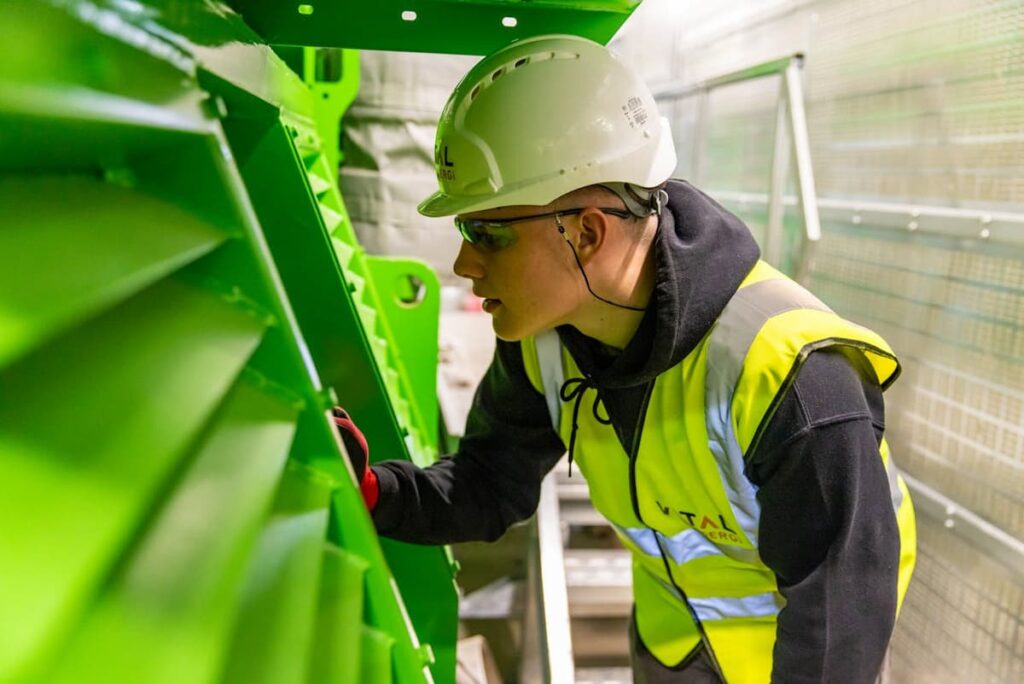
A screw press dewatering machine is one of the lowest-maintenance pieces of equipment in a wastewater treatment plant. The slow rotation speed, self-cleaning ring design, and absence of high-speed bearings mean that most problems develop gradually rather than catastrophically. Consequently, a structured maintenance program catches degradation early — before it becomes an unplanned shutdown or a permit violation.
That said, ‘low maintenance’ does not mean ‘no maintenance’. In practice, the plants that experience the fewest problems are those with a consistent maintenance routine that operators actually follow. The plants that struggle are usually those where maintenance is reactive — carried out only when something goes wrong — rather than scheduled.
This guide sets out a practical maintenance program structured around three time horizons: weekly tasks that operators can complete during normal rounds, monthly tasks requiring slightly more time and some basic tools, and annual tasks typically carried out during a planned shutdown. Each task includes what to check, what passes and what fails, and the action to take when something is out of range.
For reference standards on dewatering equipment maintenance, the Water Environment Federation (WEF) Operations & Maintenance of Wastewater Treatment Facilities series provides additional guidance on inspection intervals and acceptance criteria.
Why a Structured Maintenance Program Pays for Itself
Before working through the checklists, it is worth understanding the cost case for preventive maintenance — because in plants under budget pressure, maintenance tasks are often the first thing cut.
The Real Cost of Reactive Maintenance
Consider the failure mode for filter rings — the most commonly replaced wear component in a multi-disc screw press. Rings wear gradually over months and years. If inspected annually, a plant catches ring thinning before it causes problems and replaces rings during a planned shutdown at standard parts cost. If rings are inspected only when performance degrades — which is the reactive approach — the plant instead faces turbid filtrate, permit risk, emergency ring replacement at premium cost, and potentially several days of unplanned downtime.
In a 2021 case at a food processing facility in central Taiwan, delayed ring inspection led to a ring section failing completely during operation. A broken ring fragment damaged adjacent rings, turning a routine ring replacement into a full drum overhaul. The unplanned repair cost was approximately NTD 280,000 — roughly six times the cost of the scheduled ring inspection and replacement that had been deferred for two years.
What Good Maintenance Actually Prevents
| Component | Failure mode if neglected | Consequence |
| Filter rings | Thinning → gap widening → fines pass | Turbid filtrate; permit violation; emergency shutdown |
| Bearings | Dry running → seizure | Motor overload; shaft damage; costly repair |
| Spray nozzles | Blockage → ring blinding | Gradual DS drop; over-dosing polymer to compensate |
| Back pressure plate | Wear → inconsistent discharge resistance | Variable cake DS; cake bridging |
| Polymer make-down unit | Pump wear → under-dose | Wet cake; increased polymer spend; operational complaints |
| Gearbox oil | Low oil level → gear wear | Progressive gearbox failure; expensive replacement |
Weekly Maintenance Checklist
Weekly tasks are observational and require no tools beyond what operators carry during routine rounds. Nevertheless, they are the most important tier of the maintenance program because they catch problems before they develop. Consequently, weekly checks should be completed at the start of each operating week — not deferred when the plant is busy.
| Weekly Checklist — Complete at start of each operating week |
| ✓ | Task | How to check | Pass / Fail | Notes |
| ☐ | Check filtrate clarity visually | Observe filtrate channel during press operation. Filtrate should appear clear to slightly cloudy — never visibly turbid. | Clear to pale yellow = pass. Visibly turbid or milky = fail. | Record turbidity if meter available |
| ☐ | Observe cake discharge consistency | Watch cake discharge for 2–3 minutes. Cake should discharge continuously and break cleanly, not in slugs or as wet slurry. | Steady continuous discharge = pass. Intermittent or wet = fail. | Note any bridging or sticking |
| ☐ | Check cake DS visually | Squeeze a handful of cake — it should hold shape but not release free water when compressed. | Holds shape, no free water = pass. Releases water = fail. | Measure DS monthly with balance |
| ☐ | Verify polymer make-down is running | Check make-down unit display: aging time, pump output, solution level. Confirm polymer stock is adequate. | All parameters at set point = pass. Any alarm = fail. | Log current dose rate |
| ☐ | Listen for abnormal noise | Walk around the press during operation. Note any grinding, clicking, or metal-on-metal sounds. | Steady low hum = pass. Any metallic or irregular sound = fail. | Stop press if knocking heard |
| ☐ | Check spray wash cycle is completing | Confirm spray wash timer is activating and water is reaching all nozzle positions. Observe spray coverage. | Full coverage, no dry spots = pass. Partial spray = fail. | Check inlet pressure if low |
| ☐ | Inspect filtrate channel for solids build-up | Check filtrate trough for settled solids that indicate poor capture. Remove any accumulation. | Minimal settled solids = pass. Significant accumulation = fail. | Increase polymer dose if failing |
| ☐ | Check polymer conditioning tank level and foam | Verify tank level is within operating range. Note any foam formation. | Normal level, minimal foam = pass. Overflow or heavy foam = fail. | See Article #7, Problem 7 |
| ☐ | Confirm control panel shows no active alarms | Review panel display. Acknowledge and investigate any alarms before starting the shift. | No active alarms = pass. Any unacknowledged alarm = fail. | Log all alarms with time and response |
| ☐ | Record operating parameters | Note screw speed (RPM), back pressure setting, feed pump speed, and polymer dose rate in the logbook. | All within set-point range = pass. Deviation without explanation = investigate. | Compare to previous week’s values |
Monthly Maintenance Checklist
Monthly tasks require basic tools and, in some cases, a brief press shutdown. In practice, scheduling monthly maintenance at the end of the week — when the press can be shut down for 2–3 hours without operational impact — works well for most plants. Furthermore, monthly checks provide the data that allows engineers to spot long-term trends: gradual ring wear, increasing bearing temperature, creeping polymer demand.
| Monthly Checklist — Complete each calendar month during a scheduled stop |
| ✓ | Task | How to check | Pass / Fail | Notes |
| ☐ | Measure cake DS content | Collect 3 representative cake samples at different times during one operating session. Dry samples at 105°C and calculate DS%. | Within ±2% of target = pass. More than 3% below target = investigate. | Compare to seasonal baseline |
| ☐ | Measure filtrate TSS | Collect filtrate sample during normal operation. Measure TSS by standard gravimetric method or send to laboratory. | Below 500 mg/L = pass. Above 1,000 mg/L = fail. | Trigger: check ring gap if failing |
| ☐ | Inspect spray nozzles individually | Remove and inspect each nozzle. Check orifice for blockage, scaling, or enlargement. Clean or replace as needed. | Clear orifice, correct diameter = pass. Blocked or worn = replace. | Soak blocked nozzles in citric acid |
| ☐ | Check and record bearing temperature | Use infrared thermometer on each bearing housing during operation. Record temperatures and compare to previous month. | Within manufacturer limit (typically <70°C) = pass. Rising trend = investigate. | Check lubrication if temperature rising |
| ☐ | Verify filtration gap at accessible inspection point | With press stopped, use feeler gauge at the accessible ring gap inspection point specified in the O&M manual. | Within ±0.05 mm of nominal = pass. Gap widened = rings wearing, plan replacement. | Record gap measurement and date |
| ☐ | Grease bearing housings per lubrication schedule | Apply grease to all bearing points specified in the lubrication chart using the correct grease grade. | Grease applied and confirmed = pass. Missed points = fail. | Use manufacturer-specified grease only |
| ☐ | Inspect back pressure plate for wear | With press stopped, visually inspect the back pressure plate surface and edge seating. Check adjustment mechanism moves freely. | No visible grooving or uneven wear = pass. Visible scoring = note for replacement. | Measure plate thickness if wear visible |
| ☐ | Check gearbox oil level | Use dipstick or sight glass to verify oil level is within the marked operating range. | Within marked range = pass. Below minimum = top up immediately. | Check for discolouration — milky oil = water ingress |
| ☐ | Inspect polymer dosing pump output | Calibrate dosing pump by measuring actual output volume over a timed period and comparing to set-point. | Output within ±5% of set-point = pass. Greater deviation = recalibrate or service pump. | Replace diaphragm if output low and calibration fails |
| ☐ | Clean filtrate collection trough | Remove accumulated solids and any biological growth from the filtrate trough. Inspect for corrosion. | Clean, no corrosion = pass. Corrosion spots = treat and document. | Use high-pressure hose; protect bearings from water |
| ☐ | Review and update operating logbook | Confirm weekly logs are complete. Plot cake DS, polymer dose, and filtrate TSS trends on control chart. | Complete records with no unexplained gaps = pass. | Trends are more useful than individual readings |
| Field case — Malaysia, Selangor Province, 2022: A palm oil mill effluent (POME) treatment plant introduced monthly bearing temperature logging after experiencing an unexpected bearing seizure in 2021. Within four months of implementing the program, trending data showed one bearing housing running 12°C above its historical baseline — well before any noise or vibration was detectable. Replacing the bearing during the next scheduled stop cost approximately MYR 1,800. The previous unplanned failure had cost MYR 47,000 in emergency labour, parts, and production downtime. |
Annual Maintenance Checklist
Annual maintenance requires a full press shutdown of typically 1–3 days, depending on the scope of work. Consequently, it should be coordinated with the plant’s broader planned maintenance program to minimize operational disruption. For plants in continuous operation, the annual shutdown provides the only opportunity to inspect components that are inaccessible during normal operation — particularly the filter ring assembly and screw shaft condition.
Scheduling the Annual Shutdown
In most installations, the best time for the annual shutdown is at the end of summer — before the increased polymer demand of the colder months — or during a period of lower sludge production. For food processing plants, this often coincides with a production line changeover or seasonal shutdown. Additionally, coordinating the screw press shutdown with any upstream or downstream equipment maintenance reduces the total plant downtime required.
| Annual Checklist — Complete during planned annual shutdown (allow 1–3 days) |
| ✓ | Task | How to check | Pass / Fail | Notes |
| ☐ | Full filter ring inspection | Remove access panels and inspect all fixed and moving rings. Measure ring thickness at multiple points using vernier calipers. Record measurements. | Ring thickness within 15% of new specification = pass. More than 20% thinning = plan replacement. | Replace rings as a complete set, not individually |
| ☐ | Filtration gap measurement — full drum | Measure gap at minimum 6 positions around the drum circumference using feeler gauges. | Gap within ±0.08 mm of nominal = pass. Consistent widening = ring wear; increase inspection frequency. | Map gap variation across drum length |
| ☐ | Screw shaft visual inspection | With rings removed or with access cover open, inspect screw shaft flights for wear, surface cracking, or corrosion. Check shaft runout. | No visible cracking or significant flight wear = pass. Any crack = replace immediately. | Photograph for comparison year-on-year |
| ☐ | Full bearing replacement (if interval reached) | Replace all main bearings at manufacturer-specified service interval, typically every 3–5 years depending on operating hours. | New bearings installed and greased = pass. | Record bearing brand, grade, and installation date |
| ☐ | Gearbox oil change | Drain gearbox, flush with flush oil, refill with manufacturer-specified oil grade and quantity. | Oil changed, correct grade confirmed = pass. Incorrect grade = drain and replace. | Inspect drain plug for metal filings |
| ☐ | Inspect and pressure-test spray wash manifold | Remove manifold. Inspect pipe and fittings for corrosion. Replace all nozzles as a preventive set. Pressure-test reassembled manifold at 1.5× operating pressure. | No leaks at test pressure = pass. Any leak = repair before reassembly. | Install new nozzle set during annual regardless of condition |
| ☐ | Back pressure plate replacement or refurbishment | Measure plate thickness and inspect seating surface. Refurbish if wear is within acceptable limits; replace if beyond. | Plate within 80% of new thickness = refurb acceptable. Below 80% = replace. | Check adjustment mechanism for corrosion |
| ☐ | Motor insulation resistance test | With motor isolated, use insulation tester (megger) to measure winding resistance to earth. | Above 1 MΩ at 500V = pass. Below 1 MΩ = motor requires servicing. | Trend resistance values year-on-year |
| ☐ | VFD inspection and cooling fan check | Inspect VFD for dust accumulation, loose terminal connections, and cooling fan operation. | Clean, tight connections, fan running = pass. Dust on heatsink = clean before restart. | Use compressed air on heatsink; avoid moisture |
| ☐ | Control panel inspection | Check all terminal connections for tightness. Inspect cable insulation. Verify all alarm limits are set correctly in PLC. | All terminals tight, insulation intact = pass. Any loose connection = rectify. | Update PLC set-points if process has changed |
| ☐ | Full performance verification test | After reassembly, run press for minimum 4 hours with representative sludge. Measure cake DS, filtrate TSS, polymer dose, and energy consumption. Compare to commissioning baseline. | All parameters within 10% of commissioning values = pass. Significant deviation = investigate before returning to service. | Record as the new annual baseline |
| ☐ | Update maintenance records and spare parts inventory | Complete all maintenance documentation. Verify spare parts stock: at minimum 1 set of rings, 1 bearing kit, 1 nozzle set, 1 diaphragm pump kit. | Records complete, spares confirmed in stock = pass. | Order replacements immediately if stock is low |
Recommended Spare Parts Inventory
Maintaining a minimum spare parts inventory eliminates the most significant risk in screw press operation: waiting weeks for parts during an unplanned failure. The table below sets out the minimum recommended stock for a single-press installation. For multi-press sites, the inventory should scale accordingly, though some items — particularly ring sets — can be shared across identical press models.
| Spare Part | Replacement Interval | Min. Stock (1 press) | Lead Time if Not Stocked | Priority |
| Filter ring set (fixed + moving) | 5–8 years | 1 complete set | 6–14 weeks | Critical |
| Main bearing kit (all positions) | 3–5 years | 1 complete kit | 2–6 weeks | Critical |
| Spray nozzle set | 1–2 years | 2 complete sets | 1–3 weeks | High |
| Diaphragm pump repair kit (polymer dosing) | 12–18 months | 2 kits | 1–2 weeks | High |
| Back pressure plate | 3–6 years | 1 unit | 4–10 weeks | High |
| Gearbox oil (correct grade) | Annually | 1 change volume | 1–2 days | Medium |
| Bearing grease (correct grade) | Per lubrication schedule | 3 kg | 1–3 days | Medium |
| O-rings and shaft seals | As required | 1 assortment kit | 1–2 weeks | Medium |
| Note on ring set stocking: Filter rings represent the largest single spare parts investment but carry the longest lead time. A plant that runs without a stocked ring set is one unplanned ring failure away from a multi-week unplanned shutdown. The cost of stocking one ring set — typically equivalent to 2–4 months of polymer spend — is consistently justified by the downtime risk it eliminates. |
Maintenance Log Template
A maintenance log is only useful if it is consistently completed and regularly reviewed. The template below captures the minimum data needed to identify trends and justify maintenance decisions. In practice, a paper logbook kept in the dewatering room works equally well as a digital system — the critical factor is that operators actually fill it in, not the format it takes.
| Date | Cake DS % | Filtrate TSS mg/L | PAM dose kg/t DS | Bearing temp °C | Alarms / issues | Initials |
How to Use Trending Data Effectively
Recording individual readings is useful, but trend analysis is where maintenance logs generate real value. Specifically, the most informative trends to track are:
- Cake DS month-on-month: a gradual downward trend without a corresponding change in sludge type or polymer dose indicates ring wear widening the filtration gap.
- Polymer dose month-on-month: an upward creep without a change in sludge composition indicates make-down unit degradation, dilution water quality change, or seasonal temperature effects.
- Bearing temperature month-on-month: a rising temperature trend — even within specification — indicates increasing friction that will eventually result in failure.
- Filtrate TSS after each ring inspection: if TSS is lower immediately after inspection, the act of inspection (which includes cleaning the ring surfaces) is confirming that ring blinding was contributing to the problem.
In practice, plotting these four parameters on a simple run chart — one page per parameter per year — takes less than 10 minutes per month and provides the clearest possible view of press health over time.
Field Case: Thailand — How a Maintenance Program Resolved a Recurring Performance Problem
A shrimp processing facility in Samut Sakhon Province, Thailand operated two screw presses serving a combined DAF sludge load of approximately 180 kg DS/h. For three years, the plant had experienced cyclical performance drops every 4–6 months: cake DS falling from 19% to 13%, polymer consumption spiking, and filtrate becoming turbid. Each episode was resolved by a combination of dose adjustment and press cleaning, after which performance recovered — until the next cycle.
The pattern suggested a root cause that was gradual and cyclical rather than sudden. Consequently, when we were asked to review the plant in 2022, the first step was not to examine the presses but to examine the maintenance records. The records — such as they were — showed no consistent measurement data, no trend tracking, and no record of ring inspections at either press.
Root Cause Identified
Physical inspection revealed that the filter rings on both presses were at approximately 60% of their original thickness — significantly below the replacement threshold — and that the filtration gap had widened from the nominal 0.2 mm to between 0.35 and 0.42 mm across different positions on the drum. Furthermore, three of the twelve spray nozzles on Press 1 were completely blocked, allowing a section of the ring drum to operate without effective cleaning.
The cyclical performance pattern was explained by the interaction between these two factors: as rings gradually wore and gaps widened, fine particles began escaping into the filtrate. Operators compensated by increasing polymer dose, which temporarily improved floc size and reduced filtrate turbidity. However, the higher polymer dose also increased the polymer load on the blocked nozzle section, causing progressive blinding of that drum section. Eventually the blinding became severe enough to trigger a crisis, at which point cleaning resolved the nozzle problem — until the next cycle began.
Resolution and Outcome
Ring sets on both presses were replaced, all nozzles were renewed, and a structured maintenance program was implemented: weekly observations, monthly bearing checks and nozzle inspections, and an annual ring measurement protocol. As a result, 18 months later the plant had experienced no performance cycles. Cake DS had stabilized at 20–22%, polymer consumption had decreased by 28% from the pre-program average, and the operations team had confidence in the press performance for the first time since commissioning.
Summary
Screw press maintenance does not require specialist skills or complex equipment. It requires consistency — showing up weekly to check the same things, recording the numbers, and acting on trends before they become failures.
The three-tier program in this guide — weekly observations, monthly measurements, and annual inspections — is calibrated to match the actual failure modes of multi-disc screw press equipment. Weekly tasks catch conditioning problems before they affect performance. Monthly tasks catch mechanical degradation before it causes failures. Annual tasks provide the systematic inspection needed to make informed decisions about ring replacement, bearing service, and component refurbishment.
Furthermore, the spare parts inventory table addresses the most common maintenance failure: discovering that a critical component needs replacing and then waiting 8–12 weeks for parts to arrive. A stocked spare parts kit converts that scenario from an extended unplanned shutdown into a routine 1–2 day repair.
Need Spare Parts or a Maintenance Support Contract?
We supply genuine replacement parts for multi-disc screw press dewatering machines — filter rings, screw shafts, bearing kits, spray nozzle sets, and back pressure plates.
Parts ship within 2–4 weeks to most destinations worldwide. Annual maintenance contracts are available for plants requiring scheduled ring inspection, bearing replacement, and performance verification.
→ Send us your press model and serial number for a parts quotation within 48 hours.
CE certified equipment | English O&M documentation | Global parts shipping