
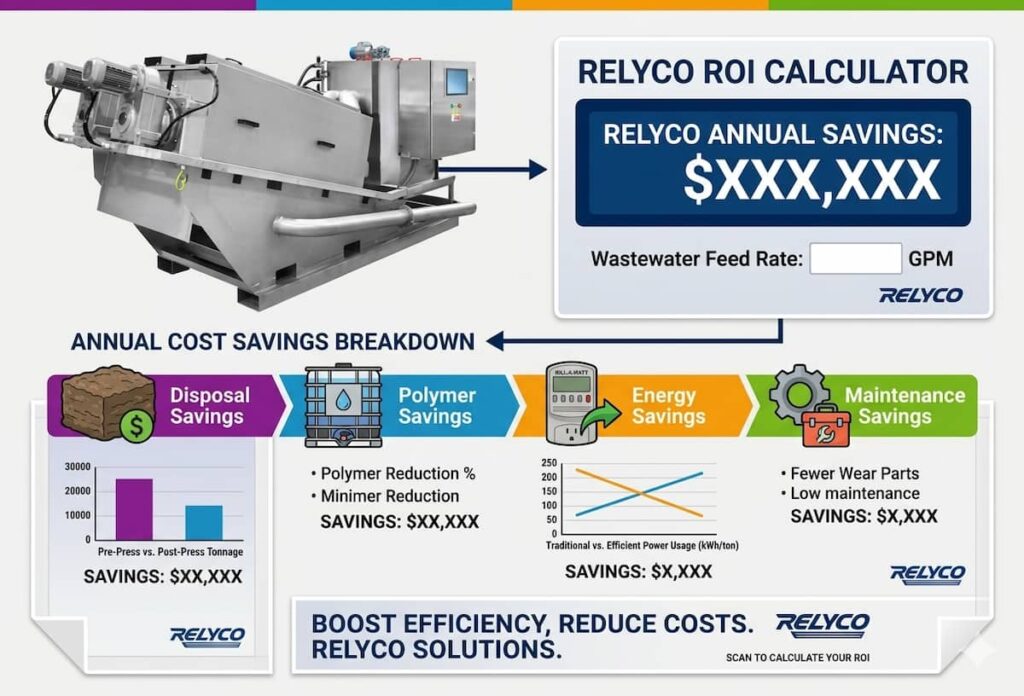
How to quantify what a screw press investment actually returns — with worked examples across disposal cost, polymer, energy, and maintenance savings.
ROI calculations for dewatering equipment get simplified in ways that make them look cleaner than they are. A vendor’s payback claim usually rests on a single cost driver — typically cake disposal savings from improved dryness — and ignores polymer, energy, maintenance, and staffing differences that can easily double or halve the actual return. This guide works through all four savings categories, shows you how to build a realistic total calculation, and illustrates with worked examples that reflect actual project outcomes rather than best-case assumptions.
The goal isn’t to produce a number you can put in a board presentation without caveats. It’s to give you a calculation structure that holds up under scrutiny — one that captures the savings that are real, flags the assumptions that drive the result, and identifies where the uncertainty actually lives. For a broader overview of screw press technology and where it fits in the dewatering landscape, the Water Environment Federation provides process selection guidance that contextualises these economics within a full-plant design framework.
A note on what this guide covers: it focuses on the economics of switching to a screw press from another dewatering technology, or of justifying a new screw press installation. The same framework applies to comparing screw press options from different manufacturers, though some cost categories will be smaller in that case.
The Four Cost Categories That Drive Screw Press ROI
Screw press economics come down to four savings categories. Each one is real — but each one also depends on site-specific inputs that vary considerably. Understanding which categories dominate your specific situation is more useful than applying a generic payback figure.
1. Cake Disposal Cost Savings
Cake disposal is usually the largest single cost driver, and consequently the one most vendors lead with. The logic is straightforward: drier cake weighs less, costs less to transport, and in many cases qualifies for lower-cost disposal routes. A switch from 18% TS to 22% TS on a plant producing 1,000 kg DS/day reduces wet cake weight by roughly 200 kg/day — about 73 tonnes per year going to landfill or drying that didn’t need to be there.
However, the disposal cost saving is only as large as the actual dryness improvement — which depends on what you’re switching from and what your sludge actually does in a screw press. Comparing a well-tuned centrifuge to a screw press on the same municipal sludge, the dryness difference may be only 2–3 percentage points. Comparing a poorly performing belt press on fine biological sludge, the difference might be 5–7 points. The calculation has to be built on realistic dryness expectations for your specific sludge, not datasheet figures.
Daily DS production (kg) × 365
÷ (Target TS% / 100) = New annual wet cake (kg)
÷ (Current TS% / 100) = Current annual wet cake (kg)
Wet cake reduction (kg/yr) × Disposal cost ($/kg) = Annual saving ($)
2. Polymer Cost Savings
Polymer savings are the second major category — and the one most often underweighted in vendor ROI calculations, perhaps because it doesn’t favour screw press vendors to highlight it when pitching against other screw press brands. When switching from centrifuge to screw press, polymer savings are usually significant: centrifuges typically require 4–12 g/kg DS of active polymer, while screw presses on the same sludge usually require 3–7 g/kg DS. That 2–5 g/kg DS difference compounds daily over the plant life.
Belt press polymer consumption is more variable and depends heavily on sludge type. On fine biological sludge where the belt press is struggling, polymer doses can be high as operators try to compensate for poor gravity drainage. Switching to a screw press on the same sludge typically reduces polymer consumption and improves dryness simultaneously — the two outcomes that in a belt press situation tend to work against each other.
Daily DS production (kg) × 365 = Annual DS (kg)
× (Current dose − New dose) (g/kg DS) ÷ 1,000 = Active polymer saved (kg/yr)
Active polymer saved (kg/yr) × Polymer cost ($/kg active) = Annual saving ($)
3. Energy Cost Savings
Energy savings are most significant when switching from centrifuge to screw press — the centrifuge’s high rotational energy consumption (60–130 kWh/t DS) versus the screw press’s low drive energy (20–50 kWh/t DS) creates a large gap. Switching from belt press to screw press yields moderate energy savings, mainly from eliminating belt wash-water pump loads. Comparing two screw press options from different manufacturers, energy differences are usually small enough to be secondary to other factors.
Annual DS production (t) × (Current energy − New energy) (kWh/t DS)
= Annual energy saved (kWh)
Annual energy saved (kWh) × Electricity cost ($/kWh) = Annual saving ($)
4. Maintenance and Staffing Savings
Maintenance savings are the hardest category to quantify but often the most meaningful in operational terms. Belt press maintenance is genuinely labour-intensive: daily belt tracking and nozzle checks, frequent belt replacements, and the staffing requirements that follow from a machine that needs active management rather than periodic oversight. Switching to a screw press on a plant with limited staffing can free 1–2 hours of operator time per day — which either translates directly to reduced labour cost or, more commonly, allows existing staff to focus on higher-value plant management tasks.
Centrifuge maintenance savings are different in character: lower labour hours but potentially large reductions in OEM service contract costs, bearing replacement expenses, and unplanned downtime. These are harder to estimate in advance but worth capturing in the calculation even as rough ranges rather than precise figures.
Worked Example 1: Belt Press to Screw Press Conversion
This example represents a mid-size food processing plant — realistic parameters, not best-case assumptions.
Plant Parameters
Savings Calculation
800 × 365 ÷ 0.17 = 1,718 t/yr
800 × 365 ÷ 0.22 = 1,327 t/yr
391 t/yr
391 × $85 = $33,235/yr
800 × 365 × 4 g/kg ÷ 1,000 = 1,168 kg active/yr
1,168 × $3.20 = $3,738/yr
292 t DS/yr × 30 kWh/t = 8,760 kWh/yr
8,760 × $0.11 = $964/yr
Belt replacement + labour reduction ≈ $8,000/yr
~$45,900/yr
Payback Period
2.8 years
In this example, cake disposal savings dominate — which is typical when switching from a belt press that is genuinely underperforming on dryness. Note that the energy saving is relatively small; this is intentional. It reflects a realistic assessment, not an inflated figure. Overstating any one category undermines the credibility of the whole calculation.
Poultry processing facility, ~750 kg DS/day. Existing two-belt-press installation had been producing 16–17% TS cake for two years — the sludge characteristics (high FOG, fine particle size) were simply not well matched to belt press gravity drainage. A screw press pilot on the same sludge achieved 21–23% TS. The retrofit project replaced both belt presses with three screw presses. Pre-project cost modelling had projected annual savings of approximately $38,000 on disposal and polymer combined. Post-commissioning tracking at 18 months showed actual savings running at $41,000/yr — slightly above projection, primarily because the polymer dose achieved in operation (4.8 g/kg DS) came in below the conservative estimate used in the model. The additional maintenance saving from eliminating belt replacement and wash-nozzle management was estimated at $7,500/yr, bringing the total to approximately $48,500/yr against an installed cost of $145,000.
Worked Example 2: Centrifuge to Screw Press Conversion
Centrifuge-to-screw-press conversions have a different savings profile: smaller disposal saving (because centrifuges already produce relatively dry cake), but larger energy and potentially large maintenance savings. Additionally, the capital cost delta is often smaller than in the belt press case because screw presses and centrifuges of equivalent capacity tend to be closer in price than the belt press comparison.
Plant Parameters
Savings Calculation
1,500 × 365 ÷ 0.25 = 2,190 t/yr
1,500 × 365 ÷ 0.21 = 2,607 t/yr
417 t/yr MORE cake × $60 = −$25,020/yr (cost increase)
1,500 × 365 × 4 g/kg ÷ 1,000 = 2,190 kg active/yr
2,190 × $3.00 = $6,570/yr
547.5 t DS/yr × 60 kWh/t = 32,850 kWh/yr
32,850 × $0.09 = $2,957/yr
$22,000/yr
~$6,500/yr
Reading the Result: When the Economics Don’t Favour Conversion
This example illustrates an important point: a centrifuge-to-screw-press conversion is not always economically straightforward. The dryness reduction — from 25% to 21% TS — creates a real disposal cost penalty that partially offsets the polymer, energy, and maintenance savings. Whether the conversion makes sense depends heavily on the disposal cost per tonne, the OEM service contract costs, and how much the dryness reduction actually matters for downstream disposal or reuse requirements.
When centrifuge-to-screw-press conversions do make sense: The economics improve substantially when centrifuge OEM service costs are high, when the centrifuge is approaching a major overhaul (scroll replacement, bearing rebuild), or when disposal costs are low enough that the dryness penalty is modest. Additionally, if the plant is in a region with limited centrifuge service infrastructure, the unplanned downtime cost can be significant and is often excluded from simple ROI models.
120,000 PE plant, two decanter centrifuges approaching major overhaul. The plant operator had been quoted $95,000 for a full overhaul of both centrifuges — scroll replacement on one, bearing rebuild plus scroll inspection on both. Capital budget for the year was constrained. An alternative evaluation was commissioned: replace both centrifuges with four screw presses. Capital cost of the screw press option was $185,000 installed — $90,000 more than the centrifuge overhaul. The annual operating savings (polymer, energy, OEM service contract elimination) were estimated at $31,000/yr. Additionally, the screw press option eliminated the structural risk of running increasingly worn centrifuges while the overhaul budget was being approved. Net payback on the capital premium: approximately 2.9 years. The client approved the conversion. Cake dryness dropped from 24% to 20% TS — a difference that fell within acceptable limits for their local composting partner’s process.
New Installation ROI: Greenfield and Plant Expansion Cases
For new installations, the ROI framing is different — there’s no existing technology to compare against, so savings are measured relative to the next-best alternative, usually a belt press or centrifuge at equivalent capacity. The same four cost categories apply, but the comparison baseline is the alternative technology’s projected operating costs rather than an existing system’s measured costs.
Setting the Comparison Baseline
Greenfield ROI calculations depend heavily on which alternative is being compared. Screw press vs. belt press comparisons on biological sludge typically show strong ROI on polymer, maintenance, and sometimes dryness. Screw press vs. centrifuge comparisons typically show strong ROI on energy, polymer, and installed capital cost — but may show a dryness disadvantage that adds back to disposal cost.
The most common mistake in greenfield comparisons is using the lowest reasonable operating cost for the baseline technology (belt press at 18% TS, minimum polymer dose) and the most optimistic case for the screw press. A realistic comparison uses achievable operating parameters for both technologies on the same sludge type, verified where possible by pilot data.
Including Capital Cost Differences
Total installed cost differences between technologies should be part of the ROI calculation, not just operating cost differences. Screw presses frequently have lower total installed costs than belt presses of equivalent capacity (no wash-water system, lower odor-control scope, lower civil requirements) and substantially lower installed costs than centrifuges (no reinforced slab, no large VFD drives, lower noise/vibration scope). These capital differences are real savings that improve the IRR of a screw press investment even before operating cost differences are counted.
Sensitivity Analysis: Which Assumptions Drive the Result
Any ROI model is only as reliable as its key assumptions. Running a sensitivity analysis — varying the two or three most uncertain inputs and observing the impact on payback period — is more useful than presenting a single number with false precision.
| Assumption | Base Case (Example 1) | Pessimistic | Payback Impact |
|---|---|---|---|
| Achieved cake dryness (screw press) | 22% TS | 20% TS | Payback extends ~0.6 years |
| Cake disposal cost | $85/t | $50/t | Payback extends ~1.1 years |
| Polymer dose (screw press) | 5 g/kg DS | 7 g/kg DS | Payback extends ~0.1 years |
| Maintenance saving | $8,000/yr | $3,000/yr | Payback extends ~0.3 years |
Cake dryness and disposal cost are the two variables that move the result most — which makes sense given that disposal savings dominate the belt press comparison case. Polymer and maintenance savings, while real, are secondary drivers. A payback calculation that is sensitive to achievable dryness should be stress-tested with pilot data before being presented as a basis for investment decisions.
The most honest thing we can say about screw press ROI calculations is that the disposal cost saving is usually real but often overestimated, the polymer saving is usually real and often underestimated, and the maintenance saving is real but difficult to quantify until you’re living with the machine. Build your model with conservative dryness assumptions, verify them with a pilot test if the disposal cost saving is the dominant driver, and treat the maintenance saving as upside rather than as a base case input. A calculation that holds up under pessimistic assumptions is more useful than one that only works under optimistic ones.
Frequently Asked Questions
What is a realistic payback period for a screw press investment?
For a belt press replacement on underperforming biological sludge, payback periods of 2–4 years are common at realistic disposal costs of $60–120/tonne wet cake. Centrifuge replacements on energy-intensive installations can achieve similar paybacks, though the savings profile is different. New installations compared against belt press alternatives typically show 3–5 year paybacks depending on operating cost assumptions. Projects where disposal costs are low (below $40/tonne) or sludge volumes are small tend to have longer paybacks that may not justify the investment on economic grounds alone.
How does cake disposal cost affect the ROI calculation?
Disposal cost is usually the most sensitive variable in the model. At $120/tonne wet cake, even a modest 3-point dryness improvement generates $25,000–40,000/yr in savings on a medium plant. At $30/tonne, the same dryness improvement generates $6,000–10,000/yr — and the ROI case rests much more heavily on polymer and maintenance savings. Before building an ROI model, confirm your current and projected disposal costs carefully; they are the input that most often differs between the model and operational reality.
Should I include carbon cost savings in the ROI calculation?
Carbon costs are becoming increasingly relevant in markets with carbon pricing mechanisms — EU ETS, UK ETS, and various national carbon taxes. Lower cake weight means lower transport emissions; lower energy consumption means lower Scope 2 emissions; lower polymer consumption reduces upstream manufacturing emissions. Whether these translate into direct financial savings depends on whether your organisation faces a carbon cost mechanism. Where carbon pricing applies, it’s worth including as a line item in the model, but note that carbon prices are volatile and long-term projections carry significant uncertainty.
Can I use this framework to compare two screw press models from different manufacturers?
Yes, with some modifications. When comparing two screw press options, the dryness difference is typically smaller (1–2 percentage points rather than 4–7), so disposal savings are a secondary driver. The comparison tends to rest more heavily on polymer consumption differences, spare parts cost differences (particularly if one option uses proprietary parts at a premium), OEM service contract costs, and — if one machine is significantly more reliable — unplanned downtime costs. Total cost of ownership over ten years is usually a better framework than simple payback for comparing two screw press options.
What inputs do I need to build a screw press ROI model for my plant?
At minimum: current and target cake dryness (ideally from pilot data), daily dry solids production, disposal cost per tonne wet cake, current and expected polymer dose and active polymer unit cost, current and expected energy consumption per tonne DS, current electricity rate, and estimated maintenance cost differential. For centrifuge replacements, add current OEM service contract costs. For belt press replacements, add current belt replacement frequency and cost, and estimated labour time saved per day. Missing any of these precisely is fine — build the model with reasonable estimates and run sensitivity analysis on the uncertain ones.
Want a Site-Specific ROI Calculation for Your Project?
Send us your sludge data, current operating costs, and disposal rates. Our engineering team will build a detailed cost comparison for your specific application — including realistic dryness projections based on your sludge characteristics, not datasheet figures.