
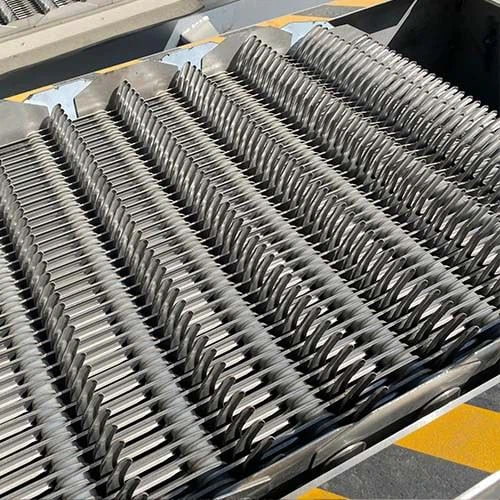
Channel velocity, bar spacing, headloss, and the decisions vendors don’t put in their brochures
Mechanical bar screen sizing looks straightforward on paper — pick a bar spacing, calculate a channel velocity, add a headloss allowance. In practice, however, the decisions compound quickly. A screen sized for average flow performs poorly at peak. One specified with too-fine bar spacing drives up headloss and polymer costs downstream. Mechanical bar screen sizing is, in short, the kind of task where comfortable assumptions cost money at commissioning. This guide works through the real variables: approach velocity, bar clear spacing, screen area, headloss under partial blockage, and the structural details that determine long-term reliability.
The focus here is on municipal wastewater treatment plants — specifically the preliminary treatment headworks where bar screens sit first in line. Industrial applications share the same physics but carry different solids loads and surge factors that deserve their own treatment.
For context on where mechanical bar screens fit within a broader comparison of screen types, the Water Environment Federation maintains updated design guidance through its MOP 8 series — useful if you need a regulatory reference point alongside this operational discussion.
Channel Velocity: The Parameter That Drives Everything Else
Approach velocity — the flow velocity in the channel just upstream of the screen — is the most important sizing parameter. It has two competing constraints. Too low, and grit and heavy organics settle in the channel before reaching the screen. Too high, and fine solids pass straight through the bar openings instead of being captured.
Recommended Approach Velocity Range
The industry-standard range for municipal headworks is 0.6 to 1.2 m/s at average flow. Most designers target 0.9 m/s as a working midpoint. At peak wet-weather flow, the velocity typically climbs to 1.5–1.8 m/s, which is acceptable for short durations.
Below 0.4 m/s, grit deposition becomes a genuine operational problem. Operators will notice a buildup of sandy material in front of the screen during low-flow overnight periods. This creates a blockage pattern that is different from rag accumulation — it’s denser, it doesn’t compress, and it wears rake teeth faster.
Above 1.5 m/s at sustained flow, turbulence in the screen chamber begins to push light plastics and fibrous materials through the gaps rather than holding them against the bars. Additionally, high velocity shortens the effective interception window between bar-cleaning cycles.
Velocity and Channel Geometry
Channel width and water depth determine the cross-sectional area, which controls velocity at any given flow rate. The relationship is simple: Q = V × A. The complication is that wastewater flows vary enormously — from minimum dry-weather flow (sometimes 30–40% of average) to peak wet-weather flow (often 3–4× average at older combined sewer systems).
A single-channel installation sized for average flow will run at dangerously low velocity during dry-weather nights. Consequently, headworks designers frequently specify dual channels with one screen in operation at low flow and both in service during peak events. This is not overbuilding — it’s the only way to maintain a reasonable velocity envelope across the full flow range.
Bar Clear Spacing: Choosing the Right Opening
Bar clear spacing — the gap between adjacent bars — determines what passes through and what gets captured. It also drives headloss, rake cycle frequency, screenings volume, and downstream pump protection. Consequently, this is not a purely hydraulic decision.
Standard Spacing Categories
| Category | Clear Spacing | Typical Application | Screenings Volume |
|---|---|---|---|
| Coarse | 25–50 mm | Primary protection, raw sewage lift stations | Low |
| Medium | 10–25 mm | Municipal WWTP headworks (most common) | Moderate |
| Fine | 3–10 mm | Reuse applications, upstream of membrane systems | High |
For standard municipal headworks, 6 mm is the most common specification today. Ten years ago, 10–15 mm was more typical. The shift toward 6 mm reflects two pressures: increased wipes and non-dispersible content in sewage, and tighter tolerances on solids reaching downstream equipment.
However, 6 mm spacing is not a free upgrade. It increases headloss significantly, raises rake operating frequency by 30–60%, and produces a higher volume of wetter screenings. A screenings compactor becomes essentially mandatory at 6 mm — not optional.
Bar Thickness and Open Area
Bar thickness is typically 8–12 mm for stainless steel flat bar construction. Thinner bars reduce headloss but reduce structural stiffness. Furthermore, the ratio of clear spacing to (clear spacing + bar thickness) determines open area percentage. A 6 mm clear spacing with 10 mm bar gives 37.5% open area. A 10 mm spacing with 10 mm bar gives 50%.
Open area matters because it directly affects the clean-screen headloss and the headloss escalation as blockage develops. Screens with lower open area foul faster and show steeper headloss curves during blockage events.
Screen Area Calculation
The required gross screen area is derived from peak flow and allowable approach velocity. The calculation is straightforward — but several correction factors are routinely missed in preliminary sizing.
Basic Sizing Formula
Required net open area = Q_peak ÷ V_approach. The gross screen area is then: gross area = net open area ÷ (open area fraction × blockage factor).
The blockage factor accounts for the screen operating under partial fouling between cleaning cycles. A blockage factor of 0.6–0.7 is commonly used for preliminary sizing. This means the screen is assumed to be 30–40% blocked by accumulated screenings at the point the rake cycle triggers. If you omit this factor, you undersizes the screen by 30–40%.
Worked Example
Peak flow: 0.85 m³/s. Target approach velocity: 0.9 m/s. Bar spacing: 6 mm, bar width: 10 mm, open area fraction: 0.375. Blockage factor: 0.65.
Net open area required = 0.85 ÷ 0.9 = 0.944 m². Gross screen area = 0.944 ÷ (0.375 × 0.65) = 3.88 m².
A screen 1.2 m wide × 3.3 m tall gives 3.96 m² gross area — slightly above target, which is appropriate. Additionally, channel width must accommodate the screen frame plus 150–200 mm clearance on each side for maintenance access.
45,000 m³/day plant, combined sewer system. Original headworks spec called for 10 mm bar spacing, single channel, no blockage factor applied to screen sizing. The design engineer had used a nearly identical spec at a smaller plant with good results and, honestly, didn’t revisit the assumptions for the larger flow range.
During commissioning, peak wet-weather flow (roughly 2.8× average) produced approach velocities above 1.6 m/s consistently. Rag accumulation between rake cycles caused headloss to spike to 380 mm within 4 minutes of each cleaning cycle. The upstream wet well surged repeatedly. A second channel was added at roughly $95,000 additional construction cost — more than twice the original screen procurement cost. The blockage factor issue was identified only after post-commissioning hydraulic modeling.
Mechanical Bar Screen Sizing: Headloss Analysis
Headloss across a bar screen is not fixed — it varies continuously with blockage state, flow rate, and bar geometry. This is the variable that surprises operators most on their first high-rainfall event.
Clean-Screen Headloss
Clean-screen headloss follows a standard orifice equation. For most municipal screens at average flow, clean headloss is 30–80 mm. This is manageable. The design problem is not clean headloss — it’s the headloss envelope under blockage.
Blocked-Screen Headloss
As screenings accumulate, effective open area decreases and headloss rises steeply. A screen that reads 60 mm headloss when clean may show 250–400 mm at 50% blockage. Moreover, the relationship is nonlinear — headloss escalates more rapidly above 40% blockage than below it.
Most control systems trigger the rake cycle at a differential headloss setpoint — typically 100–150 mm above clean-screen baseline. The cycle frequency adjusts automatically with solids loading. In a well-designed installation, this keeps headloss within a predictable band. In an undersized installation, the rake cannot clear screenings fast enough during peak loading, and headloss climbs continuously.
Headloss Allowance in Civil Design
The civil structure — channel invert levels, upstream wet well, downstream gravity main — must accommodate peak headloss, not average headloss. A common error is designing to clean-screen headloss and providing only 50–80 mm freeboard. Peak headloss under partially blocked conditions can consume that freeboard entirely.
Specifically, design the upstream wet well level for the following scenario: peak flow + 60% blocked screen. The resulting headloss — often 300–450 mm for a 6 mm screen at peak flow — determines the wet well high-high alarm level and overflow trigger.
Screen Inclination and Frame Design
Most mechanical bar screens are installed at 75–85° from horizontal — nearly vertical, but with a slight backward lean. This inclination serves two functions: it allows screenings to drain as the rake lifts them, and it reduces the structural load on the rake mechanism compared to a fully vertical installation.
Inclination Trade-offs
A steeper inclination (closer to vertical) minimizes the screen footprint in the channel. It also reduces the effective screen area exposed at the water surface — relevant for very deep channels where the submerged portion of the screen handles most of the hydraulic load.
A shallower inclination (70–75°) gives the rake mechanism more mechanical advantage when clearing heavy rags. Several manufacturers favor this geometry for coarse screening applications. However, it requires more horizontal channel length to accommodate the screen frame.
Frame Materials and Corrosion
Stainless steel 304 is standard for most municipal applications. Stainless steel 316 is appropriate for high-chloride environments — coastal plants, facilities treating industrial discharge with elevated chloride content. The cost differential between 304 and 316 is modest relative to total screen cost. Specifying 304 to save $2,000 on a $40,000 screen in a coastal environment is a false economy — replacement costs dramatically more.
Carbon steel frames with epoxy coating appear in some budget-constrained specifications. In my experience, this breaks down within 5–7 years in warm, humid climates where condensation is persistent. The coating fails at weld seams first, and localized corrosion proceeds rapidly from there.
There is a persistent tendency in preliminary design to size bar screens for average flow and add a 20% “safety factor” to the result. This does not replace proper peak-flow sizing with a blockage factor. The hydraulic behavior of a screen at 3× average flow is qualitatively different — not just proportionally larger — and the 20% margin disappears quickly when the rake cycle cannot keep pace with rag accumulation. Size for peak. Always.
Rake Mechanism Selection and Cycle Control
The rake mechanism is the mechanical heart of any bar screen installation. It determines cleaning effectiveness, maintenance frequency, and the failure modes you will encounter five years into operation.
Front-Raked vs Back-Raked Mechanisms
Front-raked screens clean from the upstream face — the direction screenings press against the bars. Back-raked screens clean from the downstream face. Each approach has distinct advantages, and the right choice depends on the solids profile of the incoming wastewater.
Front-raked systems handle heavy rag loads better. The rake engages screenings in the direction of flow pressure, giving mechanical advantage against dense accumulations. Back-raked systems produce drier screenings because the rake lifts material away from incoming flow before depositing it. This distinction matters for screenings handling and disposal costs.
Cycle Control Logic
Modern screens offer three control modes: time-based cycling, differential headloss triggering, and flow-proportional cycling. Headloss triggering is generally the most efficient. It runs the rake only when needed, extends mechanical wear intervals, and responds to actual solids loading rather than a fixed schedule.
Time-based cycling — still common in older installations — runs the rake at fixed intervals regardless of need. During low-flow periods, this results in unnecessary mechanical cycles and premature wear. Furthermore, during sudden high-load events, the fixed interval may be too long to prevent headloss surges.
Food processing plant, 8,000 m³/day. Screen originally installed with fixed 10-minute rake interval — a default the vendor left unchanged from their standard commissioning template. During production peak shifts, screenings load tripled. The 10-minute interval was inadequate, headloss climbed above 300 mm, and the upstream equalization tank nearly overflowed twice within the first month of operation.
Switching to differential headloss control at a 120 mm trigger setpoint resolved the headloss problem entirely. Rake cycle frequency during peaks dropped from every 10 minutes to every 4–6 minutes, and during overnight periods extended to 35–40 minutes. Mechanical component wear reportedly decreased measurably over the following year — fewer cycles at lower frequency during the long overnight lulls.
Screenings Volume and Handling
Screenings volume is a function of bar spacing, incoming solids concentration, and flow volume. Municipal sewage typically generates 5–20 litres of screenings per 1,000 m³ of flow at 6 mm spacing. At 10 mm spacing, that drops to 3–10 litres per 1,000 m³.
Screenings Moisture Content
Raw screenings from a mechanical bar screen contain 70–85% moisture. Consequently, 1 m³ of raw screenings weighs roughly 500–700 kg and is difficult to handle, transport, or landfill efficiently. A screenings compactor reduces moisture to 50–65% and volume by 40–60%.
At 6 mm bar spacing, a screenings compactor transitions from a cost option to a practical necessity. Without compaction, screenings volume and disposal frequency create operational problems within the first wet season.
Annual Screenings Tonnage Estimate
| Plant Size (m³/day) | 6 mm Spacing (t/year) | 10 mm Spacing (t/year) | Compactor Required? |
|---|---|---|---|
| 5,000 | 18–30 | 8–15 | Borderline |
| 20,000 | 70–120 | 30–55 | Yes, at 6 mm |
| 50,000 | 175–300 | 75–130 | Yes, both spacings |
| 100,000 | 350–600 | 150–260 | Yes, multiple units |
These figures are rough benchmarks. Industrial discharge contributions, seasonal tourism loads, and infiltration/inflow from aging sewers all shift the actual numbers. Notably, plants with high I/I ratios during wet weather may see screenings volumes spike to 3× the dry-weather rate during sustained rainfall events.
Bypass Provisions and Redundancy
A bar screen that goes offline for maintenance removes a critical protection point from the treatment process. Consequently, headworks design must include bypass or redundancy provisions. The specific approach depends on plant size and regulatory requirements.
Dual-Channel Configurations
Dual channels with independently operable screens are the standard approach at plants above 10,000 m³/day. Each channel is sized for the full peak flow so that either screen can handle the plant alone. Both screens operate in parallel at high flow. One screen handles normal flow. This configuration eliminates the need for bypass — maintenance occurs on the offline unit while the other remains in service.
Single-Channel Bypass
Smaller plants sometimes use a single channel with a manually operated bypass gate. This allows coarse solids to pass the screen during cleaning or maintenance. It is not a good solution for extended maintenance — bypass periods longer than a few hours risk accumulation of rags and debris in downstream pumps and pipework.
Additionally, some regulatory regimes require that bypass events be logged and reported. Vendors will tell you a single screen is adequate for a small plant. The operational reality is that you will bypass that screen more often than you expect — scheduled maintenance, rake malfunctions, and unexpected jams all add up.
Common Sizing Errors and How to Avoid Them
After reviewing bar screen specifications on projects ranging from small package plants to large municipal headworks, the same errors appear repeatedly.
Error 1: Ignoring Minimum Flow Velocity
Sizing for average or peak flow without checking minimum flow velocity is the most common error. A screen channel sized for 0.9 m/s at average flow may run at 0.25–0.3 m/s during minimum dry-weather hours. Grit accumulates. Grease layers form. Operators face a cleaning problem at the start of every morning shift.
Error 2: No Blockage Factor in Area Calculation
As discussed above — omitting the blockage factor undersizes the screen by 30–40%. Vendors’ published sizing tables may not include this correction. Check the methodology, not just the output number.
Error 3: Specifying 304 Stainless in Corrosive Environments
This is a cost-driven error that compounds over time. The false economy of saving on material grade typically manifests as early corrosion failure at welded joints within 5–8 years, requiring early replacement or expensive repair.
Error 4: Fixed-Interval Rake Control
Setting time-based rake cycles at commissioning and never revisiting the setpoint is extremely common. Solids loads change seasonally, and the optimal cycle interval at commissioning may be significantly wrong by year two. Install headloss-triggered control and commission it correctly.
Error 5: Underestimating Screenings Volume at Fine Spacing
Selecting 6 mm bar spacing without planning for screenings handling and disposal is a planning gap that becomes visible within the first wet season. Furthermore, screenings that cannot be processed on-site create secondary handling costs that were not in the project budget.
Upgrade of a 25,000 m³/day WWTP that had operated with a manual bar screen for 15 years. The upgrade spec was written by a consultant with solid process knowledge but limited mechanical experience on bar screen sizing. Bar spacing was selected at 6 mm (appropriate), but the channel was sized for average flow only, with no blockage factor and no check of minimum flow velocity.
At average flow, the installation performed acceptably. During dry season, with flows dropping to roughly 35% of average, velocity in the single channel fell to 0.31 m/s. Within three weeks, the channel required manual de-gritting every Monday morning — a task that had not existed under the old manual screen arrangement. The specification also omitted a compactor; screenings were being manually shoveled into skip bins at nearly double the projected volume. A compactor was procured 8 months after commissioning at additional unbudgeted cost.
Specifying Mechanical Bar Screens: What to Include
A specification that leaves out critical parameters invites substitutions that reduce performance. The following parameters should be explicitly stated, not left to vendor discretion.
Required Specification Parameters
Clear bar spacing in millimeters — not center-to-center. Bar dimensions (width and depth). Screen inclination angle from horizontal. Frame material grade (304 or 316L stainless). Minimum approach velocity at average flow. Maximum approach velocity at peak flow. Headloss at peak flow and 60% blockage. Rake mechanism type (front or back-raked). Rake drive type (electromechanical or hydraulic). Control mode (headloss-triggered preferred). Drive motor power and IP rating. Discharge height from channel invert to screenings discharge chute. Screenings compactor integration point.
Moreover, specify that the manufacturer must provide hydraulic performance curves — headloss vs. flow rate at multiple blockage levels. This documentation is rarely included without being explicitly requested, but it is essential for verifying the installation at commissioning and troubleshooting performance issues later.
FAQ
Bar Screen FAQ: Equipment Selection and Operation
Sizing a Bar Screen for Your Headworks?
Morvolous Engineering Team works through the full hydraulic analysis — channel velocity, headloss curves, bypass provisions, and screenings handling — before equipment selection. Reach out for a technical review of your preliminary specification.
Contact Morvolous →