
Inclined Screen
Solid-Liquid
Separator
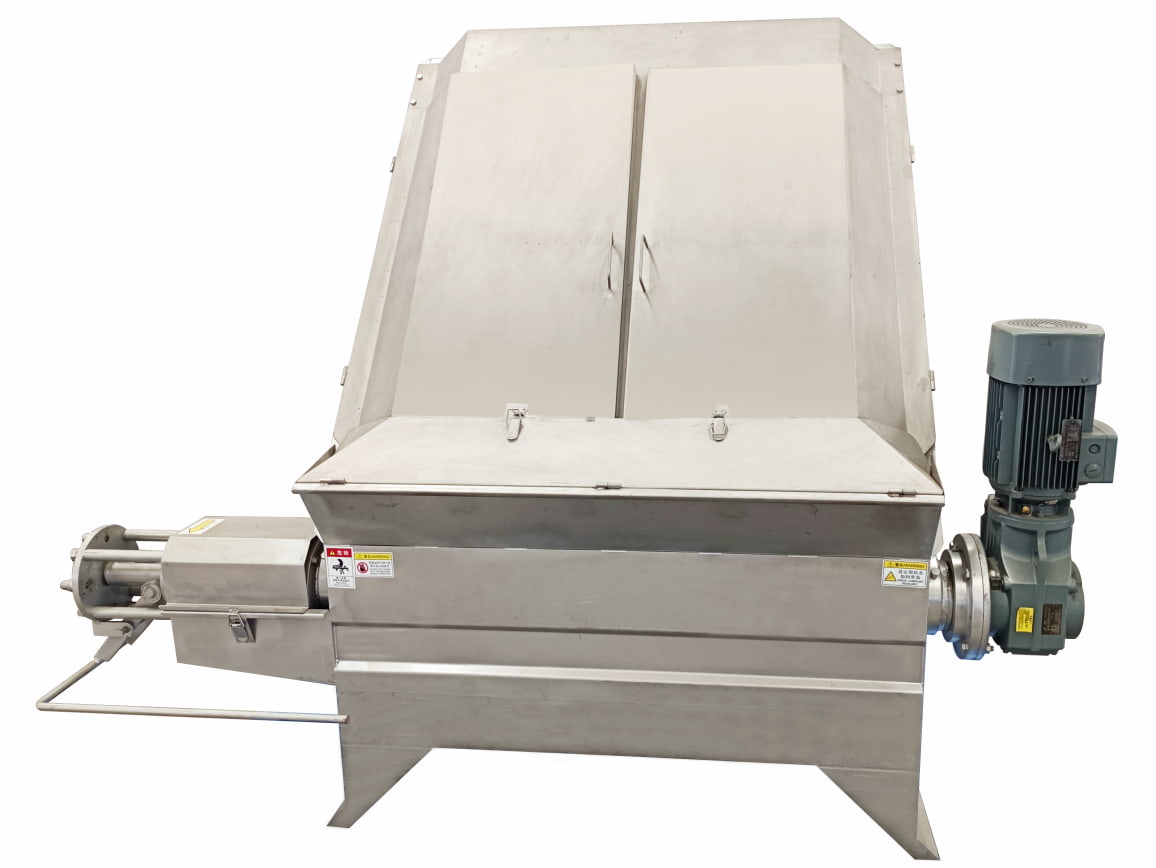
A gravity-driven wedge-wire screen separator for high-throughput removal of coarse solids from diluted livestock manure, agricultural wastewater, and organic industrial effluents — no energy consumption, no moving parts, minimal maintenance.
Gravity-Driven
High-Rate Separation
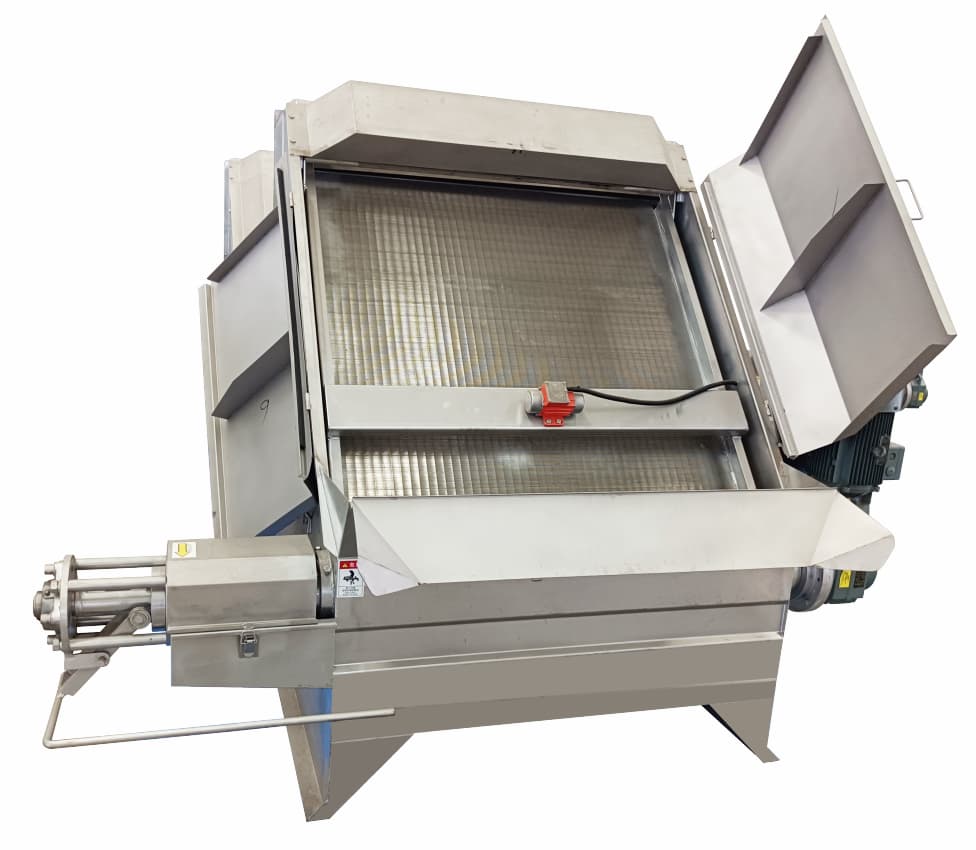
The Inclined Screen Solid-Liquid Separator is a passive, gravity-operated screening system for the pre-treatment of dilute slurries with a dry matter content of 2–10%. Raw slurry is pumped to the feed box at the top of a precision-angled wedge-wire screen panel. As the material spreads uniformly across the screen surface, the liquid fraction flows through the screen gaps under gravity while coarse solids are retained and conveyed downward by a vibration mechanism to the discharge point, where they are further compacted and extruded by a screw auger before discharge.
Because the primary separation stage is driven entirely by gravity, the inclined screen separator requires no energy for filtration — power consumption is limited to the vibration motor and screw conveyor. The wedge-wire screen panel is fabricated from SS304 stainless steel with triangular-profile wires that maximise open area, resist blinding, and maintain a stable slot width for consistent particle retention. The screen angle and slot width are configurable to suit different slurry characteristics and separation targets.
The separated solid fraction typically achieves 60–70% moisture content — suitable for direct use as organic fertiliser base material, compost feedstock, stall bedding, or biogas digester input. The liquid fraction is discharged to a collection tank for further treatment, lagoon storage, or irrigation.
- Pig farm manure and flushed swine wastewater
- Dairy and cattle farm effluent (water-flushed systems)
- Poultry (chicken, duck, goose) manure slurry
- Slaughterhouse and meat processing wastewater
- Biogas digester effluent (digestate) dewatering
- Vinasse and distillery wastewater
- Food processing and vegetable washing wastewater
- Pulp and paper mill wastewater pre-treatment
Why Solid-Liquid
Separation Matters
Pre-treatment of high-moisture slurry with an inclined screen separator delivers measurable improvements across the entire downstream management chain — reducing storage costs, lowering environmental risk, and creating usable by-products from waste streams.
- Significant reduction of organic matter loading to lagoons and storage tanks
- Lower greenhouse gas (GHG) and odour emissions from long-term liquid storage
- Reduced lagoon sludge accumulation and extended lagoon service life
- Separated solids suitable for stall bedding, compost, or organic fertiliser
- Effective pre-treatment before anaerobic digestion or biogas systems
- Nutrient separation — approximately 20% of original nutrient mass captured in solids fraction
- Reduced slurry viscosity enables long-distance pumping to distant fields, eliminating tanker truck haulage
- Simplifies and reduces cost of downstream wastewater treatment processes
Why Choose This Separator
Zero Filtration Energy
The primary screening stage is driven entirely by gravity — no pumps, blowers, or mechanical drive are needed to force liquid through the screen. Power consumption is limited to the vibration motor and discharge screw, keeping total unit power at 1.5–4.0 kW regardless of throughput.
Precision Wedge-Wire Panel
The triangular-profile wedge-wire screen is constructed from SS304 stainless steel with precisely controlled slot widths. The V-shaped wire profile maximises open area, provides a self-cleaning effect under slurry flow, and prevents solids from blinding (blocking) the screen surface — a major advantage over perforated plate screens.
High Processing Capacity
The large inclined screen surface area allows high volumetric throughput per unit footprint — up to 40 m³/h for the largest model. The combined vibration feed and screw extrusion system prevents solids accumulation and maintains consistent flow across the full screen width without operator intervention.
All-Stainless Construction
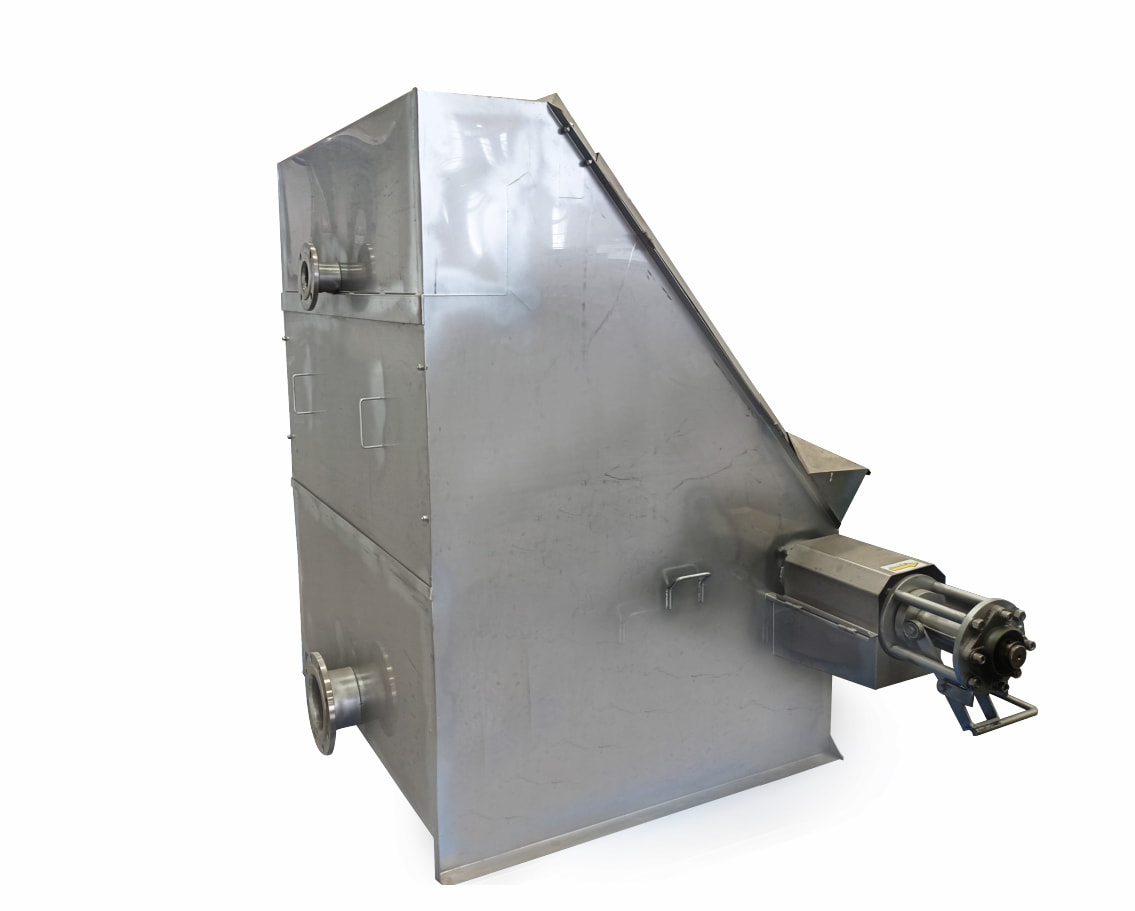
The entire machine — frame, feed box, screen housing, screw conveyor, and discharge chute — is fabricated from SS304 stainless steel. This provides complete resistance to the corrosive acids and hydrogen sulphide present in animal manure, ensuring long service life and straightforward cleaning.
Low Maintenance Cost
With no complex moving parts in the filtration zone, maintenance requirements are minimal. Routine upkeep consists of periodic screen rinsing with a pressure hose to clear surface deposits. The wedge-wire screen is inherently durable, providing many years of service without replacement under normal operating conditions.
Adjustable Screen & Angle
Screen slot width and inclination angle are configurable to match the specific dry matter content and particle size of the incoming slurry. Replacement screen panels with different slot widths can be fitted to optimise separation efficiency as feed characteristics change, without requiring a new machine.
How It Works
Slurry Feed
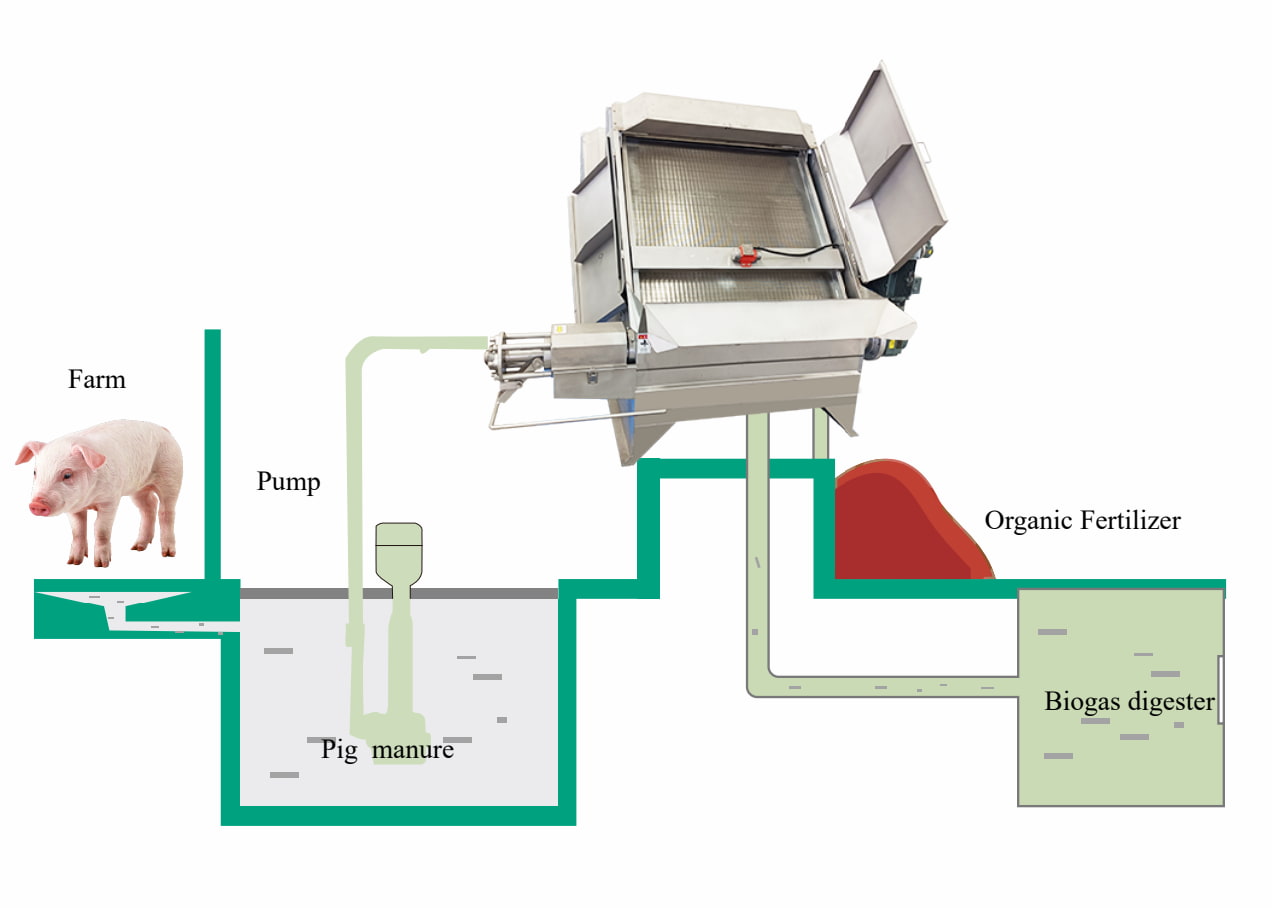
Raw slurry is pumped from the collection pit to the feed box at the top of the inclined screen. A non-clogging centrifugal pump handles high-solids slurry without blockage.
Gravity Screening
Slurry spreads uniformly across the angled wedge-wire screen surface. Liquid flows through the screen gaps under gravity, while solids are retained on the screen face and conveyed downward by vibration and hydraulic action.
Screw Extrusion
Retained solids accumulate at the lower end of the screen and enter the horizontal screw conveyor. The screw transports and compresses the solid cake, squeezing out additional liquid through a secondary drainage port before final discharge.
Separated Outputs
The dewatered solid cake (60–70% moisture) discharges from the outlet chute for direct use or further processing. The separated liquid collects in the under-trough and drains to a storage tank, lagoon, or secondary treatment unit.
Model Selection Table
| Model | Motor Power (kW) | Screen Width (m) | Machine Length (m) | Material | Flow Capacity (m³/h) |
|---|---|---|---|---|---|
| MS-GY700 | 1.50 | 0.80 | 1.70 | SS304 | 7–15 |
| MS-GY900 | 2.20 | 1.00 | 1.90 | SS304 | 10–20 |
| MS-GY1200 | 2.20 | 1.50 | 2.20 | SS304 | 18–30 |
| MS-GY1500 | 4.00 | 1.60 | 2.30 | SS304 | 25–40 |
| Note: Flow capacity ranges depend on incoming slurry dry matter content and screen slot width selection. Optimal performance achieved with DM content 2–10%. Custom slot widths and SS316 construction available on request. | |||||
General Technical Parameters
| Parameter | Value / Range |
|---|---|
| Applicable Slurry DM Content | 2%–10% (water content > 90%) |
| Minimum Particle Size for Retention | ≥ 0.3 mm |
| Solid Cake Moisture After Separation | 60%–70% |
| Screen Material | SS304 wedge-wire (triangular profile) |
| Screen Slot Width (adjustable) | 0.25 mm – 1.0 mm (per application) |
| Screen Inclination Angle | 45° (standard; adjustable) |
| Frame & Housing Material | SS304 stainless steel throughout |
| Drive System | Vibration motor (screen zone) + screw gearmotor (discharge) |
| Power Supply | 380V / 3-phase / 50Hz (standard) |
| Inlet Connection | Flanged or hose coupling (per model) |
| Note: Separation efficiency depends on feed slurry consistency and particle size distribution. Custom screen configurations and detailed process design available on request. | |
Machine Structure
& Key Components
Installation & Commissioning Notes
- Install on a level concrete pad; ensure adequate structural support for machine weight plus slurry load
- Position discharge outlet directly over a collection pad, conveyor, or storage container
- Liquid under-trough drain to connect to collection tank or lagoon inlet pipe
- Feed pump to be sized for total head plus slurry viscosity — consult pump supplier for high-solids slurry
- Allow 600 mm minimum clearance on both sides for screen inspection and cleaning access
- Rinse machine with clean water for 5 minutes after each operating shift to prevent solids drying on screen surface
- Check screen slot integrity monthly and replace screen panel if slot widening is detected
Request A Quote
Or Technical Consultation
Tell us your daily slurry volume, manure type, and dry matter content — we will recommend the right model and screen configuration for your farm or facility.