Learn how screw press sludge dewatering systems work, their advantages over conventional dewatering equipment, common applications, and how to choose the right solution for municipal and industrial wastewater treatment.
Screw press sludge dewatering has become one of the fastest-growing technologies in modern wastewater treatment. Compared with traditional belt filter presses and centrifuges, screw presses offer lower energy consumption, minimal wash water usage, quieter operation, and simplified maintenance.
As wastewater treatment plants seek to reduce operating costs while improving automation, screw press technology has become a preferred choice for municipal wastewater facilities, food processing plants, livestock farms, and many industrial applications.
This guide explains the working principle of screw press dewatering, compares it with alternative technologies, and provides practical engineering guidance for equipment selection.
For additional wastewater engineering resources, professionals can refer to the Water Environment Federation at https://www.wef.org.
Quick Reference — Screw Press Sludge Dewatering
| Parameter | Typical Value |
|---|---|
| Feed Solids | 0.2–5% DS |
| Cake Solids | 18–25% DS |
| Capacity | 0.5–100 m³/h |
| Polymer Consumption | Low |
| Wash Water Consumption | Very Low |
| Energy Consumption | Very Low |
| Operation | Continuous |
| Automation | Fully Automatic |
| Construction Material | SS304 / SS316L |
| Typical Service Life | 10–20 Years |
What Is a Screw Press?
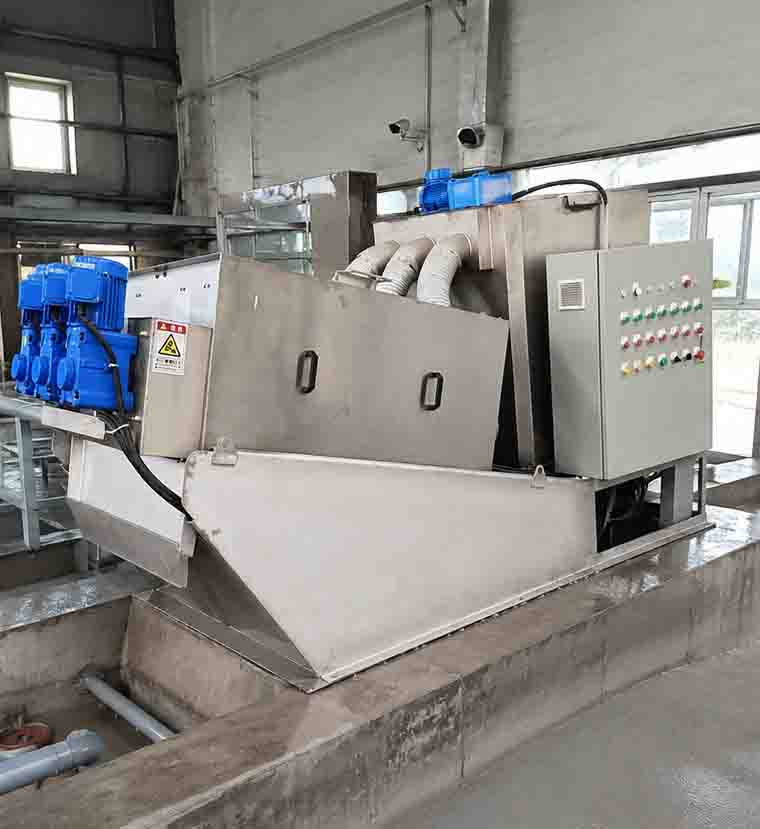
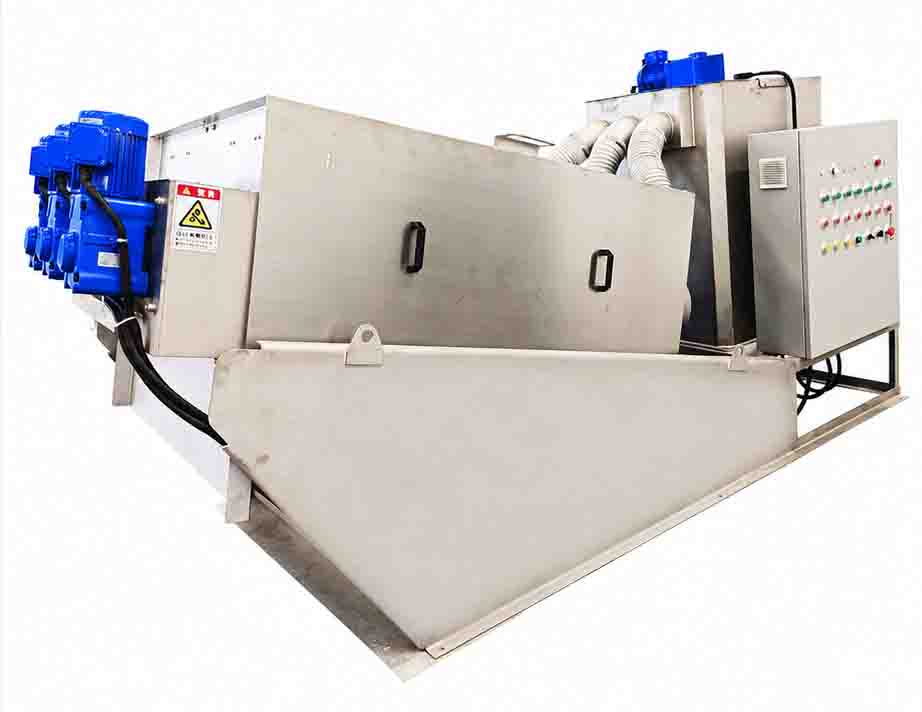
A screw press is a continuous mechanical sludge dewatering machine that separates water from sludge using a slowly rotating screw shaft enclosed within a cylindrical screen composed of fixed and moving rings.
Unlike high-speed centrifuges or belt filter presses, screw presses rely on gradual mechanical compression rather than centrifugal force or belt pressure.
Their low-speed operation minimizes wear, noise, and power consumption.
How Does a Screw Press Work?
The dewatering process consists of several stages.
Step 1 – Polymer Conditioning
Sludge enters a flocculation tank where polymer is mixed with the sludge.
Large, stable flocs are formed to improve water release.
Step 2 – Gravity Thickening
Conditioned sludge enters the screw press.
Free water drains through the spaces between the fixed and moving rings.
This stage removes a significant amount of water before compression.
Step 3 – Progressive Compression
As the screw rotates slowly toward the discharge end, the pitch between screw flights gradually decreases.
The decreasing volume compresses the sludge, forcing additional water through the filter rings.
Step 4 – Sludge Cake Discharge
The compressed sludge exits the machine as a dewatered cake, while filtrate is collected separately for return to the treatment process.
Continuous operation allows stable sludge handling with minimal operator intervention.
Main Components
A typical screw press system includes:
- Polymer preparation unit
- Flocculation tank
- Screw press body
- Fixed and moving ring assembly
- Screw shaft
- Back pressure plate
- Drive motor
- Electrical control cabinet
The anti-clogging ring design allows long operating periods without frequent manual cleaning.
Typical Applications
Municipal Wastewater Treatment
Screw presses are widely used to dewater:
- Waste activated sludge
- Primary sludge
- Mixed sludge
- Digested sludge
Their compact footprint and low maintenance requirements make them ideal for municipal treatment plants.
Industrial Wastewater Treatment
Industries using screw presses include:
- Food processing
- Beverage production
- Dairy plants
- Slaughterhouses
- Textile factories
- Paper mills
- Chemical plants
- Livestock farms
The equipment performs particularly well on sludge containing organic matter and biological solids.
Project Example – Municipal WWTP
A municipal wastewater treatment plant upgraded from an aging belt filter press to a multi-disc screw press.
Wash water consumption decreased significantly, and routine maintenance time was reduced because of the self-cleaning ring structure.
Project Example – Pig Farm Wastewater
A large pig farm installed a screw press after biological treatment to dewater excess sludge.
The dewatered sludge cake was transported for composting, reducing transportation frequency and lowering disposal costs.
Screw Press vs Other Dewatering Equipment
| Technology | Cake Solids | Energy Use | Wash Water | Maintenance | Best Application |
|---|---|---|---|---|---|
| Screw Press | 18–25% | Very Low | Very Low | Very Low | Municipal & Livestock |
| Belt Filter Press | 18–30% | Moderate | High | Moderate | Large Municipal Plants |
| Decanter Centrifuge | 20–30% | High | Low | Moderate | Industrial Wastewater |
| Plate Filter Press | 25–40% | Moderate | Low | Moderate | High-Dryness Sludge |
| Volute Screw Press | 18–25% | Very Low | Very Low | Very Low | Municipal & Industrial |
Although filter presses achieve higher cake solids, screw presses often provide lower lifecycle operating costs.
Advantages of Screw Press Sludge Dewatering
Low Energy Consumption
The screw rotates at a very low speed, typically only a few revolutions per minute.
This greatly reduces electricity consumption compared with centrifuges.
Minimal Wash Water
Unlike belt filter presses, screw presses require only a small amount of wash water because the moving-ring mechanism continuously cleans the filter surface.
Self-Cleaning Design
Alternating fixed and moving rings prevent clogging.
The equipment operates continuously with minimal manual cleaning.
Compact Installation
Screw presses occupy relatively little floor space and can often replace larger dewatering systems during plant upgrades.
Low Noise
Low rotational speed produces much quieter operation than high-speed centrifuges.
Design Considerations
Sludge Characteristics
Performance depends on:
- Organic content
- Fiber concentration
- Oil and grease
- Particle size
- Biological activity
Pilot testing is recommended when sludge properties vary significantly.
Polymer Selection
Correct polymer selection improves:
- Floc formation
- Water release
- Cake solids
- Filtrate clarity
Laboratory testing helps minimize long-term chemical costs.
Hydraulic Capacity
Equipment should be sized based on:
- Average sludge production
- Peak sludge generation
- Future plant expansion
Oversized equipment may operate inefficiently at low loading rates.
Common Design Mistakes
Focusing Only on Cake Solids
Although higher cake dryness is desirable, energy consumption, maintenance, polymer demand, and wash water requirements often have a greater impact on lifecycle cost.
Ignoring Sludge Variability
Industrial sludge characteristics may change with production schedules.
Equipment selection should consider these fluctuations.
Underestimating Polymer Optimization
Even the best screw press cannot perform efficiently without proper sludge conditioning.
Regular polymer optimization improves long-term operating performance.
Project Example – Food Processing Plant
A dairy processing facility initially experienced unstable sludge cake quality due to incorrect polymer dosing.
After optimizing polymer type and dosage through pilot testing, cake solids increased while chemical consumption decreased.
Engineering Perspective
Screw press technology has become increasingly popular because it balances operating cost, automation, and reliability.
Although centrifuges may achieve slightly higher throughput and filter presses may produce drier sludge cakes, screw presses often deliver the lowest total operating cost through reduced electricity use, minimal wash water consumption, and simplified maintenance.
For many municipal and medium-sized industrial wastewater treatment plants, screw presses provide an excellent combination of efficiency and long-term economy.
Screw Press Selection Checklist
Process Evaluation
- Identify sludge type
- Measure solids concentration
- Evaluate sludge production volume
- Determine disposal method
- Review future expansion plans
Equipment Selection
- Select screw diameter
- Verify processing capacity
- Review polymer preparation system
- Confirm automation functions
- Evaluate material construction
Procurement Review
- Compare lifecycle costs
- Confirm spare parts availability
- Review local service support
- Verify warranty conditions
- Evaluate operating references
Frequently Asked Questions
What is a screw press used for?
A screw press removes water from sludge through slow mechanical compression, reducing sludge volume before disposal or further treatment.
How dry is sludge after a screw press?
Most municipal wastewater sludge reaches 18–25% dry solids, depending on sludge characteristics and polymer conditioning.
Does a screw press require wash water?
Yes, but consumption is very low compared with belt filter presses because of the self-cleaning ring mechanism.
Is a screw press better than a centrifuge?
Neither technology is universally superior.
Screw presses typically consume less energy and require less maintenance, while centrifuges may offer higher throughput for certain industrial applications.
Conclusion
Screw press sludge dewatering systems have become one of the most efficient and economical solutions for municipal and industrial wastewater treatment.
Their low energy consumption, minimal wash water requirements, compact footprint, and automatic operation make them an excellent choice for facilities seeking to reduce operating costs while maintaining reliable sludge handling.
Proper sludge characterization, polymer optimization, and equipment sizing are essential for achieving the best long-term performance.
Need Help Selecting a Screw Press?
Morvolous supplies screw presses, polymer dosing systems, sludge conveyors, and complete sludge treatment solutions for municipal and industrial wastewater treatment plants.
Our engineering team can recommend the most suitable dewatering equipment based on your sludge characteristics, treatment capacity, and operational requirements.
About the Author
Morvolous Engineering Team
Morvolous specializes in sludge dewatering, wastewater filtration, chemical dosing systems, and turnkey wastewater treatment solutions. We provide engineering consultation and customized equipment for municipal and industrial wastewater treatment projects worldwide.