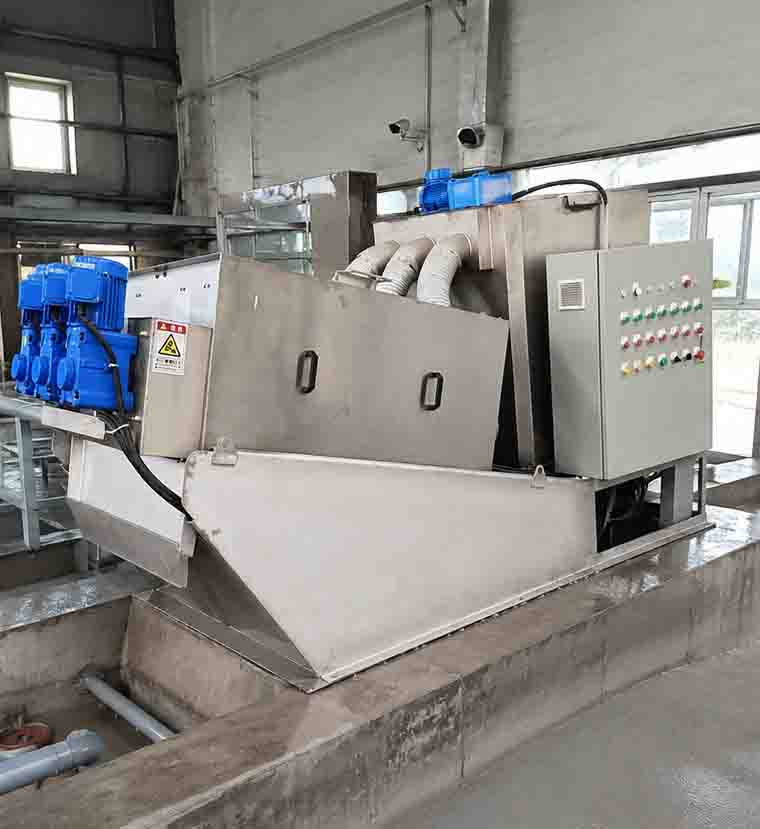
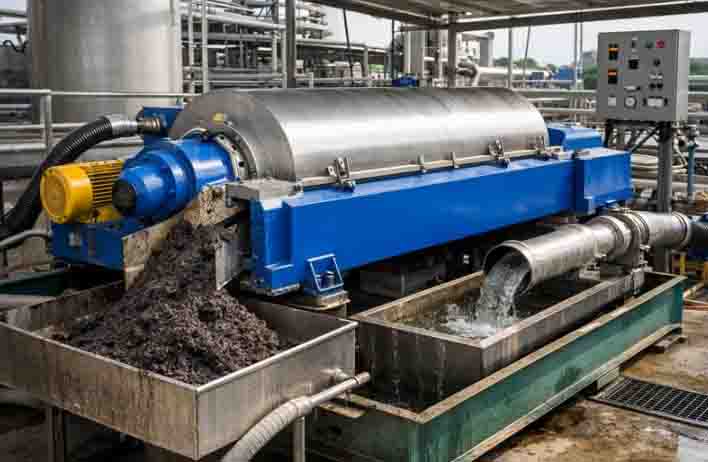
Learn how decanter centrifuges work, their advantages and limitations, typical applications, and how to select the right centrifugal sludge dewatering system for municipal and industrial wastewater treatment.
Decanter centrifuges are among the most efficient sludge dewatering technologies available for wastewater treatment. By using high-speed centrifugal force instead of mechanical pressure, these machines achieve continuous solid-liquid separation with high processing capacity and a compact footprint.
Because of their ability to handle varying sludge characteristics, decanter centrifuges are widely used in municipal wastewater treatment plants, food processing facilities, chemical industries, paper mills, and mining operations.
Although centrifuges generally require higher energy consumption than screw presses, they offer excellent flexibility, high automation, and reliable performance for demanding sludge dewatering applications.
This guide explains how decanter centrifuges work, compares them with other sludge dewatering technologies, and provides practical guidance for equipment selection.
For additional wastewater engineering resources, professionals can refer to the Water Environment Federation at https://www.wef.org.
Quick Reference — Decanter Centrifuge
| Parameter | Typical Value |
|---|---|
| Feed Solids | 0.5–8% DS |
| Cake Solids | 20–30% DS |
| Capacity | 2–200 m³/h |
| Bowl Speed | 2,000–4,500 rpm |
| Differential Speed | Adjustable |
| Polymer Consumption | Moderate |
| Energy Consumption | Moderate to High |
| Automation | Fully Automatic |
| Construction Material | SS304 / Duplex Stainless Steel |
| Typical Service Life | 15–20 Years |
What Is a Decanter Centrifuge?
A decanter centrifuge is a continuous mechanical separation machine that removes solids from sludge using centrifugal force generated by a rapidly rotating bowl.
Unlike belt filter presses or screw presses that rely on physical compression, centrifuges accelerate gravitational force thousands of times, allowing fine particles to settle rapidly against the bowl wall.
The machine continuously separates:
- Dewatered sludge cake
- Centrate (liquid phase)
Both streams leave the machine simultaneously without interrupting operation.
How Does a Decanter Centrifuge Work?
The dewatering process includes several continuous stages.
Step 1 – Sludge Conditioning
Sludge is typically mixed with polymer before entering the centrifuge.
Polymer improves particle aggregation and separation efficiency.
Step 2 – High-Speed Separation
The conditioned sludge enters the rotating bowl.
Centrifugal force drives heavier solids toward the outer wall while clarified liquid remains closer to the center.
Step 3 – Solids Conveying
An internal screw conveyor rotates at a slightly different speed than the bowl.
The conveyor transports accumulated solids toward the discharge end.
Step 4 – Cake Discharge
The dewatered sludge exits continuously through discharge ports.
Clarified liquid flows out separately through adjustable weirs.
Main Components
A typical decanter centrifuge consists of:
- Rotating bowl
- Screw conveyor
- Differential gearbox
- Feed pipe
- Drive motor
- Variable frequency drive (VFD)
- Lubrication system
- Control cabinet
Modern systems include automatic monitoring for vibration, temperature, and torque.
Typical Applications
Municipal Wastewater Treatment
Municipal treatment plants commonly use centrifuges for:
- Waste activated sludge
- Digested sludge
- Mixed sludge
- Biosolids processing
The compact footprint makes centrifuges especially attractive for plant upgrades.
Industrial Wastewater Treatment
Common industrial applications include:
- Food processing
- Beverage production
- Chemical manufacturing
- Pharmaceutical production
- Paper mills
- Mining
- Oil and gas
- Metal finishing
Centrifuges can handle significant variations in sludge composition.
Project Example – Municipal WWTP
A wastewater treatment plant upgraded its sludge dewatering system from aging belt presses to two decanter centrifuges.
The project reduced floor space requirements while increasing daily sludge processing capacity.
Automatic operation also reduced labor requirements.
Project Example – Paper Mill
A paper manufacturing facility installed a decanter centrifuge to dewater fiber-rich sludge.
The centrifuge consistently achieved stable cake solids despite fluctuations in production schedules.
Recovered water was returned to the manufacturing process.
Decanter Centrifuge vs Other Technologies
| Technology | Cake Solids | Energy Use | Wash Water | Footprint | Best Application |
|---|---|---|---|---|---|
| Decanter Centrifuge | 20–30% | High | Low | Small | Industrial & Municipal |
| Screw Press | 18–25% | Very Low | Very Low | Small | Municipal |
| Belt Filter Press | 18–30% | Moderate | High | Large | High Throughput |
| Plate Filter Press | 25–40% | Moderate | Low | Medium | High Dryness |
| Volute Screw Press | 18–25% | Very Low | Very Low | Small | Municipal & Industrial |
Centrifuges are particularly advantageous where installation space is limited and sludge production varies significantly.
Advantages
Compact Footprint
Centrifuges require much less installation space than belt filter presses.
This makes them suitable for upgrading existing wastewater treatment plants.
Continuous Operation
The equipment provides uninterrupted sludge dewatering with minimal operator involvement.
High Automation
Modern centrifuges automatically adjust operating parameters according to sludge characteristics.
Remote monitoring is commonly available.
Flexible Operation
Centrifuges can process a wide variety of sludge types with relatively simple operational adjustments.
Limitations
Higher Energy Consumption
The high rotational speed requires more electricity than screw presses.
Energy cost should be included in lifecycle evaluations.
Greater Mechanical Complexity
Rotating components operate at high speed and require regular inspection.
Preventive maintenance is essential for reliable operation.
Higher Initial Investment
Capital cost is generally higher than conventional screw presses.
However, compact installation and automation may offset this investment.
Design Considerations
Sludge Characteristics
Successful centrifuge performance depends on:
- Organic content
- Particle size
- Fiber concentration
- Oil and grease
- Sludge age
Pilot testing helps determine expected cake solids and polymer demand.
Differential Speed
The speed difference between the bowl and conveyor affects:
- Cake dryness
- Solids recovery
- Throughput
Automatic adjustment improves overall performance.
Polymer Optimization
Proper polymer selection improves:
- Floc strength
- Water release
- Cake solids
- Centrate quality
Routine optimization minimizes operating costs.
Common Design Mistakes
Selecting Equipment by Capacity Alone
Processing capacity should be balanced with cake solids, energy consumption, and sludge characteristics.
Ignoring Maintenance Access
Although centrifuges are compact, sufficient clearance is required for servicing the rotating assembly.
Maintenance planning should be included during plant design.
Underestimating Energy Costs
Electricity consumption can become a significant operating expense over the equipment lifecycle.
Lifecycle cost analysis provides a better comparison than purchase price alone.
Project Example – Chemical Plant
A chemical wastewater treatment facility initially selected a belt filter press because of its lower purchase price.
After evaluating installation constraints and labor requirements, engineers selected a decanter centrifuge instead.
The compact installation reduced building modifications and improved long-term operational efficiency.
Engineering Perspective
Decanter centrifuges remain one of the most versatile sludge dewatering technologies available today.
Although they generally consume more energy than screw presses, they provide superior flexibility, compact installation, and excellent automation.
For facilities with limited space, fluctuating sludge production, or demanding industrial applications, centrifuges often provide the most practical long-term solution.
Equipment selection should always consider sludge characteristics, maintenance capabilities, and total lifecycle cost rather than focusing solely on capital investment.
Decanter Centrifuge Selection Checklist
Process Evaluation
- Identify sludge type
- Measure feed solids concentration
- Evaluate daily sludge production
- Review sludge variability
- Define disposal requirements
Equipment Selection
- Select bowl diameter
- Verify processing capacity
- Determine differential speed control
- Review automation features
- Confirm material selection
Procurement Review
- Compare lifecycle costs
- Evaluate energy consumption
- Confirm spare parts availability
- Review service support
- Verify warranty conditions
Frequently Asked Questions
What is a decanter centrifuge used for?
A decanter centrifuge continuously separates solids from sludge using centrifugal force, reducing sludge volume before disposal or further treatment.
How dry is sludge after centrifuge dewatering?
Typical municipal sludge reaches 20–30% dry solids, depending on sludge characteristics and polymer conditioning.
Does a centrifuge require polymer?
Most sludge dewatering applications use polymer to improve solids separation and increase cake dryness.
Is a centrifuge better than a screw press?
Each technology has advantages.
Centrifuges generally provide higher throughput and greater flexibility, while screw presses offer lower energy consumption and reduced maintenance.
Conclusion
Decanter centrifuges provide efficient, continuous sludge dewatering for municipal and industrial wastewater treatment plants.
Their compact footprint, automatic operation, and ability to process varying sludge characteristics make them an excellent choice for many modern treatment facilities.
Selecting the correct centrifuge requires careful evaluation of sludge properties, processing capacity, operating costs, and long-term maintenance requirements.
When properly designed and operated, decanter centrifuges deliver reliable performance and significant operational benefits.
Need Help Selecting a Decanter Centrifuge?
Morvolous supplies decanter centrifuges, screw presses, polymer dosing systems, sludge conveyors, and complete sludge treatment solutions for municipal and industrial wastewater treatment plants.
Our engineering team can help evaluate your sludge characteristics and recommend the most suitable dewatering equipment for your application.
About the Author
Morvolous Engineering Team
Morvolous specializes in sludge treatment, wastewater filtration, chemical dosing systems, and turnkey wastewater treatment solutions. Our engineers provide customized equipment selection, process optimization, and technical support for municipal and industrial wastewater projects worldwide.