MABR, MBBR, and MBR are widely used terms in modern wastewater treatment. Their names look very similar, but the three technologies are based on different treatment principles. Understanding these differences is important when selecting a biological treatment process for municipal wastewater, industrial wastewater, or water reuse applications.
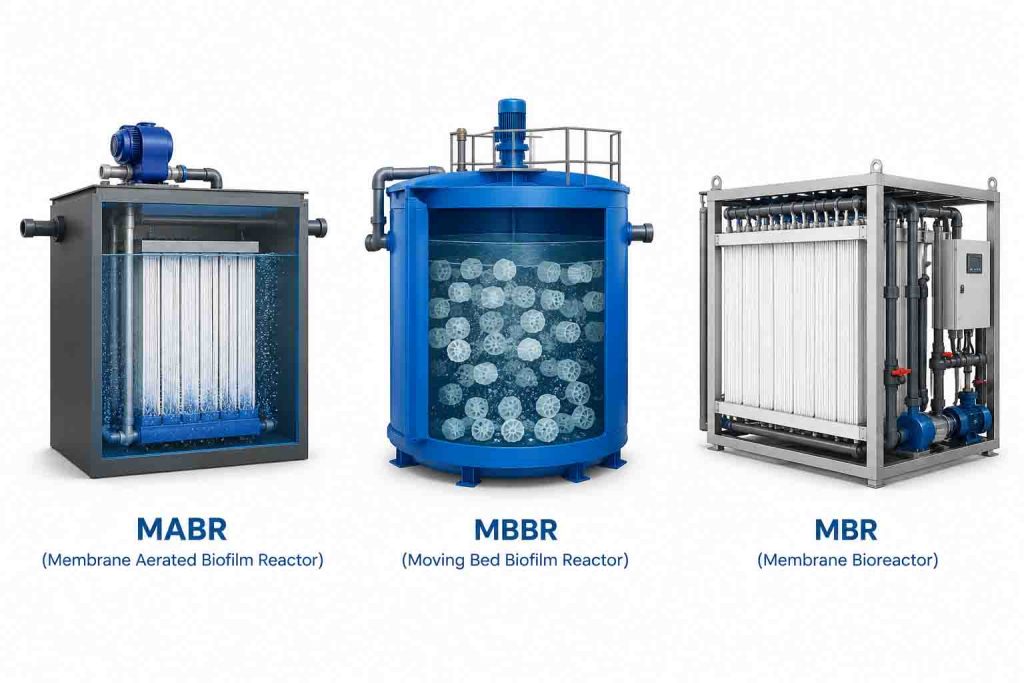
In simple terms, MBBR uses carriers to provide a surface for microorganisms to grow, MBR combines biological treatment with membrane separation, while MABR uses a gas-permeable membrane to deliver oxygen directly to a biofilm. Although all three can provide intensive biological treatment in a relatively compact footprint, they solve different treatment problems.
For additional technical background on membrane-based biological treatment, readers can also refer to professional wastewater treatment resources such as the International Water Association and other established water-treatment engineering publications.
MBBR: Biological Treatment with Moving Carriers
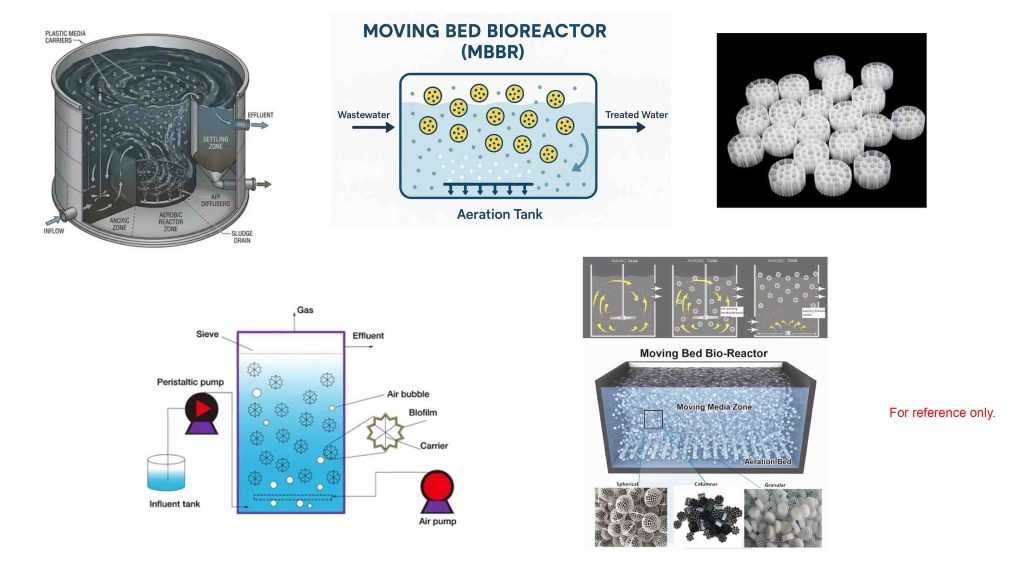
MBBR stands for Moving Bed Biofilm Reactor. It is a fixed-film biological treatment process in which microorganisms grow on specially designed plastic carriers. The carriers remain suspended and move within the biological tank, while the microorganisms attached to their surfaces form a biofilm that removes organic pollutants and nutrients from wastewater.
A typical MBBR process can be arranged as:
Influent → MBBR Tank → Secondary Clarification → Effluent
The carriers provide additional surface area for microorganisms. Instead of relying only on suspended activated sludge, the MBBR process retains a large amount of biomass on the carrier surfaces. Aeration can keep the carriers moving and also provide dissolved oxygen for biological treatment.
One important advantage of MBBR is its relatively simple configuration. The process does not use a membrane for final solid-liquid separation, so it generally requires a downstream clarification or filtration step. This makes MBBR attractive for wastewater treatment plant upgrades, industrial wastewater applications, and projects where additional biological capacity is required without completely rebuilding the existing biological process.
Main Advantages of MBBR
- Good resistance to changes in organic loading
- Additional biomass can be retained on carrier media
- Relatively simple biological process
- No membrane filtration system is required
- Suitable for upgrading existing treatment tanks
- Applicable to municipal and industrial wastewater
- Generally easier to operate than membrane-based separation systems
The main limitation is that MBBR itself does not provide membrane-level solid-liquid separation. The treated water normally needs a secondary clarifier, filtration system, or another downstream separation process.
MBR: Biological Treatment Combined with Membrane Separation
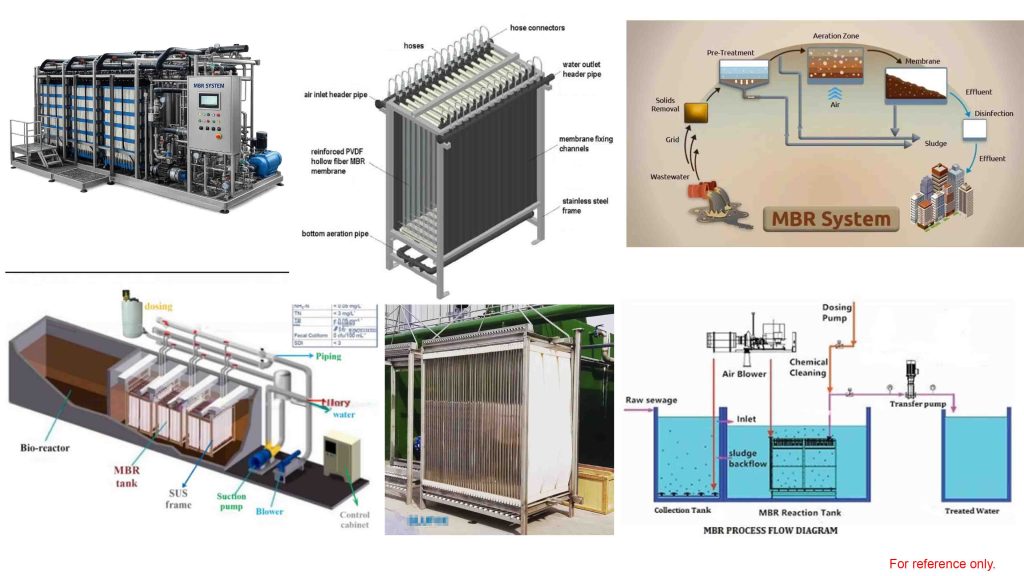
MBR stands for Membrane Bioreactor. Unlike MBBR and MABR, an MBR is primarily a suspended-growth biological process combined with membrane separation.
A typical MBR process can be represented as:
Influent → Biological Reactor → Membrane Tank → High-Quality Effluent
The microorganisms remain suspended in the biological reactor, while the membrane retains activated sludge, suspended solids, and many microorganisms. The treated water passes through the membrane and is collected as permeate.
The most important feature of an MBR is therefore the role of the membrane:
In an MBR, the membrane is mainly used for solid-liquid separation.
This allows the membrane system to replace the conventional secondary clarification step in many configurations. Because the membrane acts as a physical barrier, MBR systems can produce very clear effluent with very low suspended solids.
For applications requiring high-quality effluent or water reuse, MBR can offer significant advantages. The technology is particularly useful where land is limited and where a compact treatment process is required.
Main Advantages of MBR
- Very high effluent clarity
- Very low suspended solids in treated water
- Compact treatment footprint
- High biomass retention
- Suitable for strict discharge standards
- Well suited to many water reuse applications
- Can replace conventional secondary clarification
However, MBR systems also have higher technical and operational requirements. Membrane fouling needs to be controlled, and membranes require regular physical and chemical cleaning. Aeration is also required for biological treatment and, in submerged systems, for membrane scouring.
Therefore, MBR can provide excellent effluent quality, but this performance comes with higher equipment, energy, and maintenance requirements compared with a conventional MBBR process.
MABR: Membrane-Based Oxygen Transfer
MABR stands for Membrane Aerated Biofilm Reactor. Although the name contains the word “membrane,” its membrane performs a very different function from the membrane in an MBR.
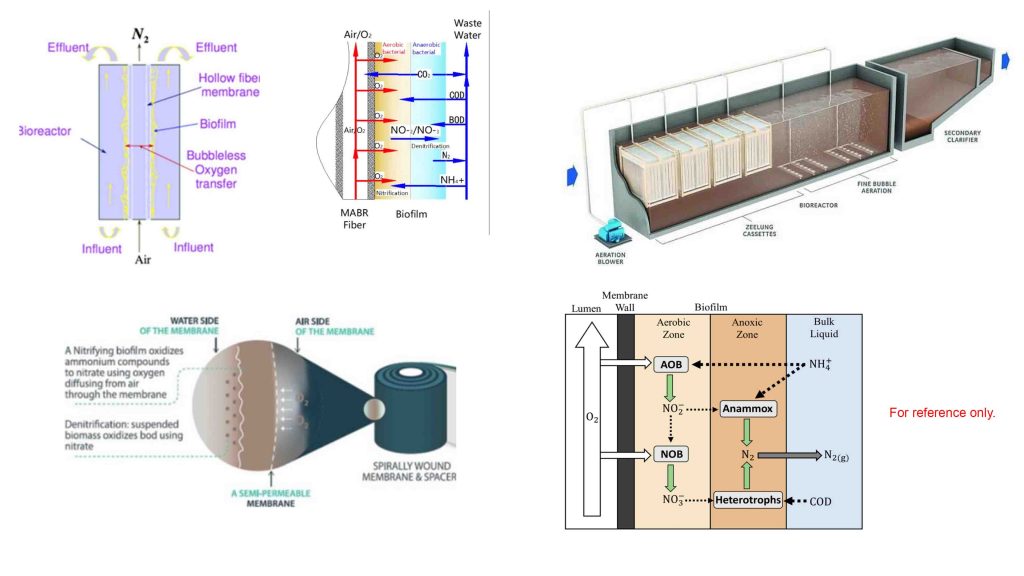
In an MABR, microorganisms grow as a biofilm directly on or near the membrane surface. Air or oxygen is supplied inside the membrane, and oxygen passes through the membrane directly into the biofilm. This is often described as bubbleless or molecular oxygen transfer.
A simplified MABR structure can be understood as:
Air/Oxygen → Gas-Permeable Membrane → Biofilm → Wastewater
The wastewater does not pass through the membrane as it does in an MBR. Instead, the membrane is used for oxygen delivery and also acts as the supporting surface for the biofilm.
This difference is one of the most important points when comparing these three technologies.
Main Advantages of MABR
- Highly efficient oxygen transfer
- Bubbleless oxygen delivery
- Potentially lower aeration energy demand
- Compact biological treatment
- Biofilm-based biological process
- Can support nitrification and denitrification within different regions of the biofilm
- Potential for simultaneous biological nitrogen removal
Research has shown that the oxygen transfer configuration of MABR can create different oxygen and substrate gradients within the biofilm. This can help create aerobic and anoxic zones within the same biofilm, making simultaneous nitrification and denitrification possible under suitable conditions.
MABR is therefore particularly interesting when energy efficiency, compact biological treatment, and nitrogen removal are important design considerations. However, it is a more specialized technology than conventional MBBR or MBR, and full-scale industrial applications are still developing. Recent research has identified promising applications for industrial wastewater while also noting the need for further pilot and demonstration work for different high-strength wastewater conditions.
MABR vs MBBR vs MBR: What Is the Difference?
The easiest way to understand the three technologies is to focus on the main function of the media or membrane.
| Item | MBBR | MBR | MABR |
|---|---|---|---|
| Full Name | Moving Bed Biofilm Reactor | Membrane Bioreactor | Membrane Aerated Biofilm Reactor |
| Biological Process | Fixed-film | Suspended-growth | Fixed-film |
| Main Component | Moving carrier media | Membrane | Gas-permeable membrane |
| Biofilm / Biomass | Biofilm on carriers | Suspended activated sludge | Biofilm on membrane |
| Membrane Function | No membrane | Solid-liquid separation | Oxygen delivery |
| Oxygen Supply | Conventional aeration | Conventional aeration | Oxygen through membrane |
| Main Separation Method | Secondary clarification or filtration | Membrane filtration | Usually requires downstream separation |
| Effluent Quality | Good, depending on downstream separation | Very high | Depends on overall system configuration |
| Footprint | Relatively compact | Compact | Compact potential |
| Energy Focus | Moderate aeration demand | Biological aeration + membrane operation | High oxygen transfer efficiency |
| Main Advantage | Simple biofilm treatment and retrofit potential | Excellent effluent quality | Efficient oxygen delivery |
| Main Challenge | Requires downstream solid-liquid separation | Membrane fouling and cleaning | Specialized membrane and biofilm control |
MABR and MBBR are both fixed-film technologies because microorganisms grow on a supporting surface. MBR is different because it retains suspended biomass using a membrane separation process. This fundamental difference is more important than the similar abbreviations suggest.
The Most Important Difference: What Does the Membrane Do?
The word “membrane” can make MABR and MBR sound like almost the same technology, but their membranes perform completely different jobs.
In MBR, the membrane works mainly as a physical separation barrier. Wastewater passes toward the membrane, while biomass and suspended solids are retained in the biological process.
In MABR, the membrane is not primarily used to filter the treated wastewater. Instead, air or oxygen is supplied through the membrane, allowing oxygen to diffuse directly into the biofilm.
This can be summarized in one sentence:
MBR uses a membrane for separation, while MABR uses a membrane for oxygen transfer.
This distinction is also highlighted by specialist wastewater engineering references comparing MABR and MBR technologies.
Which Technology Should You Choose?
There is no single technology that is best for every wastewater treatment project. The appropriate process depends on influent characteristics, discharge requirements, available footprint, energy costs, nitrogen removal targets, investment budget, and operator requirements.
Choose MBBR When:
MBBR can be a practical option when the project needs additional biological capacity but does not require membrane-level effluent separation. It is particularly attractive for upgrading existing wastewater treatment plants because carrier media can be added to suitable biological tanks without converting the entire process to membrane filtration.
Choose MBR When:
MBR is a strong choice when the project requires very high-quality effluent, a compact treatment footprint, or water suitable for further reuse treatment. The membrane provides reliable solid-liquid separation, but membrane fouling, cleaning, replacement, and energy consumption need to be considered during system design.
Choose MABR When:
MABR becomes attractive when oxygen transfer efficiency and energy reduction are major considerations. Its membrane-based oxygen delivery can reduce the limitations associated with conventional bubble aeration. At the same time, the technology requires careful control of biofilm development and should be evaluated according to the specific wastewater characteristics and treatment objectives.
MABR, MBBR, and MBR in One Simple Comparison
For a quick understanding:
MBBR = Carrier + Biofilm
Microorganisms grow on moving carriers, while conventional aeration supplies oxygen.
MBR = Activated Sludge + Membrane Separation
Microorganisms remain suspended, and the membrane separates treated water from biomass.
MABR = Membrane + Biofilm + Oxygen Transfer
Microorganisms grow on the membrane surface, while oxygen is delivered directly through the membrane.
Therefore, the three technologies can be remembered as:
MBBR focuses on biomass retention.
MBR focuses on solid-liquid separation.
MABR focuses on efficient oxygen transfer.
Understanding this difference makes it much easier to select the right biological wastewater treatment process for a specific project. Instead of choosing a technology simply because it has a smaller footprint or a newer name, engineers should consider the wastewater characteristics, required effluent quality, nitrogen removal objectives, energy demand, maintenance requirements, and overall project economics.