Sludge dewatering is often treated as a simple equipment selection task. In practice, it is a process design decision. Sludge characteristics can change the required equipment size, polymer demand, cake dryness, and operating cost.
A good system should reduce sludge volume without creating unnecessary chemical or energy costs. The right choice also depends on daily sludge production, solids concentration, working hours, and downstream disposal requirements.
Modern wastewater plants commonly use screw presses, centrifuges, and belt filter presses for mechanical dewatering. Each machine has a different operating principle. Therefore, the cheapest machine is not always the cheapest system to operate.
For broader information about biosolids management and wastewater residuals, the U.S. EPA provides technical resources through its Biosolids Management Program. This provides useful background when planning the complete sludge treatment chain.
Quick Reference: Sludge Dewatering Equipment
| Parameter | Screw Press | Centrifuge | Belt Filter Press |
|---|---|---|---|
| Main principle | Slow mechanical compression | Centrifugal separation | Gravity drainage + belt compression |
| Typical feed solids | About 0.5–5% DS | About 1–6% DS | About 1–5% DS |
| Polymer requirement | Moderate | Moderate to high | Moderate |
| Energy demand | Low | High | Low to moderate |
| Noise level | Low | High | Low to moderate |
| Footprint | Compact | Compact | Relatively large |
| Operator requirement | Low | Medium to high | Medium |
| Wash water demand | Low to moderate | Low | High |
| Typical cake dryness | About 15–25% DS | About 18–30% DS | About 15–25% DS |
| Best strength | Simple continuous operation | High throughput | Stable mechanical dewatering |
Actual performance varies with sludge type, feed concentration, polymer selection, machine size, and operating conditions.
What Is Sludge Dewatering?
Sludge dewatering removes part of the water contained in wastewater sludge. The objective is not to dry sludge completely. Instead, mechanical equipment reduces water content enough to make transportation, storage, disposal, or further treatment more economical.
A typical sludge line may look like:
Sludge Thickening → Polymer Conditioning → Dewatering → Cake Collection → Final Disposal
Dewatering equipment normally receives conditioned sludge. Polymer helps combine fine particles into larger flocs. The machine then separates free water from the solids.
This distinction matters because dewatering equipment cannot compensate for poor sludge conditioning. A machine with a large capacity may still produce poor results when the polymer system or feed conditions are wrong.
Why Sludge Characteristics Matter More Than Machine Size
Engineers sometimes compare machines only by rated capacity. That approach can lead to poor results.
Two sludge streams with the same flow rate can behave very differently. Biological sludge contains fine particles and can be difficult to dewater. Primary sludge usually has different settling and filtration characteristics. Industrial sludge can also contain oils, fibers, minerals, or chemical precipitates.
Important design inputs include:
- Sludge flow rate
- Dry solids loading
- Feed solids concentration
- Organic content
- Particle size
- Sludge age
- Polymer response
- Target cake dryness
- Required operating hours
The dry solids load is particularly important.
For example, a system receiving 10 m³/h of sludge at 2% dry solids handles approximately:
10 × 1,000 × 2% = 200 kg DS/h
This value is more useful for equipment sizing than flow rate alone.
Screw Press: Low-Energy Continuous Dewatering
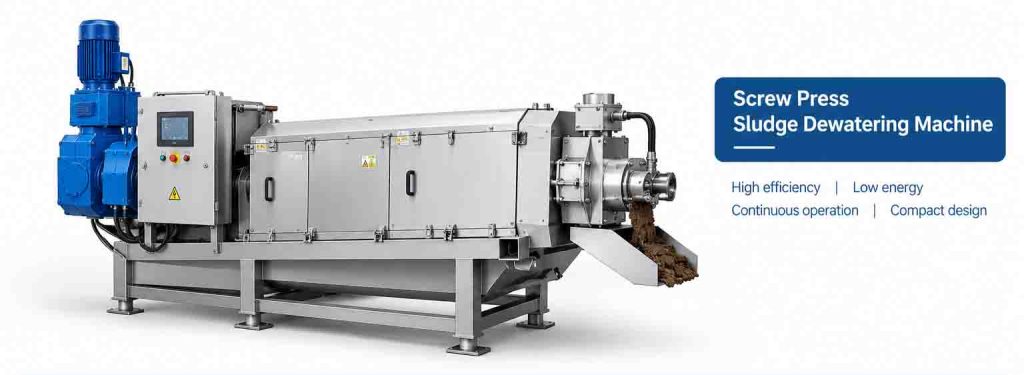
A screw press uses a slowly rotating screw inside a cylindrical screen. The screw transports sludge through the machine while gradually increasing compression.
Free water passes through the screen openings. The solids continue toward the discharge end.
The process can be simplified as:
Feed → Flocculation → Gravity Drainage → Compression → Cake Discharge
The screw press is one of the most attractive options when low energy use and simple operation are important.
Main Advantages of a Screw Press
The biggest advantage is its low-speed mechanical design. The screw rotates much more slowly than the bowl of a centrifuge. This reduces power consumption and generally produces less noise.
The equipment also has a compact footprint. Automatic operation can be achieved with relatively simple control logic.
A screw press normally needs polymer conditioning before dewatering. The polymer dose should be established through sludge testing rather than copied from another installation.
Where Screw Presses Work Well
Screw presses are particularly suitable for:
- Municipal wastewater sludge
- Biological sludge
- Food processing sludge
- Livestock wastewater sludge
- Small and medium wastewater plants
- Sites with limited operator availability
The machine is also attractive where the plant wants continuous operation with limited wash water.
Where a Screw Press May Not Be the Best Choice
Very high throughput can favor a centrifuge. Some oily or difficult industrial sludges may also require more extensive testing.
A screw press should therefore be selected according to actual sludge characteristics. Rated hydraulic flow alone is not enough.
Centrifuge: High Throughput in a Compact Footprint
A centrifuge uses centrifugal force to separate solids and liquid. The sludge enters a rotating bowl, where the high centrifugal force drives denser solids toward the bowl wall.
A screw conveyor then transports the concentrated solids toward the discharge point.
The basic process is:
Feed → High-Speed Rotation → Solid-Liquid Separation → Cake Discharge
Centrifuges can handle high dry-solids loads in a relatively compact area. They are often considered when plant capacity is high or available space is limited.
Main Advantages of a Centrifuge
High throughput is the main attraction. A centrifuge can process substantial sludge loads while occupying less floor space than many conventional belt systems.
The enclosed design also reduces direct exposure to sludge. This can be useful for plants with odor-control requirements.
Another advantage is process flexibility. Differential speed, feed rate, torque, and polymer dosage can often be adjusted to improve separation.
The Trade-Off
The high-speed rotating bowl requires more energy than a slow-speed screw press. Mechanical components also require careful maintenance.
Operators should monitor:
- Bearing condition
- Vibration
- Differential speed
- Torque
- Feed rate
- Polymer dosage
- Cake dryness
- Centrate quality
A centrifuge can be an excellent high-capacity solution, but its operating cost should be evaluated over the complete life cycle.
Belt Filter Press: Continuous Gravity and Pressure Dewatering
A belt filter press uses a series of belts and rollers to remove water from conditioned sludge.
The sludge first enters a gravity drainage zone. Water drains through the porous belt. The thickened sludge then enters a pressure zone where rollers squeeze additional water from the solids.
The general process is:
Feed → Flocculation → Gravity Drainage → Low-Pressure Compression → High-Pressure Compression → Cake
Belt filter presses have a long history in municipal and industrial wastewater treatment.
Main Advantages of a Belt Filter Press
The technology provides continuous dewatering with relatively low energy demand. It is also easy to understand from a mechanical perspective.
Large systems can provide substantial sludge processing capacity.
However, belt filter presses normally require regular belt washing. The installation also needs enough space for the machine, wash-water system, drainage, and sludge handling equipment.
Screw Press vs Centrifuge vs Belt Filter Press
The following comparison is more useful for preliminary equipment selection.
| Selection Factor | Screw Press | Centrifuge | Belt Filter Press |
|---|---|---|---|
| Low energy priority | Excellent | Poor | Good |
| High capacity | Good | Excellent | Excellent |
| Compact installation | Excellent | Excellent | Fair |
| Low noise | Excellent | Poor | Good |
| Low wash-water demand | Good | Excellent | Poor |
| Simple operation | Excellent | Fair | Good |
| Automation potential | Excellent | Excellent | Good |
| Maintenance complexity | Low | High | Medium |
| Polymer sensitivity | Medium | High | Medium |
| Suitable for small plants | Excellent | Fair | Fair |
| Suitable for very large plants | Good | Excellent | Excellent |
No single technology wins every category. The correct selection depends on which constraint is most important for the project.
How to Select Sludge Dewatering Equipment
1. Start With Dry Solids Loading
Do not size a machine only by sludge volume.
Calculate:
Dry Solids Load = Sludge Flow × Feed Concentration × Operating Time
For example, 20 m³/h at 2% DS gives approximately 400 kg DS/h.
The selected machine should then provide enough solids capacity with an appropriate operating margin.
2. Test Polymer Demand
Polymer can have a major effect on dewatering performance.
Too little polymer may produce poor floc formation. Too much polymer can increase chemical cost and may reduce performance.
Jar tests and pilot testing are often more useful than relying on generic dosage figures.
3. Define the Required Cake Dryness
The required cake dryness depends on the final disposal route.
A plant sending sludge to landfill may prioritize transport cost. A facility using thermal treatment may have different requirements.
Do not specify the highest possible cake dryness without checking the total economics.
4. Check Centrate or Filtrate Quality
Dewatering does not eliminate pollutants. It transfers much of the liquid fraction back to the wastewater treatment process.
A poor dewatering setup can therefore increase the internal return load.
Engineers should check:
- Suspended solids
- Ammonia
- Phosphorus
- COD
- Polymer residuals
The liquid return stream should be included in the overall plant mass balance.
5. Compare Total Operating Cost
Purchase price is only one part of the cost.
A useful comparison should include:
Equipment + Polymer + Electricity + Wash Water + Maintenance + Labor + Sludge Disposal
A low-cost machine can become expensive if it consumes more polymer or produces wetter cake.
Project Anchor: Small Municipal Plant
A municipal plant in Southeast Asia had roughly 300 m³/day of wastewater and limited operator availability. The existing sludge system required frequent manual adjustment.
The engineering team compared a belt filter press with a screw press. The project favored the screw press because the plant prioritized low energy demand and simple automatic operation.
After polymer optimization, the dewatering system achieved stable continuous operation. The plant also reduced routine operator intervention.
This type of project shows why equipment selection should start with operating priorities rather than machine price.
Project Anchor: Industrial Wastewater
An industrial facility in Eastern Europe generated a high-solids sludge stream from chemical treatment. The original concept focused on a compact centrifuge.
Pilot testing showed that the sludge required significant polymer conditioning. The final design therefore included a dedicated polymer preparation and dosing system.
The centrifuge remained suitable because the project had a high solids load and limited installation space.
The lesson is straightforward: dewatering equipment and polymer preparation should be designed as one system.
Project Anchor: Food Processing Sludge
A food processing plant in Latin America produced sludge with variable organic content. The daily sludge volume changed significantly between production shifts.
The engineering team evaluated a belt filter press and screw press. The screw press provided better flexibility for the site’s variable operating schedule.
The final system used automatic sludge feeding and polymer dosing. This reduced the need for constant manual adjustment.
What Equipment Should Be Installed Before the Dewatering Machine?
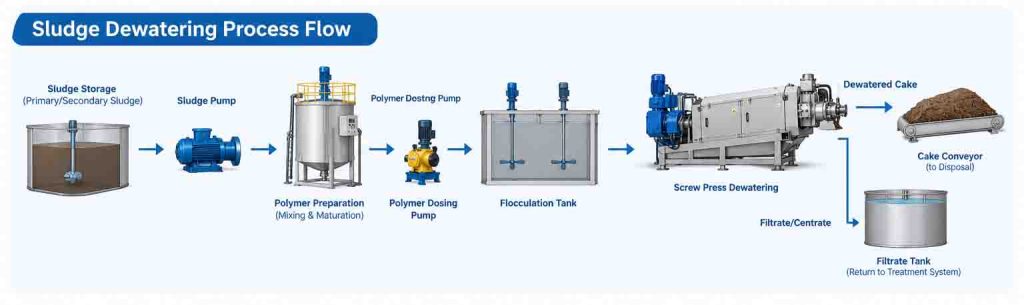
A complete sludge dewatering system normally includes more than the main machine.
A typical arrangement is:
Sludge Storage → Sludge Pump → Polymer Preparation → Polymer Dosing → Flocculation → Dewatering Machine → Cake Conveyor
Important auxiliary equipment includes:
- Sludge feed pump
- Polymer preparation system
- Polymer dosing pump
- Flocculation tank
- Control cabinet
- Cake conveyor
- Filtrate or centrate collection
- Wash-water system
- Sludge storage tank
This is why comparing only the machine quotation can be misleading. Two suppliers may quote the same dewatering capacity while including very different auxiliary equipment.
Polymer Preparation and Dosing
Polymer conditioning is often the hidden factor behind dewatering performance.
A dry polymer preparation system can automatically mix, mature, and store polymer solution before dosing. A typical three-stage arrangement includes:
Pre-Wetting → Mixing → Maturation → Storage → Dosing
The polymer solution must have enough time to hydrate and develop its flocculation performance.
For large systems, automatic polymer preparation can reduce operator workload and improve dosing consistency.
Maintenance Requirements
Maintenance requirements vary significantly between technologies.
A screw press usually needs routine inspection of the screw, screen, bearings, seals, and wash-water system.
.A centrifuge requires closer attention to vibration, bearings, differential speed, lubrication, and wear components.
A belt filter press needs regular belt cleaning, alignment checks, roller inspection, and belt tension adjustment.
A maintenance plan should consider both routine service and major wear-part replacement.
Engineer’s View: Which One Would We Choose?
If the plant has moderate sludge production and wants simple, low-energy operation, we would normally start with a screw press evaluation.
And If the dry-solids load is very high and floor space is limited, a centrifuge deserves serious consideration.
If the project already has experience with belt systems and has sufficient space and wash water, a belt filter press can still be a strong option.
The important point is not to select equipment from a catalogue capacity alone. Sludge testing, solids loading, polymer demand, cake target, and operating cost should drive the decision.
<div class=”callout”>
Engineering rule of thumb: compare dewatering systems by cost per ton of dry solids processed, not only by equipment purchase price.
</div>
Sludge Dewatering Equipment: Final Selection Checklist
Before placing an equipment order, confirm the following:
- What is the daily sludge production?
- And What is the feed solids concentration?
- What is the required dry-solids throughput?
- What cake dryness is required?
- And What polymer type will be used?
- What is the expected polymer consumption?
- How many operating hours are required each day?
- AND How much wash water is available?
- How much floor space is available?
- Where will the dewatered cake go?
- What will happen to the filtrate or centrate?
- & What spare parts are required?
- What level of automatic control is expected?
- What are the long-term electricity and maintenance costs?
The Water Environment Federation and International Water Association also provide broader technical resources for wastewater and residuals management.
FAQ
Is a screw press better than a centrifuge?
Not universally. A screw press usually offers lower energy use and simpler operation. A centrifuge can provide higher throughput and a compact installation. Sludge characteristics should decide the final choice.
Which dewatering machine uses the least energy?
A screw press generally has a lower power requirement than a centrifuge. Actual energy consumption depends on capacity, feed solids, operating hours, and system configuration.
Does every sludge dewatering system need polymer?
Many systems benefit from polymer conditioning, especially when the sludge contains fine particles. The exact requirement depends on sludge characteristics and should be confirmed through testing.
What determines sludge cake dryness?
Cake dryness depends on sludge type, feed concentration, polymer conditioning, machine settings, solids loading, and equipment design. Higher dryness is not always the most economical target.
How should I compare supplier quotations?
Compare the complete system rather than the main machine price. Include polymer equipment, pumps, control systems, conveyors, wash-water systems, installation requirements, spare parts, energy use, and expected cake dryness.
Conclusion
Selecting sludge dewatering equipment is a balance between performance, operating cost, capacity, and maintenance requirements.
A screw press is attractive for simple and energy-efficient operation. A centrifuge is strong for high-throughput applications with limited space. A belt filter press remains a practical option where continuous operation and established technology are priorities.
The best solution is the one that matches the actual sludge. Before purchasing, confirm the dry-solids load, polymer response, cake target, and downstream disposal route.
For a complete project evaluation, Morvolous can help compare the process configuration, auxiliary equipment, and dewatering capacity based on your actual sludge data.