A DAF thickener uses fine air bubbles to lift sludge solids toward the water surface.
The process is particularly useful for biological sludge that does not settle well.
A simplified process is:
Sludge Feed → Air Saturation → Bubble Attachment → Flotation → Thickened Sludge Removal
The bubbles attach to solids and increase their buoyancy. A surface scraper then removes the floated sludge.
DAF thickening can achieve strong solids concentration and capture when the sludge has poor gravity settling characteristics.
When DAF Thickening Makes Sense
DAF is often considered for waste activated sludge. It can also work well where rapid thickening is required.
The trade-off is higher mechanical and control complexity than a simple gravity thickener.
Operators must control:
- Recycle flow
- Air saturation
- Pressure
- Solids loading
- Chemical conditioning
- Skimmer operation
The final design should therefore consider the complete DAF system rather than only the flotation tank.
Gravity Belt Thickener
A gravity belt thickener uses a moving porous belt.
Conditioned sludge enters the belt. Free water drains through the belt while the solids remain on the surface.
The thickened sludge then leaves the unit for storage or dewatering.
The process is:
Polymer Conditioning → Gravity Drainage → Thickened Sludge → Dewatering
Gravity belt systems are particularly useful when mechanical thickening is required but a centrifuge is not justified.
They can provide continuous operation and relatively high throughput. However, belt washing and polymer control must be considered during plant design.
Rotary Drum Thickener
A rotary drum thickener uses a rotating perforated or wedge-wire drum.
Conditioned sludge enters the drum. Water passes through the screen surface while the solids move toward the discharge end.
The main process is:
Sludge + Polymer → Rotary Drum → Filtrate → Thickened Sludge
Rotary drum thickening is attractive for compact installations.
It can also work well as a front-end unit before a screw press or another dewatering machine.
Why Pair a Rotary Drum With a Screw Press?
The two machines perform different jobs.
The rotary drum concentrates the sludge. The screw press then removes additional water.
This arrangement can reduce the hydraulic load entering the dewatering machine.
For some projects, however, a direct-feed screw press can already handle the available sludge concentration. Adding a separate thickener would then increase equipment cost without enough benefit.
Centrifugal Thickening
A centrifuge can perform either thickening or dewatering.
The high-speed rotating bowl creates centrifugal force. Dense solids move toward the bowl wall while liquid moves toward the center.
The EPA notes that centrifuges can be used for both thickening and dewatering. Their compact footprint can be attractive where capacity is high and space is limited.
The disadvantage is energy consumption. Centrifuges also require experienced operation and closer mechanical maintenance.
Sludge Thickening Equipment Comparison
| Selection Factor | Gravity Thickener | DAF Thickener | Gravity Belt | Rotary Drum | Centrifuge |
|---|---|---|---|---|---|
| Main principle | Settling | Flotation | Gravity drainage | Screening + drainage | Centrifugal force |
| Energy demand | Low | Medium | Low–medium | Low–medium | High |
| Footprint | Large | Medium | Medium | Compact | Compact |
| Primary sludge | Excellent | Good | Good | Good | Good |
| Waste activated sludge | Fair | Excellent | Good | Excellent | Excellent |
| Operator skill | Low–medium | Medium | Medium | Low–medium | High |
| Wash water | Low | Medium | High | Medium | Low |
| Continuous operation | Yes | Yes | Yes | Yes | Yes |
| Polymer use | Optional / application-specific | Often useful | Common | Common | Common |
| Main strength | Low operating cost | Biological sludge | Continuous drainage | Compact design | High capacity |
| Main limitation | Large footprint | More controls | Belt maintenance | Screen maintenance | High power |
The comparison should be treated as a preliminary selection tool. Actual performance varies with sludge type and operating conditions.
How to Select Sludge Thickening Equipment
1. Determine Feed Solids
Start with laboratory or plant data.
Measure:
- Total solids
- Volatile solids
- Flow rate
- Daily dry-solids production
- Sludge temperature
- Particle characteristics
Feed concentration strongly affects the required equipment capacity.
2. Calculate Dry-Solids Loading
Use:
DS Load = Flow × Solids Concentration
For example:
50 m³/h × 1% DS = 500 kg DS/h
This gives a better basis for sizing than hydraulic flow alone.
The same 50 m³/h flow at 3% DS would carry three times the dry-solids load.
3. Identify the Sludge Type
Primary sludge and secondary sludge should not be treated as identical materials.
Primary sludge often responds well to gravity separation. Waste activated sludge may require flotation or mechanical thickening.
Mixed sludge requires testing because the combination can behave differently from either individual stream.
4. Define the Target Thickened Solids
Do not automatically aim for the highest possible concentration.
The target should match the next process.
For example, a downstream anaerobic digester may have a different acceptable feed concentration than a screw press.
An excessively thick stream can also create pumping and mixing problems.
5. Check the Return Liquid
Thickening produces a liquid return stream.
This stream contains some suspended solids and soluble pollutants. It normally returns to the wastewater treatment process.
The plant should therefore include the return load in its overall process calculation.
6. Evaluate Available Space
Gravity systems generally need more area.
Mechanical thickeners can provide higher capacity within a smaller footprint.
When land is expensive, the additional equipment cost may be justified by the saved footprint.
Project Anchor: Municipal Wastewater Plant
Representative project scenario — Southeast Asia
A municipal plant treated roughly 15,000 m³/day. Waste activated sludge entered the dewatering system at around 0.8% solids.
The original concept sent the dilute sludge directly to mechanical dewatering. Hydraulic flow became the main limitation.
The engineering team evaluated mechanical thickening before dewatering. The revised arrangement reduced the liquid load entering the dewatering stage and allowed a smaller downstream machine.
The final decision was based on dry-solids loading rather than sludge volume alone.
Project Anchor: Food Processing Plant
Representative project scenario — South America
A food processing facility generated roughly 80 m³/day of biological sludge. Feed solids changed significantly with production schedules.
A direct dewatering system required frequent adjustment of polymer dosage and feed flow.
The project team considered rotary drum thickening before screw press dewatering. The additional thickening stage stabilized the feed concentration.
The final system achieved more consistent operation during production changes.
Project Anchor: Municipal Sludge With Limited Space
Representative project scenario — Eastern Europe
A municipal wastewater plant had limited room for expansion. The sludge stream contained roughly 1–2% solids after biological treatment.
A conventional gravity thickener would have required significant additional area.
The design team compared gravity, DAF, and centrifugal thickening. The compact mechanical options received stronger consideration because land was the main project constraint.
The final selection balanced equipment cost against civil construction and available footprint.
Should Thickening Always Be Added Before a Screw Press?
No.
This is an important point for equipment suppliers and plant engineers.
A screw press can often accept relatively dilute sludge. If the feed already has suitable solids concentration, a separate thickener may not provide enough economic benefit.
Adding another machine creates:
- Additional capital cost
- Additional pumps
- Additional controls
- Additional maintenance
- Additional wash-water requirements
- Additional return-liquid flow
The correct question is not:
“Can thickening improve dewatering?”
It usually can.
The better question is:
“Does thickening reduce the total project cost enough to justify the additional equipment?”
When Direct Screw Press Dewatering Is Better
Direct dewatering can be attractive for smaller facilities.
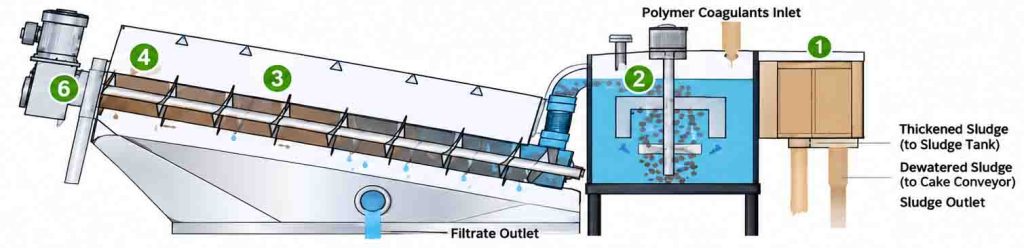
The screw press can combine conveying, drainage, and compression in one compact unit. This reduces the number of process stages.
A simple system may therefore be:
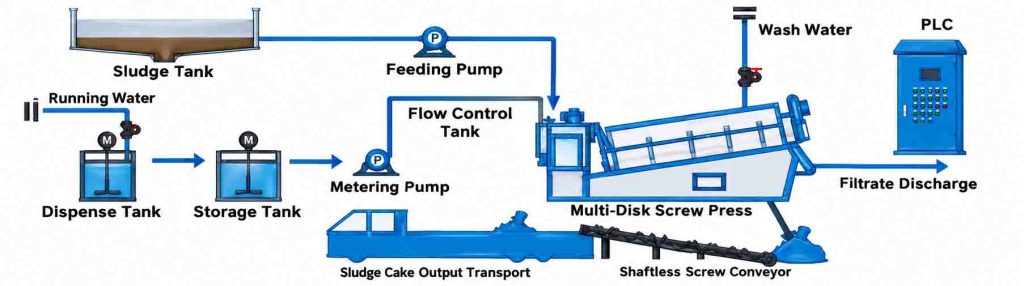
Sludge Tank → Polymer Dosing → Screw Press → Cake Conveyor
This configuration is particularly useful when the sludge feed concentration is already suitable for the machine.
When Pre-Thickening Is Better
Pre-thickening becomes more attractive when hydraulic flow is high.
A typical arrangement is:
Sludge Tank → Thickener → Thickened Sludge Tank → Polymer Dosing → Screw Press
The thickener removes part of the water first. The screw press then focuses on final mechanical dewatering.
This approach can increase the effective solids throughput of the downstream machine.
Polymer Use in Sludge Thickening
Polymer can improve floc formation.
It is especially relevant for fine biological sludge.
However, polymer should not be added automatically. The correct dosage depends on the sludge characteristics and the selected thickening technology.
EPA reference data for gravity thickening lists polymer dosage in the range of approximately 2.5–6 g/kg of dry solids for the cited applications. Actual plant requirements can differ substantially.
Jar testing should therefore come before final dosing equipment selection.
Operation and Maintenance
Good thickening performance depends on stable operation.
Operators should monitor:
- Feed solids concentration
- Thickened sludge concentration
- Overflow or filtrate quality
- Sludge flow
- Solids loading
- Blanket depth where applicable
- Polymer dosage
- Motor load
- Odor conditions
For gravity systems, the EPA recommends routine monitoring of feed and thickened solids, supernatant quality, flow, solids removal, and blanket conditions.
Mechanical thickeners need additional inspection of screens, belts, bearings, drives, pumps, and wash-water systems.
Common Sludge Thickening Problems
Thickened Sludge Is Too Dilute
Possible causes include excessive hydraulic loading, poor settling, insufficient polymer, or excessive withdrawal rate.
Start by checking feed concentration and solids loading. Do not immediately increase chemical dosage.
Solids Float in a Gravity Thickener
Gas formation can cause solids to rise.
Long retention times can create septic conditions. Poor sludge withdrawal can also increase the problem.
The solution may involve adjusting withdrawal frequency, reducing detention time, or improving gas release.
Filtrate or Supernatant Contains Too Many Solids
High return-liquid solids can indicate poor floc formation or excessive hydraulic loading.
Check the polymer system and feed conditions before changing the thickener size.
Polymer Consumption Is Too High
Excessive dosage can increase operating cost without improving performance.
Run a jar test or pilot test before changing the chemical program.
Engineer’s View: Thickening Is a Process Decision
Sludge thickening equipment should not be selected as an isolated machine.
Its value comes from what happens after thickening.
If the thickener reduces the load on a dewatering system, the total project can become smaller and more stable. If the existing dewatering machine already handles the feed effectively, an additional thickener may not be justified.
The best design considers the entire sludge line:
Feed → Thickening → Conditioning → Dewatering → Cake Handling → Disposal
The dry-solids balance should remain the foundation of the design.
<div class=”opinion-box”>
Engineering position: Do not compare thickeners only by outlet solids concentration. Compare the complete system by dry-solids capacity, solids capture, energy, polymer demand, footprint, maintenance, and downstream dewatering cost.
</div>
Sludge Thickening Equipment: Final Selection Checklist
Before selecting a thickening system, confirm:
- What is the sludge source?
- What is the feed solids concentration?
- What is the hydraulic flow?
- What is the daily dry-solids load?
- Is the sludge primary, secondary, or mixed?
- Does the sludge settle well?
- Is flotation more suitable than gravity separation?
- What thickened solids concentration is required?
- What is the downstream dewatering technology?
- How much installation space is available?
- What polymer dosage is expected?
- How will the return liquid be handled?
- What wash-water supply is available?
- What level of automatic control is required?
- Has representative sludge been tested?
The U.S. EPA recommends evaluating thickening technologies based on site-specific sludge characteristics and using representative testing before final design.
For broader biosolids treatment and management references, engineers can also consult the EPA’s technical biosolids resources and technology fact sheets. EPA Biosolids Resources
FAQ
Is sludge thickening the same as sludge dewatering?
No. Thickening increases the solids concentration while keeping the sludge relatively fluid. Dewatering removes much more water and produces a sludge cake.
What is the best sludge thickening equipment for waste activated sludge?
There is no universal answer. DAF, gravity belt, rotary drum, and centrifuge systems can all be considered. Waste activated sludge often settles poorly, so flotation or mechanical thickening may outperform simple gravity settling.
Does a screw press need a sludge thickener?
Not always. A screw press can often process dilute sludge directly. Pre-thickening becomes more attractive when hydraulic flow is high or when the downstream dewatering capacity is limited.
How much can sludge thickening reduce volume?
The reduction depends on the starting and final solids concentration. For example, increasing concentration from 3% to 6% solids can theoretically reduce the sludge volume by about 50%, assuming the dry-solids mass remains constant.
Should sludge be tested before buying thickening equipment?
Yes. Sludge characteristics vary significantly between plants. Bench-scale or pilot testing can help determine solids concentration, settling behavior, polymer response, and expected thickened sludge quality.
Conclusion
Sludge thickening is often the missing step between sludge production and efficient dewatering.
A suitable thickener can reduce hydraulic load, improve downstream operation, lower storage requirements, and reduce the volume of material that must be handled.
Gravity thickening remains attractive for suitable primary sludge. DAF can perform well with difficult biological sludge. Gravity belt and rotary drum systems offer continuous mechanical concentration. Centrifuges provide compact, high-capacity operation when energy and maintenance requirements are acceptable.
The right sludge thickening equipment should be selected from the complete process perspective. Feed solids, dry-solids loading, sludge characteristics, target concentration, dewatering equipment, footprint, polymer demand, and lifecycle cost should all be evaluated together.
For projects where sludge data is available, Morvolous can help evaluate the thickening and dewatering configuration based on actual flow and solids loading.