An engineering guide to sludge concentration technologies, process design, and downstream treatment efficiency.
1. Introduction
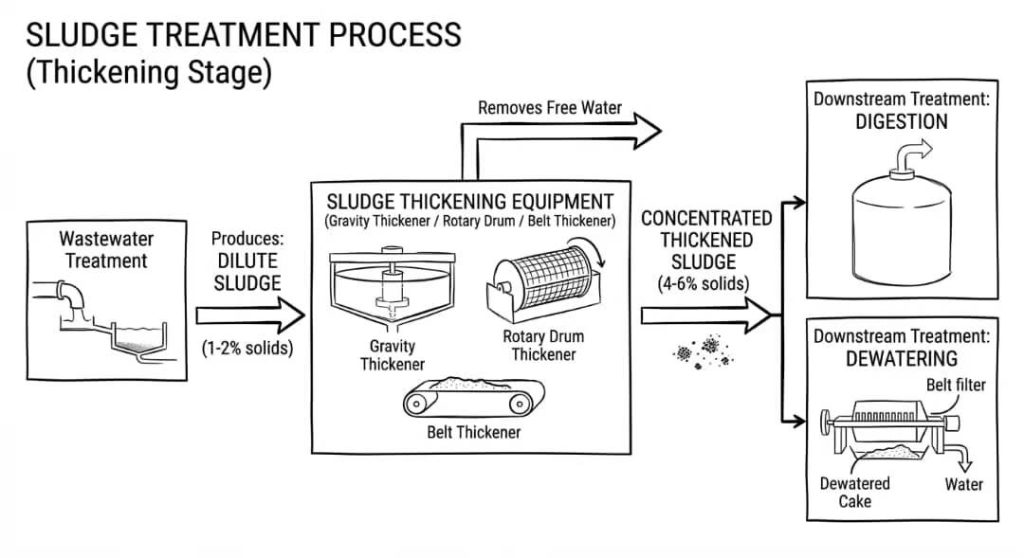
Wastewater treatment produces sludge that contains water, organic matter, suspended solids, and biological material. Moving this material through a treatment plant can consume significant energy and storage capacity. Sludge thickening helps reduce the volume before further processing.
The main objective is straightforward. Remove part of the free water while retaining as much solid material as possible. A higher solids concentration reduces the hydraulic load on digesters, dewatering machines, sludge pumps, and transportation systems.
Selecting the right sludge thickening equipment requires more than comparing machine prices. Sludge characteristics, daily flow, target solids concentration, chemical consumption, and downstream equipment all affect the final decision.
The U.S. Environmental Protection Agency explains that increasing sludge concentration from 3% to 6% total solids can reduce sludge volume by approximately 50%, assuming the dry-solids mass remains constant. This illustrates why even a moderate increase in concentration can deliver meaningful savings. Read the EPA’s Fact Sheet: Gravity Thickening for additional information on process applications, performance, and operating considerations.
2. What Is Sludge Thickening?
Sludge thickening is a physical separation process that removes part of the liquid from sludge. The output is concentrated sludge, also called thickened sludge, plus a separated liquid stream.
Unlike mechanical dewatering, thickening generally produces a pumpable slurry rather than a relatively dry sludge cake. It is normally installed before digestion, stabilization, mechanical dewatering, or other solids-handling operations.
Thickening vs. Dewatering
The two processes serve different purposes within a sludge treatment line.
| Parameter | Sludge Thickening | Sludge Dewatering |
|---|---|---|
| Main objective | Increase solids concentration | Remove more water to produce a sludge cake |
| Typical feed condition | Dilute sludge slurry | Thickened or conditioned sludge |
| Typical output | Concentrated, pumpable sludge | Semi-solid sludge cake |
| Liquid removal | Moderate | Higher |
| Common technologies | Gravity, flotation, belt, drum, centrifuge | Screw press, belt filter press, centrifuge, filter press |
| Typical downstream stage | Digestion or dewatering | Drying, transport, disposal, or reuse |
| Main performance indicators | Solids concentration, capture rate, throughput | Cake solids, capture rate, throughput |
A well-designed thickening stage can reduce the load on downstream equipment. However, excessive thickening may create pumping difficulties or interfere with processes that require a more dilute feed.
3. Main Types of Sludge Thickening Equipment
Different technologies suit different sludge characteristics. Primary sludge often settles more readily than waste activated sludge, while industrial sludge may contain fats, fibers, mineral particles, or chemical precipitates.
The following table summarizes the major options.
| Technology | Working Principle | Main Advantages | Main Limitations |
|---|---|---|---|
| Gravity Thickener | Solids settle and compact under gravity | Simple operation, low energy demand, relatively low maintenance | Requires land and adequate settling characteristics |
| Dissolved Air Flotation (DAF) Thickener | Fine air bubbles attach to solids and float them to the surface | Effective for many light biological solids, continuous operation | Requires air supply and may need polymer |
| Gravity Belt Thickener | Sludge drains through a moving porous belt | Continuous processing, accessible operation, adjustable throughput | Belt washing and polymer control are important |
| Rotary Drum Thickener | Sludge passes through a rotating screened drum | Compact footprint, enclosed configuration available, continuous operation | Screen cleaning and feed conditioning are essential |
| Centrifugal Thickener | Centrifugal force separates solids from liquid | Compact installation, high throughput potential, enclosed operation | Higher energy demand and mechanical maintenance |
The EPA identifies gravity, flotation, centrifugal, and gravity-belt technologies among established thickening methods. Its technical resources also discuss rotary drum systems. Actual performance depends on feed characteristics and operating conditions rather than equipment type alone.
4. How Different Thickening Technologies Work
4.1 Gravity Thickening
Gravity thickening uses the density difference between solids and water. Sludge enters a tank, usually through a central feed well. Settling solids accumulate near the bottom, while clarified liquid flows over the outlet weir.
A scraper mechanism moves settled sludge toward a collection hopper. The concentrated material is then pumped to the next treatment stage. Separated supernatant usually returns to the wastewater treatment process.
Gravity systems are particularly attractive for primary sludge because its particles generally settle and compact more readily. Waste activated sludge can be harder to concentrate because its biological flocs settle slowly and retain water.
4.2 Dissolved Air Flotation Thickening
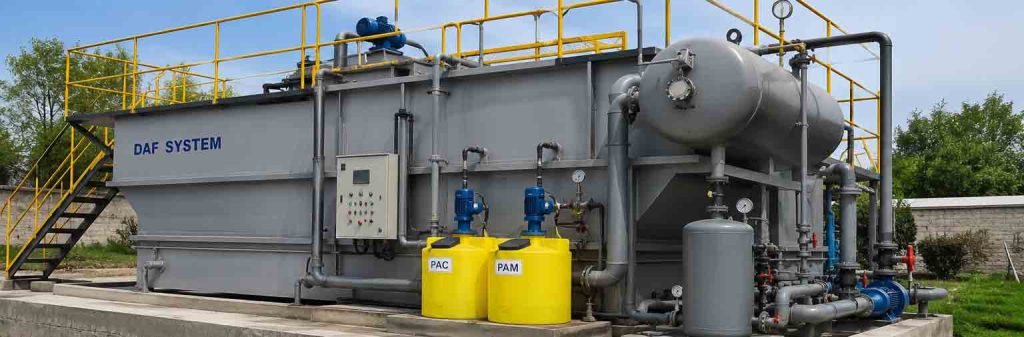
A DAF thickener uses fine air bubbles to separate solids from water. Pressurized water is saturated with air and released into the flotation tank. As the pressure drops, small bubbles form and attach to suspended particles.
The resulting aggregates rise to the surface. A scraper removes the floating sludge, while clarified liquid leaves through the appropriate outlet.
This method is often considered for biological sludge that does not settle efficiently under gravity. Polymer conditioning may improve floc formation and solids capture, but the correct dosage must be established through testing.
4.3 Gravity Belt Thickening
A gravity belt thickener distributes conditioned sludge across a continuously moving porous belt. Water drains through the belt under gravity as the sludge travels along the machine.
Drainage zones, belt speed, feed distribution, and polymer dosage influence the final solids concentration. Wash-water sprays clean the belt and help maintain drainage performance.
This technology is useful where continuous sludge processing is required and operators need access to the separation surface for inspection and cleaning.
4.4 Rotary Drum Thickening
A rotary drum thickener uses a rotating perforated or screened drum to retain sludge solids while water passes through the screen openings. Conditioned sludge enters the drum and moves through the separation zone.
The rotating screen promotes drainage and transports concentrated sludge toward the discharge. Spray systems clean the screen to limit blockage and maintain filtration performance.
Compact equipment layouts can make drum systems attractive for industrial facilities with limited floor space. However, the screen aperture, drum speed, polymer system, and feed distribution must match the actual sludge.
4.5 Centrifugal Thickening
Centrifugal thickening relies on rapid rotation to generate a force that separates denser solids from the liquid phase. In a typical decanter configuration, the solids move toward the bowl wall while the liquid forms a separate layer.
A conveyor transports the concentrated solids toward the discharge point. The clarified liquid exits through a separate outlet.
Centrifugal systems can process substantial sludge volumes in a compact footprint. Their disadvantages include energy consumption, wear-part replacement, and the need for skilled maintenance.
5. Typical Performance and Design Parameters
Performance varies considerably with sludge source, solids characteristics, temperature, chemical conditioning, and equipment configuration. The figures below are preliminary screening ranges for process comparison, not guaranteed equipment specifications.
| Parameter | Preliminary Reference | Engineering Consideration |
|---|---|---|
| Typical dilute sludge feed | Approximately 0.2–5% TS | Confirm actual feed concentration and variability |
| Gravity thickening of primary sludge | Often approximately 2–7% TS | Depends on settling and compaction behavior |
| Gravity thickening of waste activated sludge | Often approximately 0.5–3% TS | Biological sludge may resist gravity concentration |
| Thickened sludge volume reduction | Depends on feed and target solids | Calculate using dry-solids mass balance |
| Polymer dosage | Determined by testing | No universal dosage suits every sludge |
| Solids capture rate | Project-specific | Measure solids in the separated liquid |
| Hydraulic loading | Equipment-specific | Check both peak flow and solids loading |
| Operating hours | Based on daily solids production | Include cleaning, maintenance, and downtime |
The EPA’s gravity thickening technical fact sheet provides historical performance data for different sludge types. Use these values as reference information, not as substitutes for current site-specific testing.
6. How to Calculate Sludge Volume Reduction
The simplest way to estimate the benefit of thickening is to use a dry-solids mass balance.
Assume dry solids are conserved during the process. The sludge volume is approximately inversely proportional to its total-solids concentration when density changes are small.
The basic relationship is:
\[ V_2=V_1\times\frac{C_1}{C_2} \]
Where:
- \(V_1\) = initial sludge volume
- \(V_2\) = estimated thickened sludge volume
- \(C_1\) = initial total-solids concentration
- \(C_2\) = target total-solids concentration
Calculation Example
A wastewater plant produces 100 m³/day of sludge at 2% total solids. The target concentration after thickening is 5%.
\[ V_2=100\times\frac{2}{5}=40\text{ m}^3/\text{day} \]
The estimated volume reduction is:
\[ \frac{100-40}{100}\times100\%=60\% \]
The thickened sludge volume is approximately 40 m³/day, representing a 60% reduction.
This calculation assumes negligible dry-solids loss and comparable sludge density. Actual results must account for solids captured in the separated liquid, changes in sludge properties, and the operating characteristics of the selected machine.
7. How to Select the Right Technology
Step 1: Identify the Sludge Source
Determine whether the feed comes from primary clarification, biological treatment, chemical precipitation, DAF flotation, or an industrial process. Different sludges can behave very differently during separation.
For example, primary sludge may respond well to gravity settling. Biological sludge often benefits from flotation or mechanical thickening when settling performance is poor.
Step 2: Calculate Dry-Solids Production
Daily hydraulic flow alone is not enough to size a thickener. Estimate the dry-solids load using sludge flow and measured total-solids concentration.
\[ M_s=Q\times C_s \]
Here, \(M_s\) is the dry-solids mass per unit time, \(Q\) is the sludge flow, and \(C_s\) is the dry-solids concentration expressed consistently with the chosen units.
For a flow of 50 m³/day at 1% TS, the approximate dry-solids load is 500 kg/day, assuming a sludge density close to 1,000 kg/m³.
Step 3: Define the Required Outlet Concentration
The target should reflect the next process, not an arbitrary maximum solids percentage. A digester may require different feed conditions from a screw press or filter press.
Pushing the concentration too high can increase viscosity and pumping resistance. It may also increase polymer demand or reduce process stability.
Step 4: Compare Space, Energy, and Maintenance
Gravity tanks often offer simple operation but require more space. Mechanical systems can reduce the footprint, although they introduce moving parts, wash-water requirements, and additional maintenance.
The correct choice depends on lifecycle cost. Include power, chemicals, cleaning water, replacement parts, labor, and downstream savings.
Step 5: Conduct Sludge Testing
Bench testing and pilot trials help determine settling behavior, polymer response, achievable solids concentration, and solids capture. Testing should use representative samples because sludge properties may change during production cycles.
Engineering recommendation: Avoid selecting a thickener solely from a supplier’s nominal capacity. Request performance data based on the same sludge type, feed concentration, and operating conditions as the intended project.
8. Integration with Downstream Sludge Treatment
A thickener should be designed as part of the complete solids-handling process. Its outlet concentration affects pumping, storage, digestion, conditioning, and dewatering.
| Downstream Process | Role of Thickening | Important Design Check |
|---|---|---|
| Anaerobic Digestion | Reduces water volume entering the digester | Confirm acceptable feed solids and mixing requirements |
| Aerobic Digestion | Adjusts solids loading and hydraulic volume | Verify oxygen transfer and process stability |
| Screw Press Dewatering | Reduces the hydraulic load before mechanical dewatering | Check feed consistency and conditioning requirements |
| Belt Filter Press | Provides a more concentrated feed | Confirm polymer compatibility and feed distribution |
| Filter Press | Reduces the volume handled before batch dewatering | Verify pump pressure and feed characteristics |
| Sludge Drying | Reduces the amount of water entering the drying stage | Assess energy demand and target moisture content |
| Off-Site Transportation | Reduces the volume requiring transport | Confirm whether the slurry remains pumpable |
Project Anchor 1: Municipal Wastewater Plant
Consider a municipal plant producing 100 m³/day of sludge at 2% TS. The existing dewatering system experiences high hydraulic loading and frequent operating interruptions.
A preliminary mass balance indicates that increasing the feed to 4% TS would reduce the theoretical sludge volume to approximately 50 m³/day. The engineering team should then confirm the achievable concentration and capture rate through testing.
Project Anchor 2: Industrial Biological Sludge
An industrial wastewater facility generates dilute biological sludge with inconsistent settling performance. A gravity-only solution may require excessive tank volume or fail to achieve the target concentration.
The project team compares flotation and mechanical thickening through representative sludge tests. Final selection should consider solids recovery, polymer consumption, energy use, and the availability of maintenance support.
Project Anchor 3: Food Processing Facility
A food processing plant handles sludge with fluctuating organic content and seasonal production peaks. The operator wants to reduce the load entering a downstream dewatering machine without creating a complicated maintenance routine.
A continuous mechanical thickener may be appropriate if it can accommodate peak solids loading and the sludge responds well to conditioning. The final design should be based on measured production data rather than an assumed average flow alone.
These project anchors are illustrative engineering scenarios, not verified customer installations or measured project results.
9. Common Operating Problems and Solutions
| Problem | Possible Cause | Recommended Action |
|---|---|---|
| Low outlet solids concentration | Poor settling, unsuitable polymer, excessive feed rate | Conduct settling tests and optimize loading |
| High solids in separated liquid | Weak floc formation, screen damage, hydraulic overload | Check polymer mixing, screen condition, and feed distribution |
| Excessive polymer consumption | Incorrect dosage, inconsistent sludge properties | Perform dosage optimization and monitor sludge quality |
| Blocked screens or belts | Fibers, grease, poor washing, inadequate pretreatment | Inspect screening and cleaning systems |
| Unstable sludge discharge | Feed fluctuations, inconsistent conditioning | Improve equalization and control feed rate |
| Excessive odor | Long retention time or septic conditions | Review sludge age, storage, ventilation, and cleaning |
| High energy consumption | Incorrect equipment selection or operating settings | Review load profile and equipment operating parameters |
The most effective troubleshooting approach begins with the feed sludge. A thickener cannot consistently compensate for severe upstream fluctuations, poor conditioning, or an unsuitable process configuration.
10. Operating and Maintenance Checklist
Routine inspection protects separation performance and reduces unexpected downtime.
| Frequency | Inspection Item | Recommended Check |
|---|---|---|
| Daily | Feed flow and solids | Record flow, feed TS, and outlet TS |
| Daily | Polymer preparation | Verify solution concentration and dosing stability |
| Daily | Separated liquid | Observe clarity and check for solids carryover |
| Weekly | Screens or belts | Inspect for blockage, wear, and uneven drainage |
| Weekly | Pumps and drives | Check abnormal vibration, leakage, and noise |
| Monthly | Bearings and mechanical parts | Inspect lubrication and wear according to manufacturer guidance |
| Monthly | Control system | Review alarms, operating hours, and trend data |
| Periodically | Performance review | Compare solids recovery, polymer use, and energy consumption |
Maintenance intervals should follow the manufacturer’s instructions and the actual operating environment. Abrasive, corrosive, or high-grease sludge may require more frequent inspection.
11. Frequently Asked Questions
What Is the Difference Between Thickening and Dewatering?
Thickening removes part of the free water and produces a concentrated slurry. Dewatering removes additional water to produce a sludge cake that is easier to transport, dry, or dispose of.
Which Thickening Method Is Best for Waste Activated Sludge?
There is no universal winner. Dissolved air flotation, gravity belt, rotary drum, and centrifugal technologies can all be suitable under different conditions. Selection should consider settling behavior, solids loading, target concentration, and operating cost.
Does Sludge Thickening Require Polymer?
Not always. Some sludge types can be thickened effectively without chemical conditioning. Others require polymer to improve floc formation, drainage, or solids capture. Testing is the most reliable way to establish the dosage.
How Much Can Sludge Volume Be Reduced?
The reduction depends on the initial and final solids concentrations. For example, increasing sludge from 2% to 5% TS theoretically reduces the volume by 60%, assuming negligible solids loss and comparable density.
Should Thickening Be Installed Before a Screw Press?
It depends on the feed condition and the screw press design. A thickener can reduce the hydraulic load and improve process stability when the incoming sludge is too dilute. However, the need for a separate thickening stage should be evaluated against the press’s feed capacity and total system cost.
12. Conclusion
Effective sludge concentration can reduce the volume of material handled by downstream treatment processes and improve the overall economics of wastewater solids management. Gravity systems suit many readily settling sludges, while flotation and mechanical options provide alternatives for biological or difficult-to-settle solids.
The best sludge thickening equipment is the one that meets the required solids concentration and capture rate under real operating conditions. Equipment selection should balance footprint, energy, polymer demand, maintenance, and compatibility with downstream processes.
For a reliable design, begin with measured sludge characteristics, calculate the dry-solids load, and establish the target outlet concentration. Pilot testing and a complete lifecycle cost comparison can then help identify the most appropriate solution.
For additional technical background, consult the U.S. EPA’s Gravity Thickening Fact Sheet and its technical resources for sewage sludge managers.
Morvolous Engineering Team
Morvolous provides wastewater treatment equipment and engineering solutions for industrial and municipal applications. Equipment selection should be based on site-specific wastewater analysis, operating requirements, and applicable discharge standards.