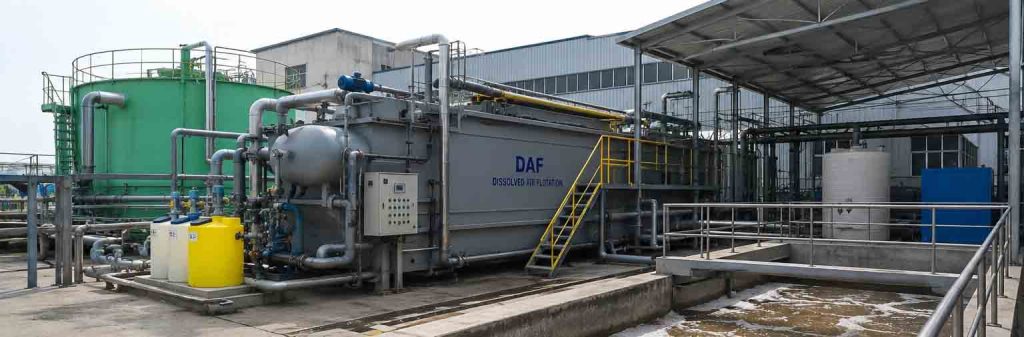
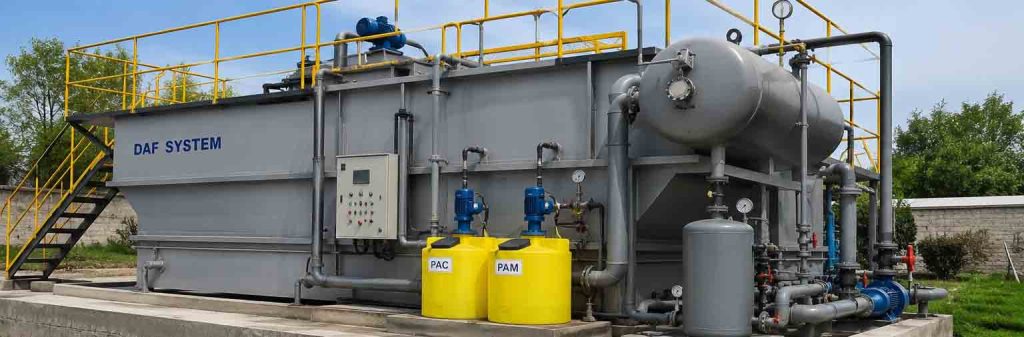
How dissolved air flotation systems solve industrial wastewater challenges across food processing, manufacturing, oil and gas, textile, and chemical industries.
Industrial wastewater often contains high concentrations of suspended solids, fats, oils, grease (FOG), and other contaminants that are difficult to remove through conventional sedimentation.
Dissolved Air Flotation (DAF) systems have become one of the most widely used technologies for industrial wastewater treatment because they provide rapid solid-liquid separation, compact footprints, and reliable performance.
Many industrial facilities struggle with fluctuating wastewater quality. DAF systems offer flexibility that traditional clarifiers often cannot match.
This guide explains how DAF systems are applied across different industries and what engineers should consider when selecting a DAF solution.
Quick Reference — DAF for Industrial Wastewater
- Typical TSS removal: 80–99%
- Typical FOG removal: 90–99%
- Hydraulic retention time: 15–45 minutes
- Recycle ratio: 20–50%
- Air saturation pressure: 4–6 bar
- Surface loading rate: 5–15 m³/m²·h
- Typical sludge solids: 3–8%
- Polymer dosage: 1–10 mg/L
- Coagulant dosage: 20–300 mg/L
- Footprint reduction vs clarifiers: up to 80%
- Startup time: typically less than 1 hour
- Suitable flow range: 5–2,000+ m³/h
Why Industrial Wastewater Requires DAF
Industrial wastewater differs significantly from municipal wastewater.
Many industries discharge wastewater containing:
- Oils and grease
- Fine suspended solids
- Proteins
- Fibers
- Emulsified contaminants
- Chemical residues
Traditional gravity settling struggles with low-density particles.
DAF systems solve this challenge by attaching microbubbles to contaminants, causing them to float to the surface for removal.
Faster Separation Performance
Sedimentation depends on particle settling velocity.
DAF relies on flotation instead.
Many particles that settle slowly can float rapidly when attached to microbubbles.
This improves treatment efficiency while reducing tank size.
Smaller Footprint Requirements
Industrial facilities often have limited installation space.
DAF units require significantly less footprint than conventional clarifiers.
This advantage becomes particularly valuable for factory expansions and retrofit projects.
How DAF Works in Industrial Applications
The operating principle remains straightforward.
Part of the treated effluent enters a pressurized saturation vessel.
Compressed air dissolves into the water under pressure.
When pressure decreases inside the flotation tank, microscopic bubbles form.
These bubbles attach to suspended particles and carry them to the surface.
A skimmer removes the floating sludge.
Clarified water exits the system for further treatment or discharge.
Food Processing Wastewater Treatment
One of the Most Common DAF Applications
Food processing facilities generate wastewater rich in:
- Animal fats
- Vegetable oils
- Proteins
- Blood
- Organic solids
These contaminants respond extremely well to flotation treatment.
Typical Performance
A properly designed DAF system can achieve:
- FOG removal above 95%
- TSS removal above 90%
- Significant COD reduction
This reduces loading on downstream biological treatment systems.
Project Example – Southeast Asia Poultry Processor
A poultry processing facility discharged wastewater containing high concentrations of fat and suspended solids.
The existing primary settling tank removed less than 50% of FOG.
Engineers installed a DAF system with chemical coagulation.
FOG removal exceeded 95%.
Downstream biological treatment performance improved substantially.
Meat and Slaughterhouse Wastewater
Slaughterhouse wastewater contains some of the highest organic loadings encountered in industrial treatment.
Common contaminants include:
- Blood
- Fat
- Protein
- Hair
- Tissue particles
DAF systems effectively remove these materials before biological treatment.
Many slaughterhouses use DAF as the primary treatment process.
Why Sedimentation Often Fails
Large portions of animal fat naturally float.
Traditional clarifiers struggle to capture these materials consistently.
DAF systems take advantage of this characteristic and improve removal efficiency dramatically.
Dairy Industry Applications
Fat Removal Challenges
Dairy wastewater contains milk fat, proteins, and suspended solids.
Wastewater quality often fluctuates throughout the production day.
DAF systems respond well to these variations.
Protecting Biological Treatment
Excessive fats can interfere with biological treatment processes.
DAF pretreatment significantly reduces this risk.
Many dairy facilities achieve stable biological performance after installing flotation systems.
Project Example – Eastern Europe Dairy Plant
A dairy processor experienced frequent biological treatment upsets.
High-fat wastewater occasionally overloaded the aeration system.
A DAF unit was installed upstream of biological treatment.
The facility achieved stable operation and reduced energy consumption within several months.
Textile Industry Wastewater
Textile wastewater presents different treatment challenges.
Common contaminants include:
- Fibers
- Dyes
- Surfactants
- Suspended solids
DAF systems remove fibers and insoluble contaminants efficiently.
Additional treatment may still be required for color removal.
Combining DAF with Chemical Treatment
Many textile plants use coagulation and flocculation before flotation.
Chemical pretreatment improves particle aggregation and increases removal efficiency.
This combination often produces better results than sedimentation alone.
Oil and Gas Wastewater Treatment
Produced Water Applications
Oilfield wastewater contains:
- Free oil
- Emulsified oil
- Suspended solids
DAF technology is frequently applied after oil-water separation units.
The process removes remaining oil droplets that gravity separation cannot capture effectively.
Offshore Installations
Compact equipment is critical offshore.
DAF systems offer excellent treatment performance within limited space constraints.
This makes flotation technology attractive for offshore facilities.
Project Example – Middle East Oil Facility
An oil processing facility required improved removal of emulsified oil before discharge.
Conventional separation equipment could not consistently meet discharge requirements.
A chemical-assisted DAF system was installed.
Oil removal efficiency improved significantly, helping the facility achieve compliance targets.
Chemical Manufacturing Wastewater
Chemical plants often generate complex wastewater streams.
DAF systems can remove:
- Suspended solids
- Insoluble reaction products
- Oil residues
- Process contaminants
However, performance depends heavily on proper chemical conditioning.
Pilot testing is often recommended before final equipment selection.
DAF vs Clarifier for Industrial Wastewater
When DAF Is Usually Better
DAF generally performs better when wastewater contains:
- Oils and grease
- Low-density solids
- Fine suspended particles
- Emulsified contaminants
When Clarifiers Remain Effective
Clarifiers remain suitable when solids settle rapidly and footprint limitations are less important.
The most economical solution depends on wastewater characteristics rather than equipment preference.
Common Design Considerations
Chemical Conditioning
Most industrial DAF systems require:
- Coagulants
- Polymers
- pH adjustment
Proper chemical selection often determines treatment success.
Sludge Handling
DAF sludge typically contains higher solids concentrations than clarifier sludge.
This reduces downstream sludge handling requirements.
Flow Variability
Industrial wastewater flow often fluctuates dramatically.
Equalization tanks frequently improve DAF performance by stabilizing loading conditions.
Engineering Perspective
Many industrial facilities initially view DAF systems as expensive equipment.
The comparison often ignores footprint savings, treatment efficiency, and downstream operational benefits.
In my experience, DAF systems deliver the greatest value when wastewater contains oils, grease, proteins, or low-density solids.
I have seen facilities spend years optimizing biological treatment systems while ignoring poor primary separation.
Once effective flotation treatment was installed, many downstream issues disappeared.
For industrial wastewater applications, successful treatment often begins with effective solids and FOG removal.
DAF Selection Checklist for Industrial Applications
Wastewater Evaluation
- Analyze TSS concentration
- Measure FOG content
- Review COD loading
- Evaluate pH variation
- Assess flow fluctuations
Process Design
- Determine treatment objectives
- Select chemical conditioning strategy
- Size equalization requirements
- Evaluate sludge handling needs
- Review discharge standards
Equipment Selection
- Verify hydraulic loading rates
- Confirm recycle ratio
- Review saturation system design
- Check skimmer configuration
- Evaluate automation requirements
Frequently Asked Questions
General Questions
What industries commonly use DAF systems?
Food processing, slaughterhouses, dairies, textile plants, chemical manufacturers, oil and gas facilities, and many other industrial sectors use DAF technology.
Can DAF remove dissolved contaminants?
DAF primarily removes suspended and floatable contaminants. Additional treatment may be required for dissolved pollutants.
How much FOG can a DAF system remove?
Properly designed systems commonly achieve FOG removal rates between 90% and 99%.
Operational Questions
Does a DAF system require chemicals?
Many industrial applications use coagulants and polymers to improve separation performance.
Can DAF replace biological treatment?
Usually not. DAF serves as a pretreatment process that reduces loading before biological treatment.
Conclusion
DAF systems have become one of the most effective technologies for industrial wastewater treatment.
Their ability to remove suspended solids, oils, grease, and other difficult contaminants makes them valuable across multiple industries.
Successful implementation requires proper wastewater characterization, chemical conditioning, and system sizing.
For facilities facing challenges with FOG, low-density solids, or limited installation space, DAF technology often provides the most practical solution.
Need Help Selecting a DAF System?
Morvolous provides dissolved air flotation systems, chemical dosing equipment, sludge dewatering solutions, and complete industrial wastewater treatment systems.
Contact our engineering team to discuss your wastewater treatment requirements.
About the Author
Morvolous Engineering Team
Morvolous specializes in industrial and municipal wastewater treatment solutions. Our engineers support customers worldwide with DAF systems, sludge treatment equipment, filtration systems, and process optimization.