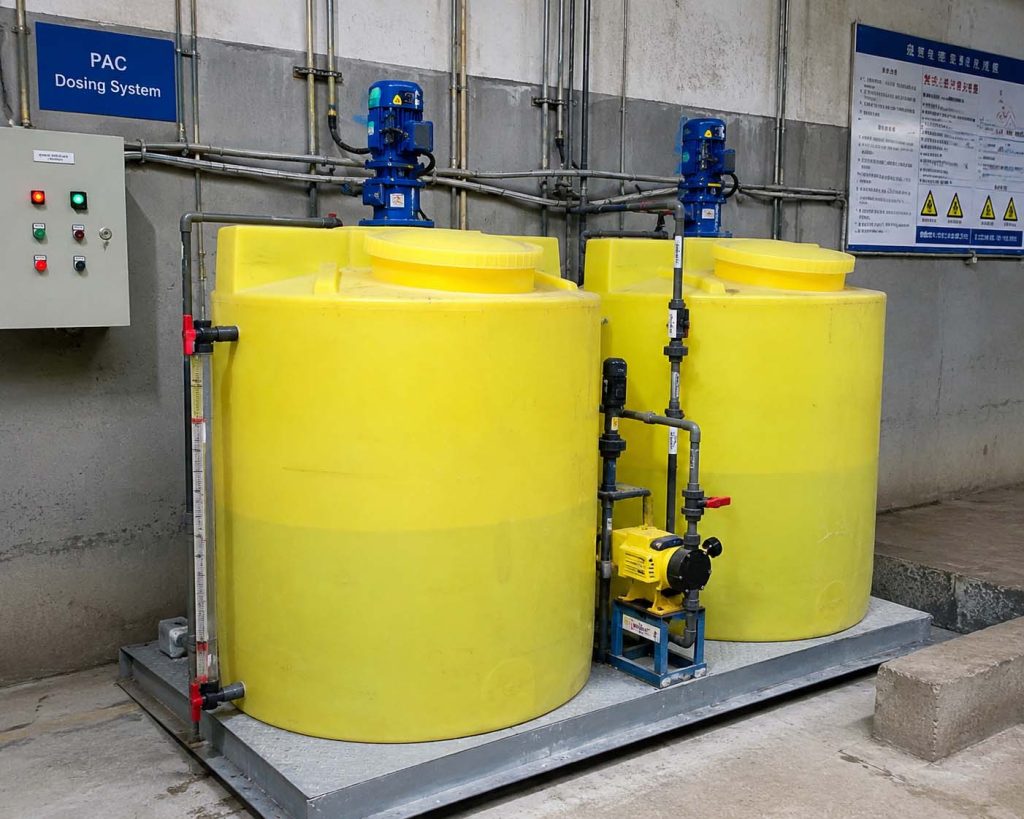
How to choose the right chemical dosing pump without oversizing, underdosing, or creating future maintenance headaches.
Chemical dosing affects almost every wastewater treatment process. Coagulation, flocculation, pH adjustment, phosphorus removal, odor control, and disinfection all depend on accurate chemical feed.
Many dosing issues are not caused by chemicals. The root cause is often poor pump selection. A pump that appears suitable on a datasheet may struggle when pressure changes, viscosity increases, or flow demand fluctuates.
Engineers often focus on flow rate first. In practice, material compatibility, turndown ratio, and control flexibility usually determine long-term performance.
Quick Reference — Dosing Pump Selection
- Dosing accuracy: ±1% to ±2%
- Typical spare capacity: 20–30%
- Recommended turndown ratio: 10:1 minimum
- Diaphragm pump pressure: up to 20 bar
- Peristaltic pump pressure: typically below 8 bar
- Polymer concentration: 0.1–0.5%
- Alum dosage: 20–200 mg/L
- Ferric chloride dosage: 10–150 mg/L
- Sodium hypochlorite concentration: 10–15%
- Stroke adjustment range: 10–100%
- Recommended storage temperature: 5–35°C
- Pulsation dampener recommended above 4 bar
Why Dosing Pump Selection Matters
A chemical dosing system only performs as well as its pump. Treatment efficiency can decline quickly when the pump cannot deliver stable and repeatable flow.
Operating costs also increase. Excess chemical consumption, maintenance downtime, and process instability often originate from an unsuitable pump specification.
The Hidden Cost of Oversizing
Many projects intentionally select larger pumps. The goal is to accommodate future expansion.
That strategy sounds reasonable. Unfortunately, oversized pumps rarely operate in their optimal range.
Small stroke settings reduce accuracy. Fine adjustments become difficult. Operators often compensate by increasing chemical dosage.
Engineering Note: A dosing pump should normally operate near its expected working range rather than near its minimum capacity.
The Risk of Undersizing
Undersized pumps create a different problem. Peak hydraulic loading can exceed available dosing capacity.
Coagulation performance declines. Effluent quality becomes unstable. Operators may have no way to increase dosage further.
Most wastewater facilities benefit from approximately 20–30% spare capacity.
Key Parameters Before Selecting a Pump
Required Flow Rate
Flow rate is the starting point for every selection process.
Engineers should calculate minimum, average, and maximum chemical demand. Designing only for average conditions creates unnecessary risk.
Required Pump Flow = Chemical Demand ÷ Chemical Concentration
Seasonal changes often influence chemical consumption. Industrial facilities may also experience significant production fluctuations.
Discharge Pressure
Pressure directly affects pump sizing and type selection.
Several factors contribute to total discharge pressure:
- Pipe friction losses
- Static head
- Injection pressure
- Backpressure valves
- Future piping modifications
Pressure estimates often increase after plant upgrades. A comfortable safety margin helps avoid future limitations.
Chemical Properties
Different chemicals place different demands on pumping equipment.
Important characteristics include viscosity, corrosiveness, temperature sensitivity, and off-gassing behavior.
Polymer solution behaves very differently from sodium hypochlorite. Ferric chloride creates different material compatibility challenges than sulfuric acid.
Warning: Material compatibility charts provide useful guidance. Actual operating temperature and concentration can significantly change performance.
Common Dosing Pump Types
Diaphragm Metering Pumps
Diaphragm metering pumps remain the most common choice for wastewater treatment.
They offer excellent dosing accuracy and strong pressure capability.
Advantages
- High accuracy
- Good pressure capability
- Low leakage risk
Limitations
- Pulsating flow
- Less suitable for highly viscous fluids
- Requires periodic diaphragm replacement
Peristaltic Pumps
Peristaltic pumps perform well with viscous chemicals and polymer solutions.
The pumped liquid only contacts the hose. Maintenance is straightforward and chemical compatibility concerns become easier to manage.
Hose wear remains the primary maintenance consideration.
Project Example – Southeast Asia
A food processing facility installed diaphragm pumps sized for future expansion. Actual demand reached only about 25% of design flow.
Operators struggled to maintain stable ferric chloride dosing. The plant replaced the oversized units with smaller metering pumps.
Chemical consumption decreased by roughly 12% within three months.
Progressive Cavity Pumps
Progressive cavity pumps handle difficult fluids effectively.
They generate smooth flow and tolerate higher viscosities than most metering pumps.
Capital cost is usually higher. Maintenance requirements also increase.
Material Selection for Long-Term Reliability
Wetted Components Matter
Material compatibility often determines equipment lifespan.
| Material | Typical Applications |
|---|---|
| PVC | Alum, sodium hypochlorite |
| PVDF | Strong oxidizers |
| PTFE | Highly corrosive chemicals |
| 316 Stainless Steel | Neutral solutions |
| EPDM | Many water treatment chemicals |
| Viton | Selected industrial chemicals |
Seal failures often appear gradually. Leakage, swelling, and reduced accuracy usually appear before complete failure.
Don’t Depend Solely on Compatibility Charts
Compatibility charts provide a useful starting point.
However, real operating conditions often differ from laboratory assumptions.
Temperature increases can accelerate chemical attack. Concentration changes can create unexpected compatibility problems.
Recommendation: Request chemical compatibility confirmation from both the pump manufacturer and chemical supplier before finalizing specifications.
Control Requirements and Automation
Manual Versus Automatic Control
Manual adjustment works well in stable applications.
Automatic control becomes valuable when influent loading changes throughout the day.
Common control methods include:
- Stroke length control
- Variable frequency drive control
- PLC integration
- Flow-paced dosing
- Residual-based dosing
Most modern wastewater facilities now prefer automated control strategies.
Turndown Ratio
Turndown ratio describes the usable operating range.
A 10:1 turndown ratio allows a pump rated at 100 L/h to accurately deliver approximately 10 L/h.
Facilities with variable flow conditions benefit from higher turndown capability.
Project Example – Eastern Europe
A municipal sludge treatment facility used diaphragm pumps for concentrated polymer feed.
Winter temperatures increased solution viscosity. Dosing performance became inconsistent.
Engineers replaced the pumps with peristaltic units designed for higher viscosity service.
Dewatering performance stabilized and operator intervention decreased substantially.
Common Dosing Pump Selection Mistakes
Choosing Based Only on Flow Rate
Flow rate is important. It is not the complete specification.
Pressure, viscosity, control requirements, and material compatibility often have greater influence on long-term performance.
Many pump replacement projects originate from overlooking these factors during procurement.
Ignoring Maintenance Requirements
Maintenance costs accumulate throughout the equipment lifecycle.
A slightly higher initial investment can reduce downtime and spare part consumption for many years.
Ease of hose replacement, diaphragm replacement, and calibration should be evaluated during selection.
Overestimating Future Expansion
Future growth is important. Excessive oversizing is rarely beneficial.
Many facilities never reach their projected expansion targets.
The result is a pump that operates permanently near its minimum output range.
Project Example – Middle East
A wastewater treatment contractor specified large-capacity sodium hypochlorite dosing pumps to accommodate a planned facility expansion.
The expansion did not occur. Five years later, operators continued running the pumps below 15% capacity.
A replacement program introduced properly sized pumps.
Chlorine dosage control improved immediately and calibration time decreased significantly.
Engineering Perspective
Many specifications focus heavily on maximum capacity. I prefer focusing on expected operating conditions.
A pump operating comfortably within its normal range usually delivers better accuracy and lower maintenance costs.
Vendors will often support optimistic expansion assumptions. Real operating data tells a more reliable story.
When uncertainty exists, I typically prioritize control flexibility, material compatibility, and maintenance accessibility before pursuing large reserve capacity.
This approach does not fit every project. However, it consistently performs well across municipal and industrial wastewater applications.
Selection Checklist Before Purchase
Technical Verification
- Confirm minimum and maximum flow requirements
- Calculate total discharge pressure
- Verify chemical compatibility
- Confirm operating temperature range
- Review turndown ratio requirements
- Evaluate automation requirements
Procurement Verification
- Check spare parts availability
- Confirm delivery lead time
- Review warranty coverage
- Evaluate maintenance complexity
- Verify local technical support
- Confirm calibration procedures
Practical Tip: Request a complete chemical compatibility statement in writing before placing the purchase order. This simple step can prevent costly disputes later.
Frequently Asked Questions
General Selection Questions
What is the most common dosing pump used in wastewater treatment?
Diaphragm metering pumps remain the most widely used option because they provide good accuracy, strong pressure capability, and reliable operation.
How much spare capacity should a dosing pump have?
Most applications benefit from approximately 20–30% spare capacity. Excessive oversizing often reduces dosing accuracy.
Can one pump handle multiple chemicals?
In most cases, no. Different chemicals require different material compatibility considerations and operating conditions.
Operation and Maintenance Questions
Which pump type works best for polymer dosing?
Peristaltic pumps and progressive cavity pumps generally perform better with viscous polymer solutions.
How often should dosing pumps be serviced?
Service frequency depends on chemical type, operating hours, and manufacturer recommendations. Monthly inspections are common in wastewater treatment facilities.
Conclusion
Dosing pump selection involves much more than matching a required flow rate. Pressure conditions, chemical characteristics, material compatibility, control requirements, and maintenance considerations all influence long-term performance.
The right pump improves treatment efficiency, reduces chemical consumption, and minimizes operational risk.
A disciplined selection process usually costs far less than correcting an unsuitable installation after commissioning.
Need Help Selecting a Dosing System?
Morvolous provides wastewater treatment equipment selection support for municipal and industrial projects worldwide.
Our engineering team can assist with chemical dosing system design, pump selection, and process optimization.
Contact Morvolous today to discuss your wastewater treatment project.
About the Author
Morvolous Engineering Team
Morvolous specializes in wastewater treatment equipment and process solutions for municipal and industrial applications. Our engineering team supports customers worldwide with equipment selection, system design, and treatment process optimization.