
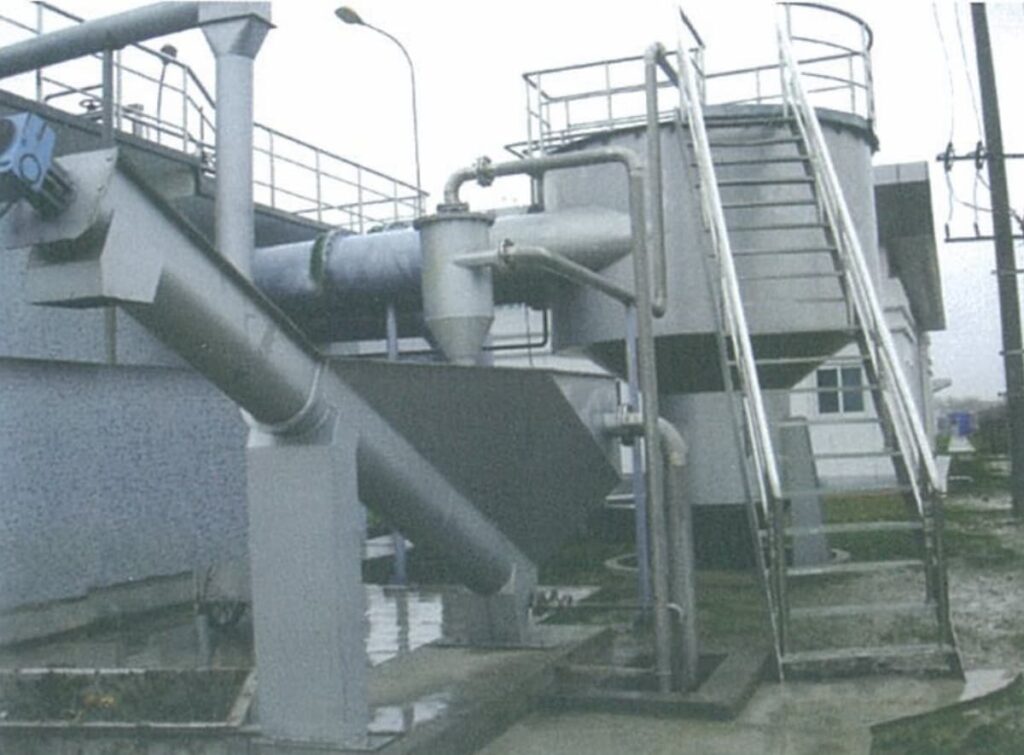
Why grit causes more downstream damage than most designers account for — and how to remove it reliably
Grit removal in wastewater treatment is preliminary treatment’s most underestimated function. Bar screens get the attention because they produce visible solids. Grit chambers look empty most of the time. Then, three years into operation, the plant discovers that grit has filled the primary settler floor, worn through pump impellers, and abraded aeration diffusers beyond economic repair. Grit removal protects every piece of equipment downstream. Done poorly, it transfers the damage budget from the headworks to the rest of the plant — quietly, and expensively.
This guide covers what grit is, why it matters, how grit removal chambers work, and how to select and size the right system for different plant conditions. It focuses on the two dominant technologies — vortex grit chambers and aerated grit chambers — with attention to the operating conditions where each performs well and where each breaks down.
The Water Environment Federation classifies grit removal as a core preliminary treatment function alongside screening. Its design guidance covers grit chamber sizing, hydraulic loading, and performance criteria that inform the discussion below.
What Is Grit and Why Does It Matter
Grit is the fraction of wastewater solids defined by density and settling velocity rather than composition. In practice, it means sand, gravel, broken glass, bone fragments, coffee grounds, and similar dense inorganic or semi-organic particles. The working definition is particles with a specific gravity above 2.65 and a settling velocity equivalent to a 0.2 mm diameter sand particle.
Where Grit Comes From
Grit enters the sewer network from multiple sources. Street runoff carries sand and gravel through combined sewer inlets. Infiltration into cracked or aging sewer pipes carries sand from surrounding soil. Industrial discharges contribute mineral fines. Food processing plants discharge bone and shell fragments. In combined systems, storm events flush accumulated deposits from the entire network simultaneously — the first-flush grit load can be five to ten times the dry-weather rate.
Separate sewer systems carry less grit than combined systems — but not as little as designers sometimes assume. Significant infiltration from deteriorated laterals, root intrusion openings, and poorly sealed manholes contributes measurable grit loads even in nominally separate systems. Any plant serving an older network should measure actual grit loads before assuming the lower end of design ranges.
What Grit Does to Equipment
Grit that passes through to downstream processes causes abrasive wear on every surface it contacts. Centrifugal pump impellers wear asymmetrically. Wear reduces efficiency first, then causes vibration, then leads to premature bearing failure. Screw press and belt press dewatering equipment accumulates grit in mechanical clearances. This accelerates wear on screw flights, press rolls, and bearings at rates far above manufacturer assumptions.
In primary settlers and anaerobic digesters, grit accumulates on the floor. It reduces active volume over time and disrupts sludge blanket management. A digester that has been accumulating grit for five years may have lost 10–20% of its effective volume — a capacity reduction that shows up as reduced hydraulic retention time and declining process performance, not as an obvious failure event.
Aeration diffusers in biological treatment suffer grit abrasion from turbulent mixing. Fine bubble diffusers are particularly sensitive. Membrane diffusers with grit abrasion show higher head loss and uneven air distribution. The damage compounds over time and is difficult to attribute definitively to grit — it looks like normal diffuser aging.
Grit Chamber Hydraulics: How Separation Works
All grit chambers exploit the density difference between grit particles and organic solids. Grit settles faster than organic particles at any given turbulence level. The design goal is to create hydraulic conditions where grit settles to the chamber floor while organic solids remain suspended and pass through with the flow.
Settling Velocity and the Design Particle
The design particle for most municipal grit chambers is a 0.2 mm diameter sphere with a specific gravity of 2.65. Its settling velocity in still water is approximately 18–22 mm/s. The grit chamber must provide sufficient residence time and low enough turbulence for this particle to reach the floor before exiting with the overflow.
Larger particles settle faster and are captured easily. The challenge is capturing particles at the lower end of the grit size distribution — fine sands and mineral fines in the 0.1–0.2 mm range. These require lower turbulence and longer residence time. Capturing them drives up chamber size and cost. Most designs accept some loss of very fine particles rather than oversize the chamber for the entire distribution.
The Organic Carryover Problem
Grit chambers must capture grit without capturing too much organic material. Raw sewage contains organic particles — food waste, faecal matter, fibrous material — with densities close to water. These settle slowly. A grit chamber with too-low turbulence captures both grit and organics, producing a grit slurry that is difficult to handle and dispose of.
Conversely, a chamber with too-high turbulence keeps organics suspended but may also keep fine grit suspended. The operating sweet spot is a turbulence level that separates grit from organics by exploiting the density difference. In practice, this means maintaining a controlled horizontal velocity — typically 0.25–0.40 m/s in aerated chambers — that resuspends organics while allowing grit to settle.
55,000 m³/day plant serving a combined sewer catchment with significant industrial discharge. The original grit chamber design used textbook grit loading figures for a comparable plant in a different region. Nobody measured actual grit concentrations in the incoming sewage during the design phase.
Three years after commissioning, the primary settler required a full desludging shutdown — the first in its design life. Inspection found roughly 0.4 m of grit and dense inorganic material on the floor across the full settler area. The digester, inspected the same year, showed a similar accumulation. Grit loads from the industrial catchment had been approximately three times the assumed design value. The grit chambers had been removing grit, but not at sufficient capacity for the actual load. A parallel grit chamber was added during the shutdown at roughly $180,000 additional capital cost — significantly more than a pre-design grit measurement programme would have cost.
Vortex Grit Chambers: How They Work
Vortex grit chambers — also called forced vortex or controlled vortex chambers — use a rotating paddle or propeller to generate a controlled spiral flow within a cylindrical chamber. Grit particles migrate outward under centrifugal action and downward under gravity, collecting in a central hopper at the base. Organics remain in the rotating flow and exit with the overflow.
Vortex Chamber Hydraulics
Wastewater enters the chamber tangentially, creating an initial rotation. The mechanical paddle or propeller maintains and controls the vortex velocity regardless of inlet flow rate. This is the key advantage of vortex designs: performance is relatively stable across a wide flow range. The paddle speed adjusts to maintain the target vortex velocity as flow varies from minimum to peak.
Grit collection efficiency for a correctly sized and operated vortex chamber is typically 90–95% for particles above 0.2 mm. Efficiency drops at very high flow rates when the vortex cannot maintain separation, and at very low flows when the vortex energy is insufficient to drive centrifugal separation effectively.
Grit Extraction from Vortex Chambers
Collected grit accumulates in the central hopper at the base of the chamber. Extraction is typically by air lift pump or submerged slurry pump, transferring the grit-water slurry to a grit classifier or washer. The extraction system must operate continuously or on a timed cycle — allowing grit to accumulate too long creates compaction problems and reduces hopper capacity.
Air lift extraction is common because it has no submerged moving parts and is therefore low-maintenance. It requires a compressed air supply and produces a dilute slurry — typically 1–5% grit by volume — that the downstream classifier must handle. Slurry pump extraction produces a more concentrated output but requires impeller maintenance and seal replacement.
Vortex Chamber Footprint and Installation
Vortex chambers are compact relative to aerated chambers for the same design flow. A vortex chamber for 500 litres per second might occupy 15–25 m² of plan area. This makes them attractive for constrained sites and upgrade projects where existing headworks have limited space.
Installation requires a cylindrical or square chamber structure, a mechanical drive unit at the top, and connections for inlet, outlet, grit extraction, and air or power supply. The drive unit — motor, gearbox, shaft seal — is the primary maintenance item. Shaft seal failure allows wastewater to enter the drive housing. Specifying the correct seal type and planning seal replacement access at design stage avoids awkward maintenance situations later.
Aerated Grit Chambers: How They Work
Aerated grit chambers use diffused air to create a spiral roll pattern within a rectangular channel. Air rises from diffusers along one side wall. The rising air creates a rolling cross-flow — the water rotates in a helical pattern down the length of the channel. Grit settles to the floor of the hopper trough while organics are kept in suspension by the rolling action.
Aerated Chamber Hydraulics
The horizontal velocity through an aerated chamber — typically 0.25–0.40 m/s — determines residence time and organic carryover. Higher horizontal velocity reduces residence time and may carry fine grit through. Lower velocity allows more organic settling, contaminating the collected grit. Air flow rate controls the intensity of the roll pattern and therefore the effective separation between grit and organics.
The key operational variable is the air-to-flow ratio. Most aerated grit chambers operate at 0.15–0.45 m³ of air per m³ of wastewater. Increasing airflow improves organic removal from the grit but reduces grit capture efficiency if turbulence becomes excessive. The optimal ratio depends on the organic content of the incoming sewage — higher organic loads require more air to keep organics in suspension.
Performance Across Flow Range
This is where aerated grit chambers show their primary weakness compared to vortex designs. Performance depends on maintaining the correct horizontal velocity. As flow drops below design, horizontal velocity drops, residence time increases, and organic carryover into the collected grit rises. As flow exceeds design, horizontal velocity rises and fine grit capture falls.
Managing an aerated chamber across a 3:1 or 4:1 flow range — common in municipal plants with significant infiltration — requires either variable air flow control or multiple channels that can be taken in and out of service. Neither approach is as clean as the variable-speed paddle control of a vortex chamber. In practice, many aerated chambers are optimised for average flow and accept performance degradation at the extremes.
Aerated Chamber Footprint and Energy
Aerated chambers are larger than vortex chambers for equivalent duty — typically 30–50% more plan area. The energy penalty is structural: compressed air supply to the diffusers is a continuous operating cost. At a 50,000 m³/day plant, the aerated grit chamber blower might consume 15–25 kW continuously. Over twenty years, that energy cost is significant. Vortex paddle drives are smaller — typically 1–4 kW — and intermittent.
That said, aerated chambers have no submerged moving parts. The diffusers require periodic cleaning but not mechanical overhaul. The chamber itself is a simple rectangular concrete structure with no complex geometry. For plants with reliable air supply and an operations team more comfortable with simple structures than mechanical drives, the aerated chamber’s simplicity is a genuine advantage.
The vortex vs. aerated debate gets framed as a performance comparison, but the real decision is often about operations capability. Vortex chambers perform better across flow ranges and have a smaller footprint. Aerated chambers have fewer submerged mechanical components and are more forgiving of maintenance neglect. At plants with limited mechanical maintenance capability — which is most small and medium municipal plants in developing markets — the aerated chamber’s robustness often outweighs its performance disadvantages. Performance on paper does not matter if the vortex drive seal fails and nobody replaces it for six months.
Grit Removal Sizing: Key Parameters
Sizing a grit removal system requires four inputs: peak flow rate, design particle size, surface overflow rate, and detention time. Each has decision points that vendors gloss over.
Peak Flow and Flow Range
Size the grit chamber for peak wet-weather flow — not average flow. At peak, both the hydraulic load and the grit load are highest. A chamber sized for average flow will be hydraulically overloaded at peak. Grit capture efficiency drops exactly when the grit load is highest. The result is that the worst grit events produce the worst capture rates — the opposite of what the treatment plant needs.
The flow range — the ratio of peak to minimum flow — determines whether multiple chambers are needed. A plant with a 5:1 peak-to-minimum flow ratio cannot maintain adequate chamber hydraulics in a single channel across that full range. Two or three parallel channels, each sized for a fraction of peak flow, allow individual channels to be taken offline at low flow, maintaining hydraulic performance in the operating channels.
Surface Overflow Rate
Surface overflow rate (SOR) is the primary sizing parameter for settling-based separation. It equals the flow rate divided by the chamber surface area. For a 0.2 mm grit particle, the target SOR is typically 600–900 m³/m²/day for vortex chambers and 500–800 m³/m²/day for aerated chambers. Exceeding the target SOR reduces grit capture efficiency for the design particle.
Detention Time
Detention time in a grit chamber is typically 2–5 minutes at design flow. Shorter detention time reduces capture efficiency for fine particles. Longer detention time increases organic carryover into the grit. The two to five minute range represents the operating envelope where the density-based separation works reliably for typical municipal sewage. Industrial flows with unusual particle distributions may require adjustment.
| Parameter | Vortex Chamber | Aerated Chamber |
|---|---|---|
| Design particle | 0.2 mm, SG 2.65 | 0.2 mm, SG 2.65 |
| Surface overflow rate | 600–900 m³/m²/day | 500–800 m³/m²/day |
| Detention time | 2–4 min at peak flow | 3–5 min at design flow |
| Horizontal velocity | N/A (rotational flow) | 0.25–0.40 m/s |
| Air rate | N/A | 0.15–0.45 m³ air/m³ flow |
| Capture efficiency (≥0.2 mm) | 90–95% | 85–95% |
| Flow range performance | Good (variable paddle speed) | Fair (fixed geometry) |
| Relative footprint | Smaller | Larger (30–50% more area) |
| Energy use | Lower (1–4 kW paddle) | Higher (15–25 kW blower) |
Grit Classification and Washing
Raw grit extracted from a grit chamber contains water, fine organic material, and grit particles. It is not ready for direct disposal. A grit classifier separates grit from the slurry and produces a relatively clean, dewatered output. A grit washer — sometimes integrated with the classifier — removes adhering organics by agitation in clean water.
Grit Classifier Operation
The most common classifier type is a screw classifier — a screw conveyor in an inclined trough that lifts grit particles out of the slurry pool while returning water and fine organics to the drain. Grit particles larger than the cut size travel up the screw and discharge at the elevated end. Fine particles and organics return with the overflow.
Classifier performance depends on the cut size — the minimum particle size retained. A cut size of 0.2 mm matches the design particle for most grit chambers. Finer cut sizes produce cleaner grit but require more careful screw clearance maintenance. Worn screw flights on a classifier allow fine particles to bypass the screw and report to the overflow — the classified grit looks the same, but the classifier is losing material it should be capturing.
Organic Content in Classified Grit
Classified grit without washing typically contains 10–30% organic material by dry weight. This is high enough to cause odour during disposal, particularly in warm climates. A grit washer reduces organic content to below 5% — producing a material that can be disposed of to landfill without odour classification in most regulatory regimes.
The grit washing step adds cost — capital and operating. However, for any plant where grit disposal to landfill requires classification as non-hazardous, the washing step pays back through reduced disposal costs within a few years. Moreover, it significantly reduces odour at the grit skip — relevant for plants near sensitive receptors.
20,000 m³/day plant, vortex grit chamber installation as part of a headworks upgrade. The original scope included a screw classifier but excluded the grit washing step to reduce capital cost. Grit organic content after classification was averaging 22% by dry weight.
Within the first monsoon season, the grit skip was generating odour complaints from plant staff and from a residential area 200 metres downwind. The disposal contractor refused to accept the grit at the standard landfill rate, reclassifying it as organic waste at roughly 2.5× the normal disposal cost. A grit washer was retrofitted eight months after commissioning. Post-washing organic content dropped to below 4%. Disposal costs returned to landfill rates. The washer capital cost was recovered in disposal savings within approximately 18 months.
Grit Removal for Industrial Wastewater
Industrial applications present grit challenges different from municipal sewage. The particle size distribution, concentration, and composition vary widely depending on the industry.
Food Processing
Food processing wastewater carries bone fragments, shell particles, fruit pits, and sand from produce washing. These particles are denser than typical municipal grit and settle faster. Smaller chambers can achieve adequate capture. However, food processing flows also carry high organic loads — the separation between grit and organics is harder to maintain, and organic carryover into the grit is higher. Washing becomes more important, not less, in food processing applications.
Mining and Quarrying
Mining process water and quarry drainage carry very high concentrations of fine mineral particles. Standard municipal grit chamber designs are inadequate for these loads. Dedicated settling tanks, hydrocyclones, or lamella settlers are more appropriate for high-concentration mineral suspensions. Grit removal in the municipal wastewater treatment sense is not the right framework for mining applications — the particle concentrations and flow characteristics are fundamentally different.
Construction Site Runoff
Construction site runoff directed to treatment carries extremely high grit and silt loads — sometimes orders of magnitude above municipal design assumptions. Temporary grit basins or sediment tanks should be specified at construction sites before runoff reaches the municipal collection system. Standard headworks grit chambers are not designed for construction runoff peak loads and will fill rapidly if such flows are admitted without pre-treatment.
Common Grit Removal Failures and Their Causes
Grit removal failures are usually invisible until a downstream inspection reveals accumulated grit in settlers, digesters, or worn pump impellers. By then, the damage is done and the cause is historical. Understanding the failure modes helps design against them proactively.
Hydraulic Overloading
The most common failure. Peak flow exceeds the design SOR. Horizontal velocity rises above the target. Fine grit passes through with the overflow. The chamber appears to operate normally — flow passes through, some grit is collected — but capture efficiency at the design particle size has fallen significantly. The symptom only appears months or years later as downstream equipment shows accelerated wear.
Grit Hopper Overflow
If grit extraction frequency is too low, the hopper fills. Grit then bypasses the hopper and exits with the overflow. In vortex chambers, a full hopper disrupts the vortex pattern and sharply reduces capture efficiency. In aerated chambers, a full trough allows grit to be resuspended by the rolling action and carried out with the flow. Extract grit frequently — daily in most municipal plants — not on a weekly schedule.
Air System Failures in Aerated Chambers
Blower failure, diffuser blockage, or air pipe corrosion disrupts the roll pattern in aerated chambers. The chamber continues to pass flow, but grit capture falls substantially. Aerated chamber performance is invisible without direct measurement — operators often do not notice a degraded roll pattern until it is pointed out. Monthly visual inspection of the roll pattern — checking that visible flow rotation is present across the full chamber width — is a basic operational check that many plants skip.
Vortex Drive Failures
Shaft seal failure on a vortex chamber paddle drive allows wastewater to enter the gearbox. The gearbox lubricant emulsifies, bearing wear accelerates, and the drive fails. Seal replacement is straightforward if planned — but requires taking the chamber offline. Many operators defer seal replacement until the drive fails entirely, which typically requires a longer shutdown and more expensive repairs. Annual seal inspection is the appropriate maintenance interval.
FAQ
Grit Removal FAQ: Design and Selection
Grit Removal FAQ: Equipment and Monitoring
Grit Removal FAQ: Retrofits and Monitoring
Designing Grit Removal for Your Headworks?
Morvolous Engineering Team works through grit loading estimates, chamber sizing, classifier selection, and integration with bar screen and downstream treatment. Reach out for a technical review before the design is locked in.
Contact Morvolous →