Compare rotary drum filters and disc filters to determine which filtration technology best fits your municipal or industrial wastewater treatment project.
Mechanical filtration has become an essential part of modern wastewater treatment. Among the available technologies, rotary drum filters and disc filters are two of the most widely used options for removing suspended solids.
Although both systems operate using mechanical screens and automatic backwashing, they serve different purposes and perform differently under various operating conditions.
Choosing the wrong filtration technology can increase operating costs, reduce treatment efficiency, and complicate future plant expansion.
This guide compares rotary drum filters and disc filters from engineering, operational, and economic perspectives to help wastewater professionals make informed decisions.
Quick Comparison
| Parameter | Rotary Drum Filter | Disc Filter |
|---|---|---|
| Typical filtration accuracy | 20–500 μm | 10–100 μm |
| TSS removal | 50–90% | 70–95% |
| Typical application | Primary / Secondary | Secondary / Tertiary |
| Hydraulic capacity | High | Very High |
| Footprint | Compact | Very Compact |
| Backwash water | Low | Very Low |
| Mechanical complexity | Moderate | Higher |
| Maintenance | Low | Low |
| Initial investment | Lower | Higher |
| Water reuse suitability | Good | Excellent |
| Municipal wastewater | Excellent | Excellent |
| Industrial wastewater | Excellent | Excellent |
Understanding the Two Technologies
Although both systems remove suspended solids using rotating filter media, their mechanical structures are very different.
Rotary Drum Filter
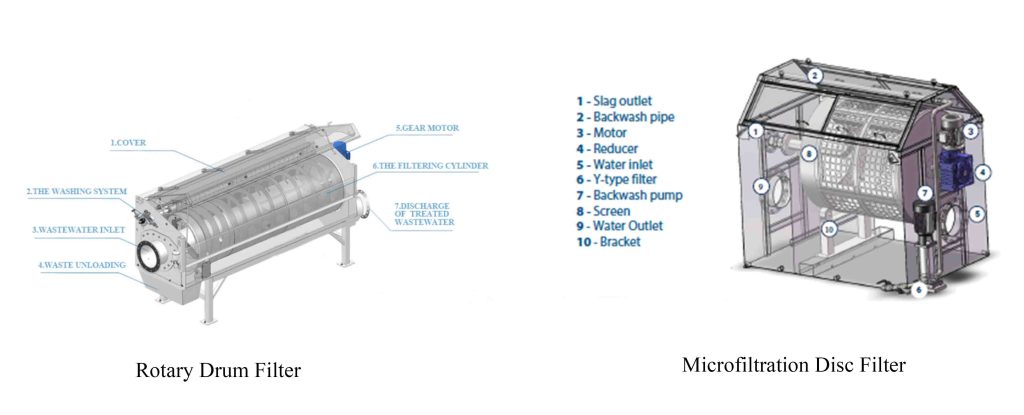
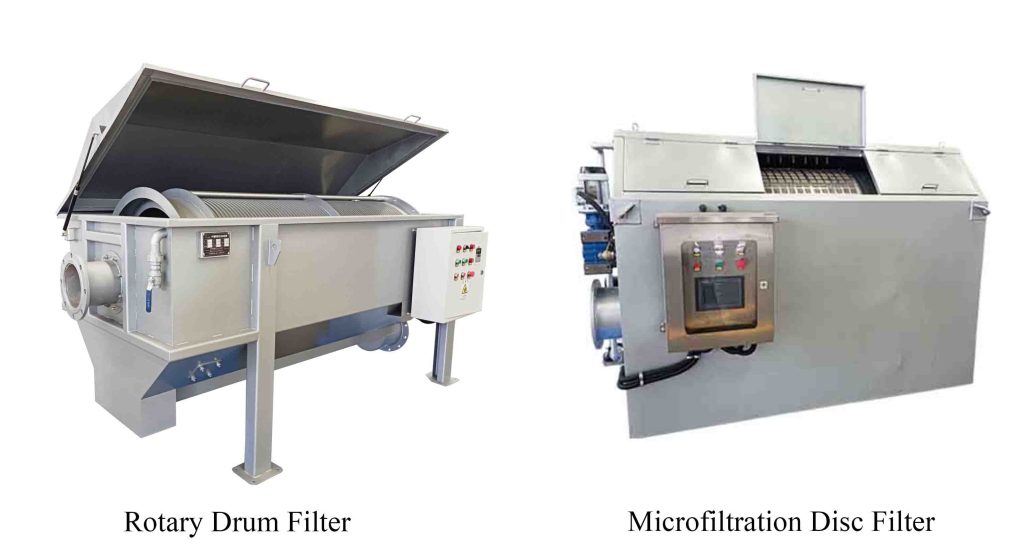
A rotary drum filter uses a cylindrical drum covered with stainless steel mesh or wedge wire screens.
Wastewater flows either from the inside outward or from the outside inward, depending on the design.
As solids accumulate, automatic spray nozzles clean the screen surface while the drum slowly rotates.
The system provides continuous filtration with minimal operator intervention.
Disc Filter
A disc filter consists of multiple vertical filter discs mounted on a central shaft.
Each disc contains numerous filter panels, dramatically increasing the available filtration area.
As solids accumulate, only a portion of the discs rotate during backwashing, allowing continuous filtration without stopping the process.
This design offers very high filtration capacity within a relatively small footprint.
Working Principle Comparison
| Feature | Rotary Drum Filter | Disc Filter |
|---|---|---|
| Filter element | Cylindrical drum | Multiple discs |
| Cleaning method | Rotating drum + spray nozzles | Rotating discs + suction or spray |
| Filtration direction | Inside-out or outside-in | Outside-in |
| Continuous operation | Yes | Yes |
| Automatic cleaning | Yes | Yes |
Both systems are fully automatic.
The difference lies mainly in how filtration area is arranged.
Disc filters pack much more screen area into the same footprint.
Filtration Performance
Suspended Solids Removal
Typical removal performance is summarized below.
| Parameter | Drum Filter | Disc Filter |
|---|---|---|
| TSS Removal | 50–85% | 70–95% |
| Fine particle removal | Good | Excellent |
| Tertiary polishing | Good | Excellent |
| Water reuse | Good | Excellent |
Disc filters generally achieve lower effluent suspended solids because they usually employ finer filter media.
However, higher removal efficiency also increases equipment cost.
Hydraulic Capacity
Both technologies can treat large wastewater flows.
The difference lies in filtration area efficiency.
Disc filters provide substantially larger filtration area within the same equipment footprint.
This allows higher hydraulic loading rates.
For very large municipal wastewater plants, disc filters often become the preferred solution.
Footprint Comparison
Space availability frequently determines equipment selection.
| Criteria | Drum Filter | Disc Filter |
|---|---|---|
| Installation area | Small | Very Small |
| Retrofit projects | Good | Excellent |
| Indoor installation | Good | Excellent |
| Large expansion | Moderate | Excellent |
Disc filters maximize filtration area by stacking multiple filter discs together.
This compact configuration makes them particularly attractive for urban wastewater treatment plants.
Maintenance Requirements
Rotary Drum Filters
Routine maintenance usually includes:
- Checking spray nozzles
- Inspecting bearings
- Lubricating drive components
- Cleaning sludge collection troughs
Maintenance requirements are generally straightforward.
Mechanical systems remain relatively simple.
Disc Filters
Disc filters require similar maintenance procedures but contain more filter panels.
Routine inspections include:
- Individual filter segments
- Central shaft bearings
- Drive assemblies
- Backwash systems
Although the number of components is greater, maintenance frequency remains relatively low.
Energy Consumption
Both systems consume relatively little energy.
Major power consumers include:
- Drive motor
- Backwash pump
- Control system
Disc filters often consume slightly less backwash water because only part of the filtration surface rotates during cleaning.
This reduces operating water consumption.
Typical Applications
Rotary Drum Filter Applications
Rotary drum filters are commonly installed in:
- Food processing plants
- Slaughterhouses
- Textile factories
- Pulp and paper mills
- Industrial pretreatment systems
- Aquaculture
- River water intake screening
They perform well where suspended solids concentrations fluctuate significantly.
Disc Filter Applications
Disc filters are commonly used for:
- Municipal tertiary treatment
- Water reuse systems
- Membrane pretreatment
- UV pretreatment
- Advanced wastewater polishing
- Nutrient removal upgrades
They excel where high effluent quality is required.
Project Example – Southeast Asia
A municipal wastewater treatment plant planned to upgrade its tertiary treatment capacity.
Engineers compared both technologies.
Because available construction space was extremely limited, a disc filter system was selected.
The installation achieved target suspended solids concentrations below design requirements while occupying approximately 40% less installation area than the original drum filter proposal.
Project Example – Europe
A food processing facility required primary solids removal before dissolved air flotation.
Engineers evaluated both systems.
Because influent suspended solids were relatively high and installation costs were a major consideration, a rotary drum filter was selected.
The system successfully reduced solids loading on the downstream DAF unit and lowered chemical consumption.
Cost Comparison
| Cost Factor | Drum Filter | Disc Filter |
|---|---|---|
| Equipment Cost | Lower | Higher |
| Civil Construction | Moderate | Lower |
| Operating Cost | Low | Low |
| Maintenance Cost | Low | Low |
| Expansion Cost | Moderate | Good |
Disc filters generally require higher initial investment.
However, lower footprint requirements often reduce civil construction costs.
The total project cost depends on plant layout rather than equipment price alone.
Advantages and Limitations
Rotary Drum Filter
Advantages
- Lower purchase cost
- Simple mechanical design
- Easy maintenance
- Reliable continuous operation
- Excellent for industrial wastewater
Limitations
- Larger footprint
- Lower filtration area
- Less suitable for ultra-low TSS requirements
Disc Filter
Advantages
- Higher filtration efficiency
- Extremely compact design
- Excellent tertiary treatment performance
- Lower backwash water consumption
- Ideal for water reuse
Limitations
- Higher initial investment
- More filter panels
- Slightly more complex mechanical structure
Engineering Perspective
Many project specifications automatically choose the technology with the highest filtration accuracy.
In practice, filtration accuracy is only one part of the selection process.
For industrial wastewater containing relatively high suspended solids, rotary drum filters often provide the best balance between investment, reliability, and operating cost.
For municipal tertiary treatment and reclaimed water production, disc filters usually deliver superior long-term performance because of their larger filtration area and finer filtration capability.
The most economical solution depends on treatment objectives rather than simply selecting the newest technology.
Selection Checklist
Choose a Rotary Drum Filter When:
- Primary filtration is required
- Industrial wastewater contains high suspended solids
- Budget is limited
- Equipment simplicity is preferred
- Future maintenance resources are limited
Choose a Disc Filter When:
- Tertiary filtration is required
- Water reuse is planned
- Space is extremely limited
- Very low effluent TSS is required
- Municipal wastewater upgrading is the primary objective
Frequently Asked Questions
Which filter removes more suspended solids?
Disc filters generally achieve lower effluent suspended solids because they typically use finer filter media and provide greater filtration area.
Which filter is better for industrial wastewater?
Rotary drum filters are often the preferred choice for industrial wastewater because they handle higher solids loading and offer a simpler mechanical design.
Which filter occupies less space?
Disc filters provide significantly more filtration area within a smaller installation footprint.
Which system costs less?
Rotary drum filters usually have lower equipment costs.
However, total project cost depends on civil construction, installation, operating expenses, and maintenance requirements.
Conclusion
Both rotary drum filters and disc filters are proven wastewater treatment technologies.
Rotary drum filters provide reliable, economical filtration for industrial applications and primary solids removal.
Disc filters offer higher filtration efficiency and superior tertiary treatment performance, making them ideal for municipal wastewater reuse projects.
The best equipment choice depends on wastewater characteristics, treatment objectives, available space, and lifecycle cost rather than equipment price alone.
Need Help Selecting the Right Filtration System?
Morvolous supplies rotary drum filters, disc filters, tertiary filtration equipment, and complete wastewater treatment systems for municipal and industrial facilities worldwide.
Our engineering team can help evaluate your wastewater characteristics, compare filtration technologies, and recommend the most suitable solution for your project.
About the Author
Morvolous Engineering Team
Morvolous specializes in advanced wastewater treatment equipment, including drum filters, disc filters, DAF systems, sludge dewatering equipment, and water reuse technologies. Our engineers support customers worldwide with equipment selection, process optimization, and turnkey wastewater treatment solutions.