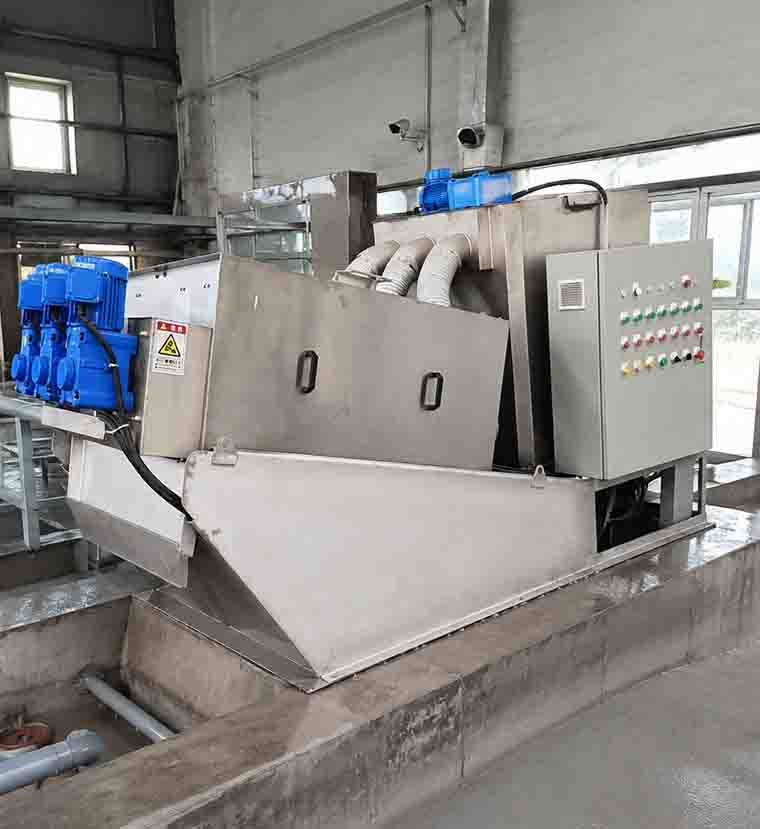
Mechanical dewatering removes a substantial amount of water from wastewater sludge. However, the resulting cake may still contain considerable moisture, increasing its transportation weight and limiting its suitability for certain disposal or reuse options. Sludge drying systems provide a further treatment stage by removing residual moisture through evaporation.
Depending on the project requirements, drying can use recovered heat, hot air, steam, or solar energy. In addition, the choice between direct and indirect heating affects energy consumption, exhaust treatment, and equipment layout. Consequently, selecting a suitable system requires more than comparing the rated drying capacity.
The U.S. Environmental Protection Agency (EPA) explains that heat drying can reduce the moisture content of wastewater solids while improving their suitability for specific biosolids management applications. Its Heat Drying Technology Fact Sheet provides further information about equipment, performance, operation, and costs.
Quick Reference: Sludge Drying Equipment
| Parameter | Typical Reference |
|---|---|
| Typical process position | After mechanical dewatering |
| Approximate incoming cake solids | 18–30% DS |
| Potential final solids content | Above 90% DS in suitable thermal systems |
| Equivalent final moisture content | Below 10% |
| Main heat sources | Natural gas, biogas, steam, hot water, recovered heat, or solar energy |
| Main dryer types | Rotary, belt, paddle, disc, flash, and solar drying systems |
| Direct drying | Hot gas contacts the sludge |
| Indirect drying | Heat passes through a heated surface |
| Main benefits | Reduced mass and volume, easier handling, potential pathogen reduction |
| Main design considerations | Evaporation capacity, energy consumption, exhaust treatment, and product quality |
| Typical downstream options | Storage, transport, beneficial reuse, or further treatment |
These figures are preliminary engineering references rather than guaranteed performance values. The EPA describes thermal drying systems that can increase sludge solids from approximately 18–30% to more than 90%, depending on the equipment and operating conditions. Actual results depend on the feed characteristics, heat supply, and required final product. EPA: Heat Drying Technology Fact Sheet
What Is Sludge Drying?
Sludge drying is a treatment process that removes water from sludge through evaporation. Unlike mechanical dewatering, which separates liquid through pressure, filtration, or centrifugal force, drying uses thermal energy or environmental heat to evaporate the remaining moisture.
For many wastewater treatment plants, drying follows a screw press, belt filter press, or centrifuge. The incoming cake is already partially dewatered; therefore, the dryer does not need to remove all the water from the original sludge stream.
A typical process is:
Sludge Thickening → Mechanical Dewatering → Sludge Cake → Drying → Dried Product Handling
Meanwhile, the dryer transfers evaporated moisture into an exhaust or vapor stream. Depending on the system, this stream may require condensation, odor control, dust collection, or other treatment before discharge.
Why Use a Sludge Drying System?
Reduce Sludge Transportation Costs
Water contributes substantial weight to dewatered sludge. By evaporating more of that moisture, a drying system reduces the mass transported off-site.
For example, consider 1,000 kg of dewatered sludge cake containing 25% dry solids. The feed contains 250 kg of dry solids and 750 kg of water.
If drying increases the solids content to 90%, the final product weighs approximately 278 kg, assuming the dry-solids mass remains constant. Thus, the theoretical mass reduction is about 72%.
Actual mass balances should account for volatile solids losses, dust, and any material removed during processing.
Reduce Storage and Handling Requirements
Dried sludge generally occupies less volume than wet cake. As a result, storage buildings, containers, and transportation arrangements may require less capacity.
Furthermore, a more stable, granular, or pelletized product can be easier to handle mechanically than sticky sludge cake.
Support Beneficial Reuse
Some dried biosolids can be considered for agricultural use, soil improvement, or other beneficial applications, subject to applicable regulations and product quality requirements.
However, drying alone does not establish that the product is suitable for every application. Heavy metals, contaminants, pathogen requirements, and local regulations must also be evaluated.
Improve Pathogen Reduction
Properly designed and operated heat-drying processes can achieve substantial pathogen reduction. Nevertheless, the required time-temperature conditions and applicable regulatory criteria must be verified for the intended use.
The U.S. EPA’s Heat Drying Fact Sheet explains the relationship between heat drying, biosolids quality, and treatment performance.
Main Types of Sludge Drying Systems
Different dryer designs transfer heat to sludge in different ways. Therefore, the most suitable technology depends on throughput, feed consistency, available energy, installation space, and the required product form.
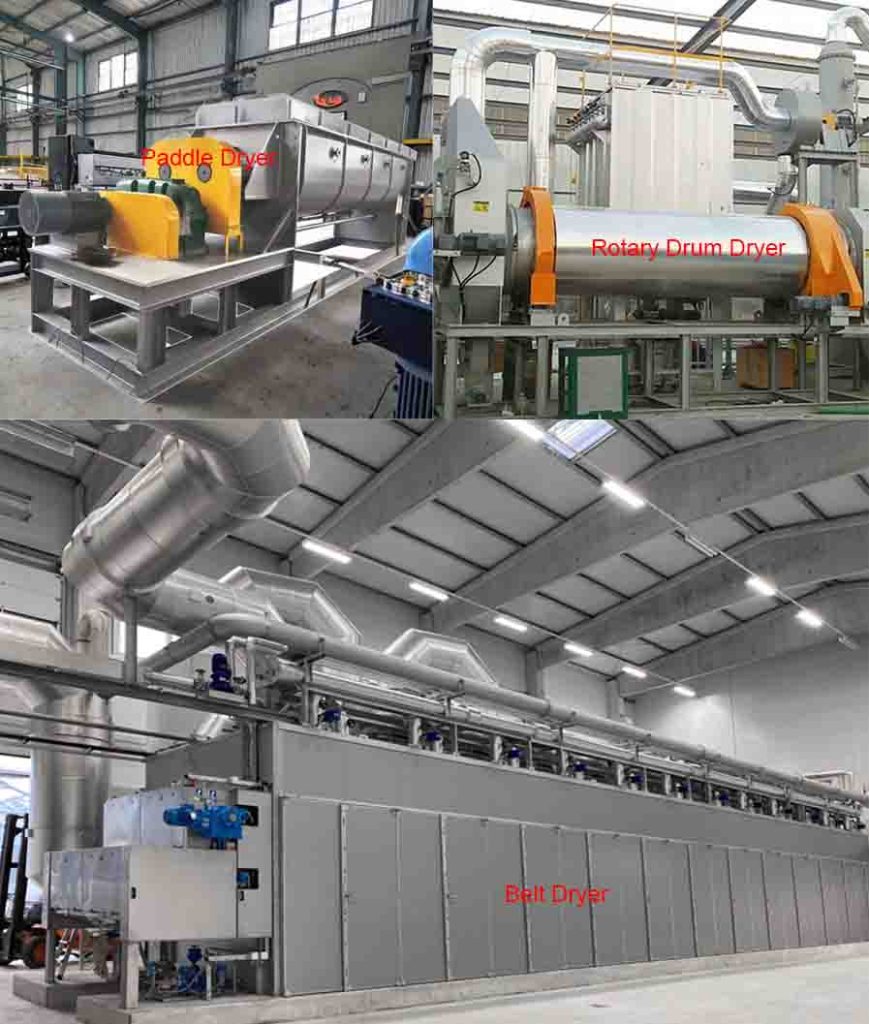
1. Rotary Sludge Dryer
A rotary dryer uses a rotating cylindrical drum to move sludge through a heated environment. As the material advances, heat evaporates moisture and internal movement helps expose new surfaces for drying.
Rotary systems are used in industrial drying applications and can be engineered for continuous operation. Depending on the design, the heating medium may contact the sludge directly or transfer heat indirectly.
Advantages
- Suitable for continuous processing
- Can handle substantial throughput
- Compatible with different feed preparation arrangements
- Can be integrated with conveying and product handling equipment
Limitations
Rotary systems require space for the drum, drive, heating equipment, and exhaust treatment. In addition, dust, odor, and fire risks must be considered during system design.
2. Belt Sludge Dryer
A belt dryer moves sludge through a drying chamber on one or more perforated conveyor belts. Heated air passes through or across the sludge layer, allowing moisture to evaporate gradually.
The feed may need to be distributed evenly across the belt. Depending on the material, preforming or other feed preparation may improve airflow and drying consistency.
Belt dryers can be attractive when controlled residence time and a relatively uniform product are important.
Advantages
- Continuous operation
- Adjustable residence time
- Modular equipment arrangement
- Suitable for integrating several drying zones
Limitations
Belt systems require adequate airflow distribution and regular cleaning. Moreover, their performance can deteriorate if the feed layer is uneven or the sludge has inconsistent physical properties.
3. Paddle or Disc Dryer
Paddle and disc dryers use heated surfaces to transfer thermal energy to the sludge. Mechanical elements move and mix the material while moisture evaporates.
These systems commonly use indirect heating, which can reduce the volume of process gas that directly contacts the sludge compared with some direct dryers.
They may be suitable where exhaust volume, installation layout, or the use of steam and hot water is an important consideration.
However, heat-transfer surfaces can accumulate deposits, so cleaning access and maintenance procedures should be included in the design.
4. Flash Dryer
A flash dryer exposes suitably prepared wet solids to a hot gas stream. Moisture evaporates rapidly, and the dried particles are separated from the gas using equipment such as cyclones and dust collectors.
Flash drying can achieve short drying times, but feed preparation is important. Some systems blend wet cake with recycled dried solids to improve handling and maintain suitable feed characteristics.
The complete installation may include a mixer, hot-gas generator, drying mill, cyclone, fan, and exhaust-treatment equipment.
5. Solar Sludge Drying System
Solar drying uses solar radiation and natural or assisted ventilation to remove moisture. Sludge is spread over a drying floor, usually within a greenhouse-type structure or a covered drying hall.
Mechanical turning equipment may be used to improve aeration and expose wetter material. In suitable climates, solar energy can reduce purchased thermal energy.
Nevertheless, drying rates depend on weather, humidity, solar availability, ventilation, and the thickness of the sludge layer. Consequently, a solar system may require a larger footprint or additional drying capacity to maintain performance during unfavorable seasons.
The EPA discusses solar drying as an option for reducing sludge moisture and potentially lowering energy requirements in its wastewater treatment technology overview.
Direct vs. Indirect Sludge Drying
The method of heat transfer is one of the main factors influencing system design.
| Factor | Direct Drying | Indirect Drying |
|---|---|---|
| Heat transfer | Hot gas contacts sludge | Heat passes through a heated surface |
| Process gas | Generally higher gas contact and exhaust volume | Often lower process-gas volume |
| Common heat sources | Heated air or combustion gas | Steam, hot water, thermal oil, or heated surfaces |
| Exhaust treatment | May require substantial dust and odor treatment | Vapor handling and odor control may still be required |
| Typical equipment | Direct rotary, belt, and flash dryers | Paddle, disc, and indirect rotary dryers |
| Main design priority | Gas flow, heat transfer, and exhaust control | Surface heat transfer, mixing, and deposit control |
Neither approach is automatically better for every project. Direct drying can provide effective heat transfer, while indirect drying can reduce direct contact between combustion gases and the product. The decision should consider energy efficiency, heat-source availability, maintenance, emissions, and final product requirements.
Sludge Drying Process Flow
A complete installation generally includes several connected stages.
A screw press, belt press, or centrifuge removes the readily separable water. Consequently, the dryer receives a concentrated cake rather than dilute sludge.
2. Feed Conditioning and Conveying
The cake is transferred to the dryer. Depending on the equipment, it may be mixed, broken into smaller pieces, or blended with recycled dried material.
3. Thermal or Solar Drying
Heat evaporates the remaining moisture. Meanwhile, conveyors, paddles, drums, or airflow move the sludge through the drying zone.
4. Vapor and Exhaust Treatment
The exhaust stream is handled according to the dryer design. Dust collection, condensation, odor control, and heat recovery may be required.
5. Product Cooling and Handling
Dried sludge may be cooled, screened, granulated, or pelletized. Appropriate conveying and storage arrangements help maintain product quality.
6. Storage or Final Use
The final material is sent for permitted beneficial reuse, disposal, or further processing.
The process flow should be developed around the required final solids content and the destination of the dried product. In particular, a system intended to produce pellets may need additional finishing equipment compared with one designed only to reduce disposal weight.
How to Calculate the Required Water Evaporation Capacity
A basic mass balance is a useful starting point for dryer sizing.
Assume a plant produces 2,000 kg/day of dewatered sludge at 25% dry solids and wants a final product containing 90% dry solids.
Step 1: Calculate the dry-solids mass.
2,000 × 25% = 500 kg dry solids/day
Step 2: Calculate the final product mass.
500 ÷ 90% = 555.6 kg/day
Step 3: Calculate the water removed.
Initial water = 2,000 − 500 = 1,500 kg/day
Final water = 555.6 − 500 = 55.6 kg/day
Water evaporation required = 1,500 − 55.6 = 1,444.4 kg/day
This means the dryer must evaporate approximately 1.44 tonnes of water per day under the stated assumptions.
In practice, the design must also consider operating hours, downtime, sludge variability, heat losses, exhaust humidity, and the actual performance of the selected dryer. The theoretical water balance alone is not enough to determine energy consumption.
Main Equipment in a Sludge Drying System
| Equipment | Main Function | Important Selection Factor |
|---|---|---|
| Feed hopper | Receives dewatered sludge | Capacity and bridging risk |
| Feed conveyor or pump | Transfers sludge | Solids content and flow |
| Mixer or conditioner | Prepares feed for drying | Consistency and mixing requirements |
| Dryer | Evaporates moisture | Water evaporation capacity |
| Heater or heat exchanger | Supplies thermal energy | Temperature and heat-source availability |
| Circulation fan | Moves drying air or gas | Airflow and pressure drop |
| Cyclone or dust collector | Separates entrained solids | Particle size and dust loading |
| Condenser or scrubber | Treats vapor or exhaust where required | Moisture, odor, and emissions |
| Product conveyor | Transfers dried material | Temperature and product form |
| Cooling equipment | Lowers product temperature | Final handling requirements |
| Control system | Monitors and adjusts operation | Temperature, airflow, feed, and safety interlocks |
The equipment list varies with the drying technology. For example, a solar drying hall may use turning and ventilation equipment instead of a conventional thermal heater, while an indirect dryer may require a dedicated heat-transfer circuit.
How to Select the Right Sludge Drying System
1. Confirm the Feed Solids Content
Start with the output from the existing dewatering equipment. A higher incoming solids concentration usually means less water must be evaporated.
Therefore, improving mechanical dewatering may reduce the required dryer capacity and energy demand.
2. Define the Final Product Requirement
The target could be a drier cake, a granular material, or a pelletized product. Each outcome has different requirements for final moisture, cooling, conveying, and storage.
Avoid specifying the highest possible solids content without a clear reason. Additional drying can increase energy consumption and may introduce unnecessary dust-handling challenges.
3. Evaluate Available Energy
Thermal drying requires energy to evaporate water. Accordingly, the availability of biogas, steam, hot water, waste heat, or other energy sources can strongly influence the project economics.
The EPA notes that some drying installations use recovered heat or other energy streams to reduce purchased energy demand. See the EPA Heat Drying Technology Fact Sheet.
4. Check the Available Space
Rotary and belt dryers need room for the dryer, feed system, exhaust treatment, and maintenance access. Solar drying may reduce purchased heat demand, but it often requires a larger land area.
A layout review should include the entire process rather than the dryer dimensions alone.
5. Review Exhaust and Odor Control
Drying can release water vapor, odors, and entrained particles. The required treatment depends on the sludge, heating method, and local environmental requirements.
As a result, exhaust treatment should be included in the initial engineering and cost estimate.
6. Compare Total Operating Costs
The purchase price is only one part of the investment. Energy, labor, maintenance, cleaning, spare parts, and dried-product transportation also affect lifecycle costs.
For this reason, compare systems using the same feed rate, incoming solids, final solids target, and annual operating hours.
Energy Consumption and Heat Recovery
Energy use is often a major consideration in thermal sludge drying. Much of the energy demand is associated with evaporating water, although actual consumption also depends on heat losses, dryer design, feed characteristics, and exhaust conditions.
Heat recovery can improve overall efficiency. For example, waste heat from a suitable industrial process or combined heat and power unit may supply part of the drying duty.
However, low-grade heat is not always sufficient to achieve the required evaporation rate. The available temperature, heat-transfer area, operating schedule, and seasonal variations should be checked before a heat-recovery system is selected.
Solar drying offers another way to reduce external heat demand. Nevertheless, weather-dependent performance must be included in the capacity calculation, particularly where the plant must operate reliably throughout the year.
Operation and Maintenance
Stable drying performance requires routine monitoring and preventative maintenance. Operators should track feed rate, inlet and outlet solids, dryer temperature, airflow, energy use, and product quality.
In addition, maintenance plans should cover conveyors, bearings, drives, heat exchangers, screens, dust collectors, and exhaust equipment. Systems handling fine dried solids need particular attention to dust accumulation and ignition risks.
A change in incoming cake moisture can also affect performance. If the dewatering process produces wetter sludge than expected, the dryer may consume more energy or struggle to achieve its target capacity.
Common Sludge Drying Problems
High Energy Consumption
Excessively wet feed, poor insulation, heat losses, and inefficient airflow can increase energy use. Check the incoming cake solids and operating conditions before increasing the heater capacity.
Uneven Final Moisture
Uneven feed distribution, insufficient mixing, or inconsistent residence time can cause the final product to contain both wet and overdried material. Improving feed preparation and process control may help stabilize product quality.
Dust Generation
Dry material can become dusty during conveying and handling. Suitable dust collection, enclosed transfer points, and safe operating procedures should be incorporated into the design.
Odor in Exhaust Gas
Heating sludge can release odor-causing compounds. Depending on the feed and dryer design, exhaust treatment may require condensation, scrubbing, or other odor-control measures.
Product Caking or Deposits
Sticky sludge may adhere to heated surfaces or conveyors. Feed conditioning, temperature control, and suitable equipment geometry can reduce the likelihood of deposits.
Project Anchor: Municipal Wastewater Plant
Representative project scenario — Southeast Asia
A municipal wastewater plant generated approximately 5 tonnes/day of dewatered sludge cake. The material contained around 25% dry solids, and transportation costs were increasing.
The engineering team evaluated thermal drying to reduce the mass sent off-site. The review compared rotary and belt dryer arrangements, including energy supply, exhaust treatment, and product handling.
The final selection would depend on verified evaporation capacity, annual energy cost, and the receiving facility’s requirements for dried biosolids.
Project Anchor: Industrial Wastewater Facility
Representative project scenario — South America
An industrial facility produced sludge with variable moisture content because its upstream production schedule changed throughout the week.
A drying system was considered to stabilize the final product and reduce disposal volume. Before equipment selection, the team identified feed consistency and the availability of waste heat as important design questions.
The evaluation included a buffer hopper, controlled feed conveyor, dryer, exhaust treatment, and finished-product storage.
Project Anchor: Solar-Assisted Sludge Drying
Representative project scenario — Southern Europe
A wastewater treatment plant had access to a large covered area and wanted to reduce dependence on purchased thermal energy.
Solar drying was evaluated alongside conventional thermal drying. The comparison considered seasonal weather, land requirements, ventilation, sludge turning, and the need for backup capacity.
The preferred approach would depend on the site’s climate and the required year-round throughput rather than the nominal drying rate alone.
Sludge Drying vs. Sludge Dewatering
These processes serve different purposes.
Mechanical dewatering removes free water through separation. Drying removes additional water through evaporation.
For instance, a screw press may reduce sludge volume while leaving a cake that still contains substantial moisture. A downstream dryer can then produce a much drier material.
However, thermal drying is not necessary for every project. If the cake already meets the requirements of the disposal or reuse route, adding a dryer may increase capital and operating costs without sufficient benefit.
The correct solution depends on the required final product and the total cost of managing the sludge.
Engineer’s View: Optimize Before Drying
The most economical drying system is not always the one with the highest evaporation capacity. Instead, the complete sludge line should be assessed, beginning with thickening and mechanical dewatering.
For example, improving the feed solids concentration can reduce the amount of water that the dryer must evaporate. Likewise, recovering usable heat may lower energy costs, while a better exhaust design can simplify environmental compliance.
Engineering principle: Calculate the daily water evaporation requirement before selecting the dryer. Then compare energy demand, product quality, exhaust treatment, and lifecycle cost using consistent design assumptions.
Sludge Drying System Selection Checklist
Before finalizing a design, confirm the following:
- What is the daily sludge production?
- What is the incoming dry-solids concentration?
- How much water must be evaporated?
- What final moisture content is required?
- Is continuous or batch operation preferred?
- Which dryer technology suits the feed characteristics?
- Is direct or indirect heating more appropriate?
- Can waste heat or biogas be used?
- Is solar drying feasible at the site?
- What exhaust and odor treatment is required?
- How will dust and fire risks be controlled?
- Is cooling, screening, or pelletizing necessary?
- How much space is available?
- What are the annual energy and maintenance costs?
- What regulations apply to the final dried product?
FAQ
What is the difference between sludge drying and sludge dewatering?
Dewatering mechanically separates water from sludge, while drying evaporates residual moisture. Consequently, drying generally produces a material with a higher solids concentration than mechanical dewatering alone.
How dry can wastewater sludge become?
Suitable thermal drying systems can produce material containing more than 90% dry solids. Nevertheless, the achievable value depends on the dryer, sludge characteristics, and operating conditions. The target should be based on the intended use rather than a maximum value alone.
Which sludge dryer is best?
There is no universal choice. Rotary, belt, paddle, disc, flash, and solar systems each have different requirements for feed preparation, heat transfer, footprint, maintenance, and energy. Representative testing and a site-specific evaluation can help determine the most appropriate option.
Can biogas be used to dry sludge?
Yes, where the gas quality, available flow, heating equipment, and safety provisions are suitable. However, the usable energy must be calculated against the drying demand, and other plant energy requirements should also be considered.
Is solar drying suitable for every wastewater plant?
No. Solar drying depends on climate, solar availability, humidity, land area, and required throughput. Therefore, plants with strong seasonal variations may need additional capacity or a complementary drying method.
Does dried sludge automatically qualify for agricultural use?
No. Drying may reduce moisture and, under appropriate conditions, pathogens. However, the final product must also meet the applicable contaminant, quality, and regulatory requirements for its intended use.
Conclusion
Sludge drying is a valuable option when mechanical dewatering alone cannot meet the required transportation, storage, or product-quality objectives. By evaporating residual moisture, a suitable system can reduce sludge mass and volume while supporting selected beneficial reuse pathways.
Rotary and belt dryers provide continuous processing options, whereas paddle and disc systems use heated surfaces to transfer energy indirectly. Flash dryers support rapid drying of suitably prepared material, and solar systems can reduce purchased energy demand where climate and available space are favorable.
Ultimately, sludge drying systems should be selected according to the complete process requirements. Incoming cake solids, daily evaporation demand, available heat, exhaust treatment, safety, final product specifications, and lifecycle costs all need to be considered together.
Morvolous can help evaluate sludge treatment equipment configurations based on project flow rates, solids concentrations, and downstream handling requirements.