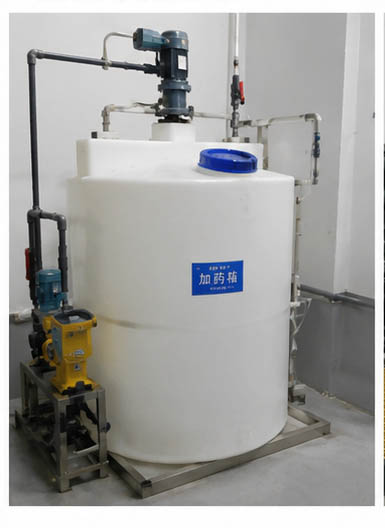
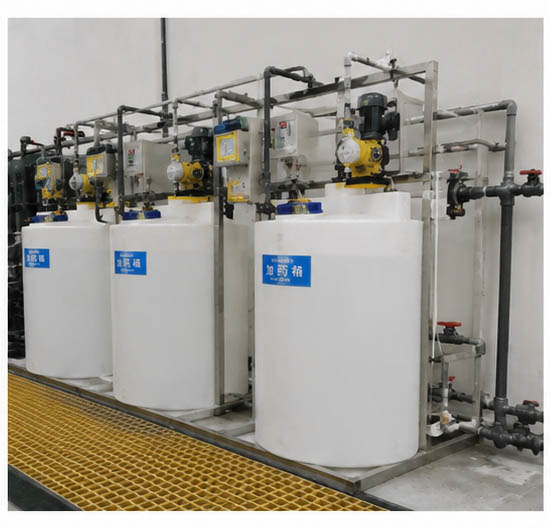
How to size, configure, and operate chemical dosing tanks for reliable wastewater treatment performance.
Chemical dosing tanks play a critical role in wastewater treatment. They provide storage, mixing, aging, and feed preparation for chemicals used in coagulation, flocculation, pH adjustment, disinfection, and sludge treatment.
Many treatment plants focus heavily on pumps and dosing equipment. However, poor tank design often causes chemical performance issues, excessive maintenance, and safety concerns.
A well-designed dosing tank improves chemical efficiency, simplifies operation, and reduces long-term operating costs.
Quick Reference — Chemical Dosing Tank Design
- Typical tank material: PE, PP, FRP, or stainless steel
- Recommended freeboard: 10–20%
- PAC storage concentration: 5–15%
- Polymer solution concentration: 0.1–0.5%
- Mixing speed for coagulants: 100–300 rpm
- Mixing speed for polymer: 30–80 rpm
- Recommended retention time: 8–24 hours
- Minimum tank reserve: 1 day
- Typical design reserve: 2–3 days
- Tank aspect ratio: 1:1 to 1.5:1
- Common agitator power: 0.37–2.2 kW
- Secondary containment volume: 110% of largest tank
Why Chemical Dosing Tank Design Matters
A dosing tank is more than a storage container.
Many chemicals require dilution, mixing, or aging before entering the treatment process. Tank geometry, mixer selection, and storage volume directly affect chemical performance.
Poor design can create dead zones, sediment accumulation, inconsistent concentration, and dosing instability.
Operators often blame pumps or chemicals when the actual issue originates inside the tank.
Determining Required Tank Volume
Start with Daily Chemical Consumption
Tank sizing begins with chemical demand.
The basic calculation is:
Tank Volume = Daily Chemical Consumption × Storage Days
For example:
- Chemical demand: 1,000 L/day
- Required storage: 3 days
Required tank volume:
1,000 × 3 = 3,000 L
Additional freeboard should be included to prevent overflow during filling.
Choosing Storage Duration
Storage requirements depend on site conditions.
Small municipal plants often maintain 2–3 days of inventory.
Remote industrial facilities may store one week or more to avoid supply disruptions.
Excessive storage is not always beneficial. Some chemicals degrade over time.
Selecting Tank Materials
Polyethylene (PE) Tanks
PE tanks are widely used for wastewater treatment chemicals.
Advantages include:
- Excellent corrosion resistance
- Low cost
- Lightweight construction
- Easy installation
PE tanks are commonly used for:
- PAC
- Sodium hypochlorite
- Ferric chloride
- Polymer solutions
FRP Tanks
FRP tanks offer higher strength and temperature resistance.
They perform well in larger industrial installations where structural requirements are more demanding.
Stainless Steel Tanks
Stainless steel remains suitable for selected chemicals.
However, compatibility must be carefully reviewed.
Strong oxidizers and corrosive chemicals may require alternative materials.
Project Example – Southeast Asia
A food processing facility installed carbon steel chemical tanks to reduce capital cost.
Ferric chloride quickly attacked internal surfaces.
Corrosion products contaminated the dosing system and increased maintenance requirements.
The plant replaced the tanks with PE units. Maintenance costs dropped significantly within the first year.
Mixer Selection and Agitation Design
Why Mixing Matters
Many chemicals separate, settle, or stratify during storage.
Without proper mixing, chemical concentration varies throughout the tank.
Operators may unknowingly overdose or underdose treatment chemicals.
Mixer Speed Selection
Different chemicals require different mixing intensity.
| Chemical | Typical Mixer Speed |
|---|---|
| PAC | 100–300 rpm |
| Alum | 100–250 rpm |
| Sodium Hypochlorite | Gentle mixing |
| Polymer Solution | 30–80 rpm |
Excessive agitation can damage polymer chains.
Once polymer molecules break apart, treatment efficiency declines.
Avoiding Dead Zones
Tank geometry affects mixing efficiency.
Tall narrow tanks often create circulation problems.
Large tanks may require multiple mixers or baffles.
Computational fluid dynamics can optimize large industrial installations. Smaller systems typically rely on proven design practices.
Tank Configuration Options
Single-Tank Systems
Single-tank systems offer the lowest capital cost.
They work well for small facilities with stable operating conditions.
Maintenance flexibility remains limited.
Dual-Tank Systems
Many wastewater facilities prefer dual-tank configurations.
Advantages include:
- Continuous operation during maintenance
- Chemical switching flexibility
- Improved operational reliability
Project Example – Eastern Europe
A municipal wastewater plant relied on a single PAC preparation tank.
Mixer failure stopped chemical preparation completely.
Engineers later upgraded the system to a dual-tank arrangement.
The new configuration improved operational resilience and reduced process interruptions.
Safety Considerations
Secondary Containment
Chemical spills can create environmental and safety risks.
Secondary containment should typically hold at least 110% of the largest tank volume.
Bund walls and containment trays remain common solutions.
Ventilation Requirements
Certain chemicals release vapors during storage.
Examples include:
- Sodium hypochlorite
- Hydrochloric acid
- Ammonia-based chemicals
Proper ventilation protects equipment and personnel.
Level Monitoring
Level monitoring prevents both overflow and chemical shortages.
Common technologies include:
- Float switches
- Ultrasonic sensors
- Radar level transmitters
Modern facilities often integrate level alarms into PLC systems.
Common Design Mistakes
Undersized Tanks
Small tanks require frequent chemical deliveries.
Operational risk increases when deliveries are delayed.
Oversized Tanks
Large tanks increase chemical aging time.
Some chemicals lose effectiveness during prolonged storage.
Poor Mixer Selection
Mixer speed and impeller design should match chemical characteristics.
A mixer designed for PAC may perform poorly with polymer solutions.
Project Example – Middle East
A wastewater contractor selected high-speed mixers for polymer preparation tanks.
The system produced excessive shear forces.
Polymer performance declined and sludge dewatering efficiency suffered.
After replacing the mixers with slower units, polymer consumption decreased noticeably.
Engineering Perspective
Many specifications focus on storage volume alone.
Storage volume matters. Mixing performance often matters more.
A properly mixed chemical solution delivers predictable dosing results. An oversized tank with poor mixing creates operational problems regardless of capacity.
When reviewing designs, I generally evaluate mixer performance before reviewing tank volume calculations.
This approach has prevented numerous commissioning issues in both municipal and industrial projects.
Chemical Dosing Tank Design Checklist
Process Design
- Confirm chemical consumption rate
- Define storage duration
- Calculate working volume
- Include freeboard allowance
- Verify dilution requirements
Mechanical Design
- Select compatible tank material
- Size agitator correctly
- Review support structure
- Verify nozzle locations
- Confirm drain arrangement
Safety Design
- Design secondary containment
- Install level alarms
- Provide ventilation
- Include overflow protection
- Verify emergency access
Frequently Asked Questions
Design Questions
What is the best material for chemical dosing tanks?
PE tanks are the most common option because they provide excellent corrosion resistance and competitive cost.
How much storage capacity should a dosing tank have?
Most facilities maintain 2–3 days of chemical inventory, although site-specific requirements vary.
Do all chemical tanks require mixers?
No. Some chemicals only require storage. Others require continuous or intermittent mixing.
Operation Questions
Can one tank store different chemicals?
Generally no. Dedicated tanks reduce contamination risk and simplify operation.
How often should dosing tanks be inspected?
Visual inspections are commonly performed weekly, while comprehensive inspections are typically scheduled annually.
Conclusion
Chemical dosing tank design directly influences treatment performance, operational reliability, and safety.
Successful designs balance storage capacity, mixing effectiveness, material compatibility, and maintenance accessibility.
A properly designed dosing tank system supports stable chemical feed, reduces operational risk, and improves overall wastewater treatment efficiency.
Need Help Designing a Chemical Dosing System?
Morvolous provides chemical dosing tanks, dosing skids, mixers, and complete wastewater treatment solutions for municipal and industrial applications worldwide.
Contact our engineering team to discuss your project requirements.
About the Author
Morvolous Engineering Team
Morvolous specializes in wastewater treatment equipment and process solutions for municipal and industrial facilities. Our engineers support customers worldwide with equipment selection, process design, and treatment system optimization.