Everything engineers need to know about drum filters, including working principles, applications, sizing considerations, advantages, limitations, and selection criteria.
Drum filters have become one of the most widely used mechanical filtration technologies in wastewater treatment. They provide efficient removal of suspended solids while occupying relatively little space.
Many municipal and industrial treatment plants use drum filters as primary filtration equipment, tertiary treatment systems, water reuse pretreatment units, or intake water screening devices.
Compared with conventional sedimentation processes, drum filters offer continuous operation, compact design, and predictable filtration performance.
This guide explains how drum filters work, where they are used, and how to select the right system for wastewater treatment applications.
Quick Reference — Drum Filter Wastewater Treatment
| Parameter | Typical Value |
|---|---|
| Filtration accuracy | 10–500 μm |
| Common mesh size | 20–200 μm |
| Hydraulic capacity | 5–5,000+ m³/h |
| Backwash water consumption | 1–3% of treated flow |
| Solids removal efficiency | 40–90% |
| Typical TSS removal | 50–85% |
| Drum rotation speed | 1–6 rpm |
| Installation type | Channel or tank mounted |
| Typical material | SS304 / SS316L |
| Automation level | Fully automatic |
| Maintenance requirement | Low |
| Typical service life | 10–20 years |
What Is a Drum Filter?
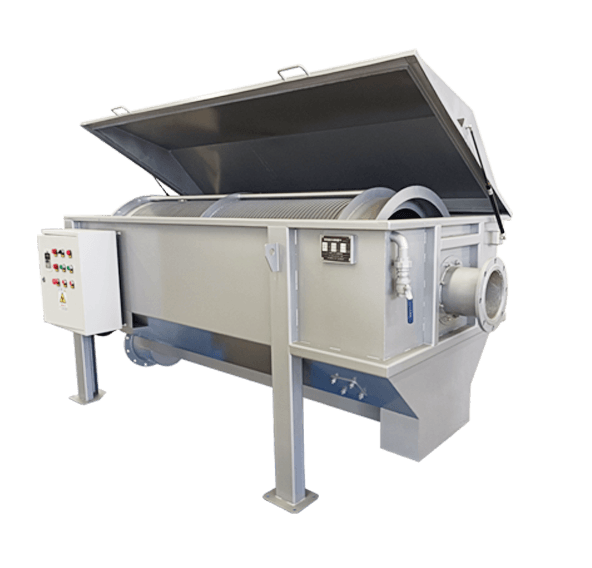
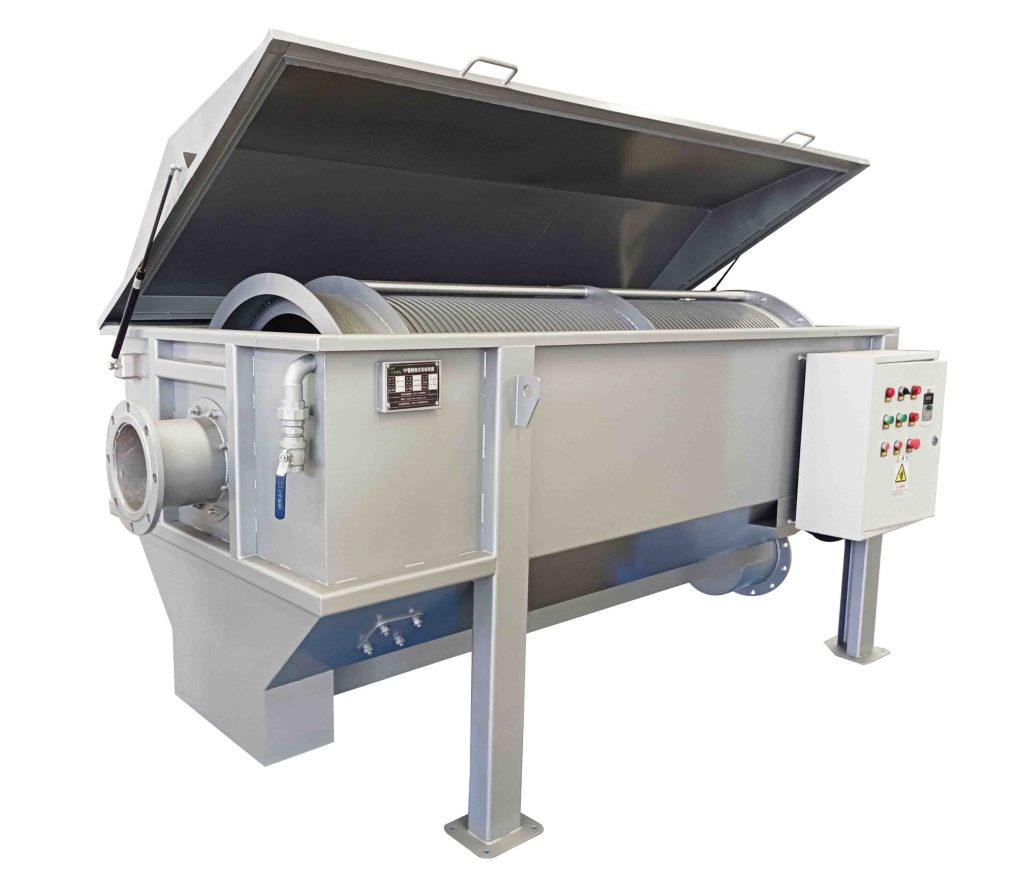
A drum filter is a rotating mechanical filtration device that removes suspended solids from water or wastewater.
The system consists of:
- Rotating drum
- Filter mesh or screen panels
- Internal support structure
- Backwash system
- Drive motor
- Control panel
Wastewater flows through the filter media.
Suspended solids remain on the screen surface.
Clean water passes through the mesh and exits the system.
As solids accumulate, the filter automatically initiates cleaning cycles.
How a Drum Filter Works
Step 1 – Filtration
Wastewater enters the drum.
The water passes through the filter mesh.
Particles larger than the mesh opening remain on the screen surface.
The filtration process occurs continuously.
Step 2 – Solids Accumulation
As solids accumulate, flow resistance increases.
The water level inside the drum begins to rise.
Level sensors monitor this condition automatically.
Step 3 – Automatic Backwashing
Once a preset level is reached, the drum rotates.
High-pressure spray nozzles clean the filter surface.
Collected solids move into a sludge trough for removal.
Step 4 – Return to Normal Operation
After cleaning, the filtration cycle continues.
The process operates automatically with minimal operator intervention.
Main Types of Drum Filters
Internal Feed Drum Filters
Internal feed designs introduce wastewater inside the drum.
Water flows outward through the screen surface.
Advantages include:
- Compact design
- Efficient cleaning
- Lower splash potential
This configuration is common in municipal wastewater applications.
External Feed Drum Filters
External feed systems introduce wastewater onto the outside surface of the drum.
Water flows inward through the screen.
Advantages include:
- Easier inspection
- Simple maintenance access
These systems are common in industrial treatment applications.
Rotary Drum Micro-Screens
Micro-screen drum filters utilize finer mesh openings.
Typical filtration ranges include:
- 10 μm
- 20 μm
- 40 μm
- 60 μm
These units are frequently used for tertiary treatment and water reuse systems.
Drum Filter Applications
Municipal Wastewater Treatment
Municipal treatment plants commonly use drum filters for:
- Primary filtration
- Secondary effluent polishing
- Tertiary treatment
- Water reuse projects
Drum filters effectively reduce suspended solids before disinfection or advanced treatment processes.
Industrial Wastewater Treatment
Industrial facilities use drum filters in:
- Food processing plants
- Textile factories
- Pulp and paper mills
- Chemical manufacturing facilities
- Slaughterhouses
The technology performs particularly well when wastewater contains fibers, suspended solids, and floating debris.
Water Reuse Projects
Water reuse systems often require low suspended solids concentrations.
Drum filters provide effective pretreatment before:
- UV disinfection
- Membrane filtration
- Reverse osmosis
- Advanced oxidation processes
Project Example – Southeast Asia Food Processor
A seafood processing facility discharged wastewater containing scales, tissue particles, and suspended solids.
The existing screening system removed only large debris.
Engineers installed a 60 μm drum filter upstream of the DAF system.
TSS loading decreased significantly and DAF chemical consumption dropped by approximately 18%.
Drum Filter vs Sedimentation
Performance Comparison
| Factor | Drum Filter | Sedimentation Tank |
|---|---|---|
| Footprint | Small | Large |
| Startup Time | Minutes | Hours |
| Automation | High | Moderate |
| TSS Removal | High | Moderate |
| Space Requirement | Low | High |
| Capital Cost | Moderate | Moderate |
| Maintenance | Low | Low |
When Drum Filters Perform Better
Drum filters generally perform better when:
- Space is limited
- Rapid startup is required
- Solids are fine
- Consistent effluent quality is important
When Sedimentation Still Makes Sense
Sedimentation remains effective when:
- Land is inexpensive
- Solids settle easily
- Energy consumption must be minimized
The correct choice depends on project objectives.
Drum Filter vs Disc Filter
Many engineers compare drum filters and disc filters during project planning.
Key Differences
| Feature | Drum Filter | Disc Filter |
|---|---|---|
| Filtration Area | Moderate | Large |
| Footprint | Moderate | Small |
| Tertiary Filtration | Good | Excellent |
| Municipal Reuse | Good | Excellent |
| Mechanical Complexity | Lower | Higher |
| Expansion Flexibility | Moderate | High |
Disc filters often dominate tertiary filtration applications.
Drum filters remain attractive because of their simplicity and lower investment cost.
Project Example – Eastern Europe Municipal Plant
A municipal wastewater treatment facility required tertiary filtration before UV disinfection.
Initial designs considered sand filtration.
Space limitations created challenges.
Engineers selected drum filters instead.
The installation achieved target TSS levels while reducing construction requirements substantially.
Key Design Parameters
Flow Rate
Flow rate remains the primary sizing parameter.
Design calculations should include:
- Average flow
- Peak flow
- Future expansion requirements
Oversizing increases investment costs.
Undersizing creates hydraulic limitations.
Mesh Opening Size
Mesh selection directly affects performance.
| Mesh Size | Typical Application |
|---|---|
| 10–20 μm | Water reuse |
| 20–60 μm | Tertiary treatment |
| 60–100 μm | Secondary polishing |
| 100–500 μm | Primary screening |
Smaller openings improve filtration but increase cleaning frequency.
Solids Loading
Suspended solids concentration influences:
- Filter area
- Backwash frequency
- Sludge production
Accurate wastewater characterization is essential.
Common Design Mistakes
Selecting Extremely Fine Mesh
Many buyers assume finer mesh always produces better results.
This is not always true.
Very fine screens increase cleaning frequency and operational costs.
Ignoring Peak Flow Conditions
Average flow data alone can be misleading.
Stormwater events and industrial discharge peaks often determine final equipment sizing.
Inadequate Sludge Collection
Filtration removes solids successfully.
Poor sludge handling can still create operational problems.
The solids collection system deserves equal attention during design.
Project Example – Middle East Industrial Facility
An industrial wastewater project selected an extremely fine 15 μm mesh.
Backwash frequency increased dramatically during operation.
Water consumption rose beyond design expectations.
Engineers later switched to a 40 μm mesh.
Treatment performance remained acceptable while operating costs decreased.
Engineering Perspective
Many treatment plants immediately focus on filtration accuracy.
Accuracy matters.
Hydraulic loading and solids characteristics often matter more.
I have seen facilities install extremely fine filtration systems that delivered little operational benefit.
Meanwhile, properly sized filters with moderate mesh openings often achieve better overall economics.
Successful filtration projects balance performance, reliability, and operating cost.
That balance usually produces better long-term results than pursuing the smallest possible mesh size.
Drum Filter Selection Checklist
Wastewater Evaluation
- Measure TSS concentration
- Determine particle size distribution
- Analyze flow variations
- Review discharge requirements
- Evaluate future expansion needs
Equipment Design
- Select mesh size
- Calculate filtration area
- Verify hydraulic capacity
- Review backwash design
- Confirm sludge handling arrangement
Procurement Review
- Verify material selection
- Check automation features
- Review spare parts availability
- Confirm local service support
- Evaluate lifecycle cost
Frequently Asked Questions
General Questions
What is a drum filter used for in wastewater treatment?
A drum filter removes suspended solids through mechanical filtration and is commonly used for primary, secondary, or tertiary treatment applications.
How much suspended solids can a drum filter remove?
Typical TSS removal ranges from 50% to 85%, depending on mesh size and wastewater characteristics.
Can drum filters replace clarifiers?
In some applications, yes. However, the final decision depends on treatment objectives and wastewater characteristics.
Operation Questions
How often do drum filters require cleaning?
Most systems perform automatic cleaning continuously or as needed based on differential water level.
What mesh size should be selected?
The optimal mesh size depends on treatment goals. Common wastewater applications use screens between 20 μm and 100 μm.
Conclusion
Drum filters provide reliable and efficient suspended solids removal for municipal and industrial wastewater treatment.
Their compact footprint, automatic operation, and flexible filtration performance make them attractive alternatives to conventional separation processes.
Successful drum filter projects depend on proper sizing, mesh selection, solids characterization, and hydraulic design.
When correctly applied, drum filters improve water quality, reduce downstream loading, and support advanced treatment processes.
Need Help Selecting a Drum Filter?
Morvolous provides rotary drum filters, micro-screen filtration systems, disc filters, and complete wastewater treatment solutions for municipal and industrial facilities.
Contact our engineering team to discuss your filtration requirements.
About the Author
Morvolous Engineering Team
Morvolous specializes in wastewater filtration, sludge treatment, and advanced water reuse technologies. Our engineers support customers worldwide with equipment selection, process design, and system optimization.