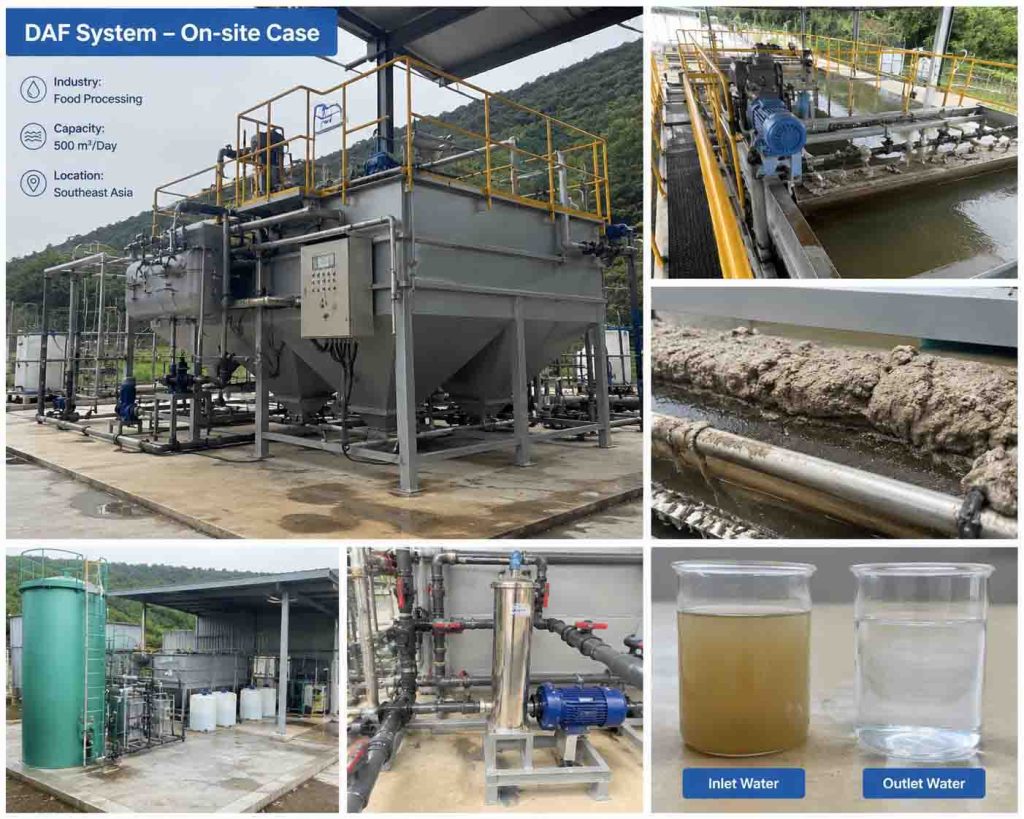
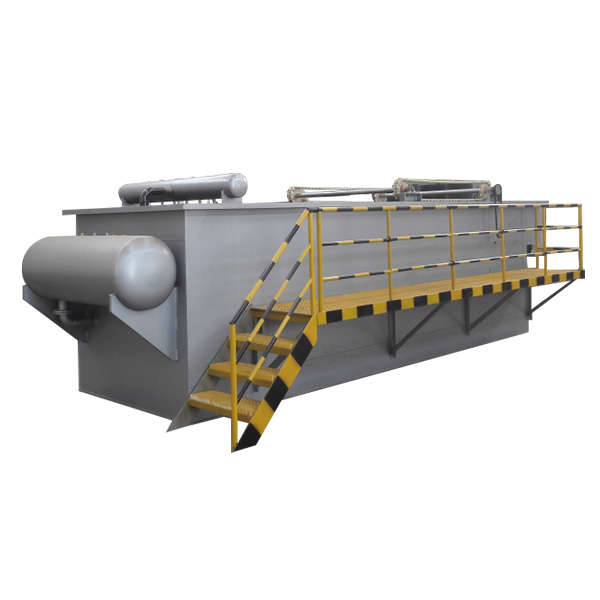
Dissolved Air Flotation (DAF) is a common wastewater treatment process. It helps remove suspended solids, oil, grease, fats, and other light particles from wastewater.
A DAF system uses small air bubbles to lift these pollutants to the water surface. A scraper then removes the floating sludge from the tank.
DAF systems work especially well when wastewater contains a high level of suspended solids, fats, oils, and grease. In addition, they can remove fine particles that may not settle well in a conventional sedimentation tank.
Today, DAF systems are widely used in food processing, slaughterhouses, dairy plants, livestock farms, petrochemical facilities, textile factories, and other industrial wastewater treatment plants.
This guide explains how a DAF system works, where it can be used, and what you should consider when selecting a system for your wastewater treatment project.
Quick Reference — DAF System
| Parameter | Typical Value |
|---|---|
| Technology | Dissolved Air Flotation |
| Main Function | Solid-Liquid Separation |
| Typical Flow Capacity | 1–500 m³/h |
| Suspended Solids Removal | Up to 90–99%* |
| Oil & Grease Removal | Up to 90–99%* |
| Air System | Dissolved Air / Recycle Water |
| Chemical Conditioning | PAC / PAM / Other Coagulants |
| Operation | Continuous |
| Automation | Manual / Automatic / PLC |
| Tank Material | Carbon Steel / SS304 / SS316L |
| Typical Application | Municipal & Industrial Wastewater |
*Actual removal efficiency depends on wastewater quality, chemical dosing, hydraulic loading, and system design.
What Is a DAF System?
DAF stands for Dissolved Air Flotation.
A DAF system separates suspended solids and other pollutants from wastewater by using small air bubbles.
The treatment process usually includes:
- Coagulation
- Flocculation
- Dissolved air flotation
- Sludge collection
- Treated water discharge
During the flotation process, air bubbles attach to suspended particles and chemical flocs. As a result, these particles become lighter and rise to the water surface.
A scraper then collects the floating sludge.
How Does a DAF System Work?
Step 1 – Wastewater Inlet
First, wastewater enters the DAF system.
If the wastewater contains large solids, a screen or other pretreatment equipment should remove them before the DAF unit.
This step protects the flotation system and improves overall performance.
Step 2 – Coagulation
Next, the system adds a coagulant such as PAC or ferric chloride.
The chemical helps destabilize small suspended particles. As a result, these particles can join together more easily.
Step 3 – Flocculation
After coagulation, the wastewater enters the flocculation section.
The system may add PAM or another flocculant to form larger flocs.
Gentle mixing helps the particles join together. At the same time, it avoids breaking the newly formed flocs.
Step 4 – Dissolved Air Injection
The DAF system takes part of the treated water and sends it to a recycle pump.
The pump pressurizes this water and mixes it with air.
When the pressurized water enters the flotation tank, the pressure drops. Therefore, the dissolved air forms many small bubbles.
Step 5 – Flotation
The small air bubbles attach to the suspended solids, oil droplets, and chemical flocs.
The particles then become lighter than water and move upward.
They collect at the surface of the flotation tank.
Step 6 – Sludge Scraping
A mechanical scraper moves across the water surface.
It pushes the floating sludge into a collection area.
The system then sends the collected sludge to further treatment or dewatering.
Step 7 – Treated Water Discharge
After flotation, the clarified water leaves the DAF tank.
The treated water can then move to the next treatment stage.
For example, a wastewater treatment plant may send the water to biological treatment, MBR, or another filtration process.
Main Components of a DAF System
A complete DAF system may include:
- DAF flotation tank
- Recycle water pump
- Air compressor
- Pressure vessel
- Air release system
- Chemical dosing system
- Flocculation tank
- Sludge scraper
- Sludge collection system
- Treated water outlet
- PLC control cabinet
The exact configuration depends on the wastewater quality, flow rate, and treatment target.
Why Is DAF Used in Wastewater Treatment?
DAF works well when wastewater contains pollutants that do not settle easily.
Typical pollutants include:
- Suspended solids
- Oil
- Grease
- Fats
- Fibers
- Algae
- Lightweight organic particles
- Chemical flocs
Unlike conventional sedimentation, DAF can quickly lift light particles to the water surface.
Therefore, it can reduce the load on downstream treatment equipment.
Typical DAF Applications
Food Processing Wastewater
Food processing wastewater often contains:
- Fats
- Oils
- Grease
- Proteins
- Suspended solids
- Organic matter
DAF can remove a large amount of these pollutants before biological treatment.
As a result, the biological system receives a lower pollutant load.
Slaughterhouse Wastewater
Slaughterhouse wastewater may contain blood, fat, tissue particles, and suspended solids.
DAF provides an effective way to remove these materials before biological treatment.
Project Example
A slaughterhouse installed a DAF system after screening and equalization.
The system used PAC and PAM to improve floc formation before flotation.
As a result, the DAF removed a large amount of suspended solids and fats. This reduced the organic load entering the biological treatment stage.
Dairy Wastewater
Dairy wastewater often contains milk solids, fat, protein, and suspended solids.
DAF can remove these pollutants before biological treatment.
In particular, the flotation process works well for fats and other light organic particles.
Livestock and Pig Farm Wastewater
Livestock wastewater can contain high levels of suspended solids and organic matter.
DAF can help reduce these pollutants after screening or solid-liquid separation.
For pig farm wastewater, a possible treatment process is:
Screening → Solid-Liquid Separation → DAF → Biological Treatment → MBR / Clarification
The actual process should depend on the wastewater quality and required discharge standard.
Industrial Wastewater
DAF systems also work well in many industrial applications, including:
- Textile wastewater
- Paper and pulp wastewater
- Petrochemical wastewater
- Chemical wastewater
- Metal processing wastewater
- Mining wastewater
Each industry has different wastewater characteristics. Therefore, the chemical dosing and DAF design may also differ.
DAF vs Sedimentation
| Parameter | DAF | Sedimentation |
|---|---|---|
| Separation Principle | Air Flotation | Gravity Settling |
| Lightweight Solids | Excellent | Limited |
| Oil & Grease | Excellent | Limited |
| Footprint | Compact | Larger |
| Separation Speed | Fast | Slower |
| Chemical Conditioning | Often Used | Often Used |
| Typical Application | FOG & Lightweight Solids | Settleable Solids |
DAF is often a better choice when wastewater contains oil, grease, or lightweight particles.
Sedimentation, however, can work well for heavier particles that settle easily.
DAF vs Other Pretreatment Technologies
| Technology | Main Function | Typical Application |
|---|---|---|
| Screening | Remove Large Solids | Municipal & Industrial |
| Grit Removal | Remove Sand & Grit | Municipal |
| Sedimentation | Remove Settleable Solids | Municipal & Industrial |
| DAF | Remove FOG & Fine Solids | Food & Industrial |
| MBR | Biological + Membrane Separation | Advanced Treatment |
| Disc Filter | Fine Particle Filtration | Tertiary Treatment |
These technologies often work together rather than replace each other.
For example, a treatment plant may use screening first, followed by DAF and biological treatment.
Advantages of DAF Systems
High Suspended Solids Removal
DAF can remove fine suspended particles that may not settle well.
Therefore, it can provide effective pretreatment for many industrial wastewater systems.
Excellent Oil and Grease Removal
The flotation process works especially well for fats, oils, and grease.
As a result, DAF is widely used in food processing, dairy, and slaughterhouse wastewater treatment.
Compact Footprint
DAF systems can provide high treatment capacity in a relatively small area.
This feature makes them useful when an existing treatment plant has limited space.
Fast Separation
DAF can separate suspended particles faster than many conventional settling processes.
Therefore, the system can reduce the required treatment area.
Flexible Chemical Conditioning
Operators can adjust PAC, ferric chloride, PAM, and other chemicals according to wastewater conditions.
Proper dosing improves floc formation and flotation performance.
Limitations of DAF
Chemical Consumption
Many DAF systems use coagulants and polymers.
Therefore, chemical costs should be included when comparing different treatment technologies.
Sludge Production
DAF removes pollutants from water, but these pollutants become flotation sludge.
The plant must therefore provide suitable sludge storage, treatment, and disposal equipment.
Operation and Adjustment
Modern DAF systems can run automatically.
However, operators still need to check chemical dosing, air pressure, water flow, and sludge removal during commissioning and routine operation.
Air System Maintenance
The recycle pump, air compressor, pressure vessel, valves, and air release components require regular inspection.
Routine maintenance helps keep the flotation process stable.
Chemical Dosing in DAF
Chemical conditioning often plays an important role in DAF performance.
| Chemical | Main Function |
|---|---|
| PAC | Coagulation |
| Ferric Chloride | Coagulation & Phosphorus Removal |
| PAM | Flocculation |
| Sodium Hydroxide | pH Adjustment |
| Sulfuric Acid | pH Adjustment |
The correct chemical combination depends on the wastewater.
For this reason, jar testing is recommended before finalizing the chemical dosage.
Design Considerations
Hydraulic Loading
The DAF system should match:
- Average flow
- Peak flow
- Hydraulic loading
- Surface loading rate
- Required retention time
Peak flow is especially important.
If the plant only considers average flow, the DAF may become overloaded during high-flow periods.
Air-to-Solids Ratio
The air-to-solids ratio affects flotation performance.
Too little air may produce poor flotation. On the other hand, too much air can increase energy use without improving removal.
Therefore, engineers should select the air supply based on actual wastewater conditions.
Recycle Ratio
A portion of treated water normally returns to the DAF recycle system.
The recycle pump pressurizes this water and mixes it with air.
The correct recycle ratio depends on the wastewater and the required treatment performance.
Chemical Dosage
PAC and PAM dosage should be determined through laboratory testing.
During commissioning, operators can further adjust the dosage according to actual treatment results.
This approach helps avoid both underdosing and chemical waste.
Common DAF Design Mistakes
Using DAF Without Adequate Pretreatment
Large solids can damage or block parts of the DAF system.
Therefore, screening should be installed upstream when necessary.
Incorrect Chemical Dosage
Low chemical dosage can produce weak flocs.
Excessive dosage, however, increases chemical costs and may create more sludge.
Proper testing and adjustment can help find the right dosage.
Ignoring Sludge Handling
The DAF system continuously collects flotation sludge.
Therefore, the plant should plan the sludge treatment system at the same time as the DAF system.
Possible equipment includes screw presses, belt filter presses, and decanter centrifuges.
Designing Only for Average Flow
Wastewater flow can change throughout the day.
Peak flow may place much higher hydraulic loading on the DAF.
For this reason, engineers should check both average and peak flow conditions.
DAF Sludge Treatment
DAF sludge often contains high levels of suspended solids and organic matter.
The plant can use different technologies to further reduce its water content.
Common options include:
- Screw press
- Belt filter press
- Decanter centrifuge
- Sludge drying
- Composting
- Anaerobic digestion
For many food processing and livestock wastewater projects, a DAF + screw press system provides a practical solution.
The DAF first removes suspended solids and FOG. Then, the screw press dewaters the collected sludge.
This combination can reduce sludge volume and make transportation and disposal easier.
DAF System Automation
Modern DAF systems can use PLC-based automatic control.
Typical functions include:
- Pump start/stop
- Recycle water control
- Air compressor control
- Chemical dosing control
- Sludge scraper control
- Water level monitoring
- Fault alarms
- Automatic operating sequences
In addition, the PLC can connect with a SCADA system.
This allows operators to monitor important operating data from a central control room.
Maintenance Requirements
Regular maintenance helps keep the DAF system working efficiently.
Routine Checks
Operators should check:
- Chemical dosing
- Pump operation
- Air pressure
- Water level
- Sludge scraper operation
- Flotation condition
Periodic Maintenance
Maintenance teams should also:
- Clean air release components
- Inspect the recycle pump
- Check the scraper mechanism
- Inspect valves and pipelines
- Calibrate instruments
- Check chemical dosing pumps
As a result, regular maintenance can reduce unexpected downtime.
Engineering Perspective
DAF performance depends on the complete treatment process, not only the flotation tank.
Pretreatment, coagulation, flocculation, chemical dosing, air saturation, hydraulic loading, and sludge removal all affect the final result.
Therefore, engineers should evaluate the complete process before selecting a DAF system.
Wastewater testing and jar testing can also provide useful data before equipment selection.
For larger or more complex projects, pilot testing can help confirm the expected treatment performance.
DAF System Selection Checklist
Process Evaluation
- Determine wastewater flow
- Analyze suspended solids
- Measure oil and grease
- Check COD and BOD
- Review pH
- Identify wastewater variability
Equipment Selection
- Determine DAF capacity
- Select tank configuration
- Size the recycle pump
- Select the air saturation system
- Design the chemical dosing system
- Confirm the sludge removal method
Procurement Review
- Compare energy consumption
- Review chemical requirements
- Verify material compatibility
- Confirm automation functions
- Check maintenance requirements
- Evaluate technical support
Frequently Asked Questions
What does DAF stand for?
DAF stands for Dissolved Air Flotation.
It uses small air bubbles to separate suspended particles and other pollutants from wastewater.
What does a DAF system remove?
A DAF system can remove suspended solids, oil, grease, fats, fibers, algae, and other light particles.
The actual removal efficiency depends on wastewater quality and system design.
Does DAF require chemicals?
Many DAF systems use coagulants and polymers to improve floc formation.
However, the exact chemical requirements depend on the wastewater characteristics.
Is DAF suitable for pig farm wastewater?
Yes.
DAF can reduce suspended solids, fats, and organic loading in pig farm wastewater.
It can also work as part of a larger treatment process before biological treatment.
What happens to DAF sludge?
The plant can send DAF sludge to further treatment.
For example, a screw press, belt filter press, or decanter centrifuge can dewater the sludge.
The final disposal method depends on local regulations and the characteristics of the sludge.
Conclusion
DAF is an effective wastewater treatment technology for removing suspended solids, oil, grease, fats, and other light particles.
Its compact design and fast separation make it useful for food processing, slaughterhouses, dairy plants, livestock farms, and many industrial wastewater applications.
However, good DAF performance requires more than a flotation tank.
Proper screening, chemical dosing, flocculation, air saturation, hydraulic design, and sludge handling all play an important role.
With the right design and commissioning, a DAF system can reduce the pollutant load before biological treatment and improve the overall performance of a wastewater treatment plant.
Need Help Selecting a DAF System?
Morvolous provides DAF systems, chemical dosing equipment, PE dosing tanks, sludge dewatering equipment, MBR systems, UF and RO systems, and complete wastewater treatment solutions.
Our engineering team can evaluate your wastewater quality, treatment capacity, and discharge requirements.
Based on these conditions, we can recommend a suitable DAF system and complete treatment process.
About the Author
Morvolous Engineering Team
Morvolous specializes in wastewater treatment equipment, sludge dewatering, chemical dosing, membrane filtration, and complete wastewater treatment solutions.
Our team provides customized engineering support for municipal, industrial, and livestock wastewater treatment projects worldwide.