Learn how screw press sludge dewatering machines reduce sludge volume, lower disposal costs, and provide continuous sludge treatment for municipal, industrial, food processing, and livestock wastewater.
Sludge is an unavoidable part of many wastewater treatment processes. After biological treatment, DAF, sedimentation, or MBR treatment, the plant still needs to manage the remaining sludge.
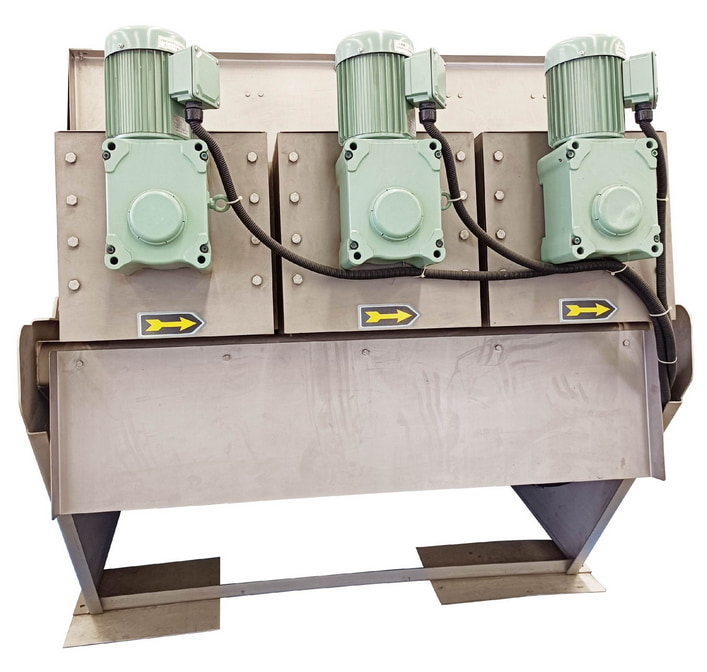
A screw press sludge dewatering machine removes water from sludge through a slow rotating screw and a filter screen. The machine produces a drier sludge cake while allowing separated water to return to the wastewater treatment process.
Compared with some traditional dewatering equipment, a screw press can provide continuous operation with relatively low energy use and simple maintenance.
For this reason, screw press dewatering machines are widely used in municipal wastewater plants, food processing factories, slaughterhouses, dairy plants, livestock farms, and industrial wastewater treatment systems.
This guide explains how a screw press works, its main components, typical applications, advantages, limitations, and the key points to consider when selecting a sludge dewatering machine.
Quick Reference — Screw Press Sludge Dewatering Machine
| Parameter | Typical Value |
|---|---|
| Technology | Screw Press Sludge Dewatering |
| Main Function | Sludge Thickening & Dewatering |
| Operation | Continuous |
| Sludge Type | Municipal / Industrial / Biological / DAF Sludge |
| Typical Feed Solids | 0.5–5%* |
| Typical Cake Solids | 15–30%* |
| Polymer Dosing | Usually Required |
| Energy Consumption | Low |
| Automation | Automatic / PLC |
| Installation | Indoor / Outdoor |
| Typical Application | Municipal & Industrial Wastewater |
*Actual values depend on sludge type, polymer dosage, feed concentration, and machine design.
What Is a Screw Press Sludge Dewatering Machine?
A screw press is a mechanical machine that separates water from sludge.
The sludge enters the machine through the feed section. A rotating screw then moves the sludge forward inside a filter screen.
As the sludge moves toward the outlet, the machine gradually increases pressure.
Water passes through the small openings in the screen. At the same time, the screw pushes the concentrated sludge toward the discharge outlet.
The result is a sludge cake with a lower water content.
How Does a Screw Press Work?
Step 1 – Sludge Feeding
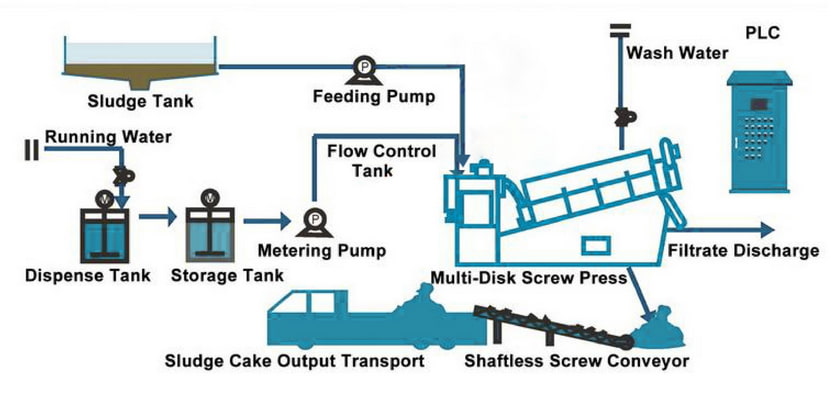
First, a sludge pump sends sludge into the screw press.
The feed sludge may come from:
- DAF
- Secondary clarifier
- MBR
- Biological treatment
- Anaerobic treatment
- Industrial wastewater treatment
The feed concentration depends on the upstream process.
Step 2 – Polymer Dosing
Next, the system adds polymer to the sludge.
The polymer helps small sludge particles join together and form larger flocs.
Good floc formation improves water separation and helps the screw press produce a better sludge cake.
Step 3 – Sludge Flocculation
After polymer dosing, the sludge enters a mixing or flocculation section.
Gentle mixing allows the polymer to react with the sludge.
The goal is to create strong flocs without breaking them apart.
Step 4 – Gravity Thickening
The conditioned sludge enters the main screw press section.
At the beginning, the screw moves slowly through the filter screen.
Free water drains through the screen by gravity.
As a result, the sludge becomes more concentrated.
Step 5 – Mechanical Dewatering
The screw continues to move the thickened sludge forward.
The gap between the screw flights and the filter section creates increasing pressure.
More water leaves the sludge during this stage.
Step 6 – Sludge Cake Discharge
Finally, the screw pushes the dewatered sludge toward the outlet.
An adjustable back-pressure plate controls the discharge resistance.
The machine then produces a relatively dry sludge cake.
Main Components of a Screw Press
A complete screw press sludge dewatering system may include:
- Sludge feed pump
- Polymer preparation system
- Polymer dosing pump
- Flocculation tank
- Screw press body
- Screw shaft
- Filter screen
- Drive motor
- Gear reducer
- Back-pressure plate
- Filtrate collection tank
- PLC control cabinet
The exact configuration depends on the sludge characteristics and required capacity.
What Types of Sludge Can a Screw Press Treat?
Screw presses can treat many types of wastewater sludge.
Common examples include:
Municipal Sludge
Municipal wastewater plants produce biological sludge and secondary sludge.
A screw press can continuously dewater this sludge before transportation or disposal.
DAF Sludge
DAF systems remove suspended solids, fats, oils, and grease from wastewater.
The collected DAF sludge often contains a high amount of water.
A screw press can reduce its water content before further treatment.
MBR Sludge
MBR systems maintain a high concentration of activated sludge.
Part of this sludge must leave the system to maintain stable operation.
A screw press can provide continuous dewatering for the excess sludge.
Livestock Sludge
Pig farms and other livestock facilities can produce large amounts of wastewater sludge.
A typical process may include:
Solid-Liquid Separation → DAF → Biological Treatment → Sludge Thickening → Screw Press
The actual process depends on the wastewater characteristics and project requirements.
Screw Press vs Belt Filter Press
| Parameter | Screw Press | Belt Filter Press |
|---|---|---|
| Operation | Continuous | Continuous |
| Energy Consumption | Low | Moderate |
| Water Consumption | Low | Higher |
| Odor Control | Easier | Requires More Attention |
| Footprint | Compact | Larger |
| Noise | Low | Moderate |
| Maintenance | Relatively Simple | More Maintenance |
| Operator Requirement | Low | Moderate |
| Typical Application | Municipal & Industrial | Municipal & Industrial |
A screw press is often a good option when the plant wants low energy use, low wash-water consumption, and simple operation.
However, a belt filter press may be suitable for certain high-capacity applications.
Screw Press vs Centrifuge
| Parameter | Screw Press | Centrifuge |
|---|---|---|
| Energy Consumption | Low | Higher |
| Noise | Low | Higher |
| Water Consumption | Low | Low |
| Operation | Continuous | Continuous |
| Maintenance | Simple | More Complex |
| Footprint | Compact | Compact |
| High-Speed Rotation | No | Yes |
| Operator Skill | Lower | Higher |
The best choice depends on sludge characteristics, capacity, required cake dryness, and operating budget.
Advantages of Screw Press Sludge Dewatering
Low Energy Consumption
The screw rotates at a relatively low speed.
Therefore, the machine usually requires less energy than high-speed dewatering equipment.
Low Water Consumption
Many screw presses do not require continuous large-volume washing water.
This can reduce operating water use.
Continuous Operation
The screw press can continuously receive sludge and discharge sludge cake.
As a result, it works well for automated wastewater treatment plants.
Compact Design
A screw press combines several dewatering stages in one machine.
Therefore, it can save installation space.
Simple Maintenance
The machine has fewer high-speed rotating components than a centrifuge.
Routine inspection and cleaning are relatively simple.
Low Noise
The screw operates at a low speed.
As a result, the equipment generally produces less noise during operation.
Limitations of Screw Press Systems
Polymer Is Usually Required
Most sludge types need polymer conditioning before entering the screw press.
Therefore, polymer consumption should be included in the operating cost.
Cake Dryness Depends on Sludge Type
Different sludge types produce different cake solids.
For example, biological sludge may behave differently from DAF sludge.
Therefore, actual dewatering performance should be confirmed through testing.
Screen Cleaning Is Important
Fine particles can build up on the filter screen.
Regular cleaning helps maintain stable filtration and dewatering performance.
Polymer Dosing for Screw Press
Polymer plays an important role in sludge dewatering.
Without proper conditioning, fine sludge particles may pass through the filter screen or form a weak sludge cake.
A typical polymer system includes:
- Polymer preparation tank
- Agitator
- Polymer dosing pump
- Sludge flow meter
- Mixing section
The polymer dosage should match the sludge characteristics.
Too little polymer may result in poor floc formation.
On the other hand, excessive polymer increases operating costs and may not improve dewatering.
Therefore, jar testing or field testing is recommended before finalizing the dosage.
Screw Press Applications
Food Processing Wastewater
Food factories often produce sludge with high organic content.
A screw press can help reduce sludge volume after biological treatment or DAF.
Slaughterhouse Wastewater
Slaughterhouse wastewater can contain large amounts of organic solids, fat, and suspended matter.
A common treatment process is:
Screening → DAF → Biological Treatment → Sludge Dewatering
The screw press can handle sludge from the DAF or biological treatment stages.
Dairy Wastewater
Dairy wastewater contains milk solids, proteins, fats, and other organic matter.
DAF can first remove fats and suspended solids.
The resulting sludge can then enter a screw press for dewatering.
Livestock Wastewater
Livestock wastewater often contains high levels of organic solids.
A screw press can reduce sludge volume and make transportation easier.
For pig farms, it can also work as part of a complete manure and wastewater treatment system.
Municipal Wastewater
Municipal wastewater treatment plants produce large quantities of biological sludge.
A screw press can provide continuous dewatering before sludge transportation, drying, composting, or disposal.
Screw Press in a Complete Wastewater Treatment Process
A screw press usually works as part of a larger treatment system.
For example, an industrial wastewater plant may use:
Screening → Equalization → DAF → Biological Treatment → MBR → Sludge Thickening → Screw Press
Another livestock wastewater project may use:
Solid-Liquid Separation → DAF → Biological Treatment → Sludge Dewatering
The final process depends on the wastewater quality and discharge requirements.
Design Considerations
Sludge Flow Rate
The first step is to determine the amount of sludge generated each day.
Engineers should consider:
- Average sludge flow
- Peak sludge flow
- Operating hours
- Feed concentration
- Dry solids loading
Sludge Concentration
Feed sludge concentration has a major effect on machine selection.
Higher solids concentration can reduce the required feed volume.
However, very thick sludge may require additional pumping equipment.
Polymer Dosage
Polymer demand depends on:
- Sludge type
- Sludge concentration
- Organic content
- Target cake dryness
- Polymer type
Testing can help determine the most suitable dosage.
Cake Disposal
The plant should also consider how it will handle the dewatered sludge cake.
Possible options include:
- Land application
- Composting
- Drying
- Incineration
- Disposal
- Further treatment
Local regulations should determine the final disposal method.
Common Screw Press Design Mistakes
Selecting the Machine Only by Flow Rate
Sludge dewatering equipment should not be selected based only on wastewater flow.
The amount of dry solids is equally important.
For this reason, engineers should calculate the dry solids loading before selecting the machine.
Ignoring Sludge Characteristics
Two plants with the same flow rate may produce very different sludge.
Therefore, sludge testing is important before equipment selection.
Incorrect Polymer Dosage
Poor polymer dosing can reduce floc strength and increase polymer costs.
Operators should adjust the dosage according to actual sludge conditions.
Not Planning Filtrate Return
The separated water returns to the wastewater treatment process.
Therefore, the plant should consider the additional hydraulic and pollutant load created by filtrate.
Automation and Control
Modern screw press systems can operate automatically.
A PLC control system can manage:
- Sludge pump
- Polymer dosing pump
- Polymer preparation
- Screw motor
- Flushing system
- Sludge level
- Alarm functions
The system can also stop automatically when the sludge level is too low or when a fault occurs.
SCADA integration can provide remote monitoring and data recording.
Maintenance
Regular maintenance helps maintain stable dewatering performance.
Routine Checks
Operators should check:
- Sludge feed
- Polymer dosing
- Screw rotation
- Filter screen condition
- Sludge cake
- Filtrate quality
- Motor operation
Periodic Maintenance
Maintenance teams should:
- Clean the filter screen
- Inspect the screw shaft
- Check the gearbox
- Inspect bearings
- Check pumps
- Calibrate instruments
- Inspect the back-pressure plate
Early maintenance can reduce unexpected downtime.
How to Improve Dewatering Performance
Optimize Polymer Dosage
Start with laboratory testing and then adjust the dosage during commissioning.
Maintain Stable Sludge Feed
Large changes in sludge flow can affect dewatering performance.
A stable feed helps the screw press operate more efficiently.
Keep the Filter Screen Clean
A clean screen allows filtrate to pass through more easily.
Therefore, regular flushing and cleaning are important.
Adjust Back Pressure
The back-pressure plate affects the final sludge cake.
Higher pressure may increase cake dryness, but excessive pressure can overload the machine.
Operators should adjust the setting based on actual sludge performance.
Engineering Perspective
Screw press dewatering is a practical solution for many wastewater treatment plants.
However, the machine itself is only one part of the dewatering process.
Polymer preparation, sludge concentration, feed control, screen cleaning, and cake handling all affect the final result.
Therefore, engineers should evaluate the complete sludge treatment process before selecting equipment.
A properly designed screw press system can reduce sludge volume, simplify transportation, lower water use, and support more efficient wastewater treatment plant operation.
Screw Press Selection Checklist
Process Evaluation
- Determine sludge flow
- Calculate dry solids loading
- Analyze sludge concentration
- Identify sludge type
- Define target cake solids
- Review disposal requirements
Equipment Selection
- Select screw press capacity
- Choose filter screen type
- Select sludge feed pump
- Design polymer dosing system
- Confirm flushing system
- Select PLC control
Procurement Review
- Compare energy consumption
- Review polymer consumption
- Check maintenance requirements
- Confirm spare parts
- Evaluate service support
- Review warranty conditions
Frequently Asked Questions
What is a screw press used for?
A screw press removes water from wastewater sludge.
It reduces sludge volume and produces a more concentrated sludge cake.
Does a screw press need polymer?
Most sludge types require polymer conditioning before dewatering.
The exact dosage depends on the sludge characteristics and should be confirmed through testing.
How dry is screw press sludge?
Typical sludge cake solids may fall within approximately 15–30%, but actual results vary with sludge type, feed concentration, polymer dosage, and machine settings.
Is a screw press suitable for pig farm wastewater?
Yes.
Screw presses can dewater sludge from livestock wastewater treatment systems.
They can work with DAF sludge, biological sludge, or other suitable sludge streams.
What is the difference between a screw press and a centrifuge?
A screw press operates at low speed and generally uses less energy.
A centrifuge uses high-speed rotation and can provide strong dewatering performance, but it often requires more energy and more skilled maintenance.
Conclusion
A screw press sludge dewatering machine provides a simple and efficient way to reduce water content in wastewater sludge.
Its low energy consumption, low water use, compact design, and continuous operation make it suitable for many municipal and industrial wastewater treatment applications.
However, good dewatering performance depends on more than machine capacity.
Sludge characteristics, polymer dosing, feed concentration, screen condition, and back-pressure settings all affect the final sludge cake.
With the right design and operating conditions, a screw press can reduce sludge volume and make sludge handling easier and more cost-effective.
Need Help Selecting a Screw Press?
Morvolous provides screw press sludge dewatering machines, DAF systems, chemical dosing equipment, PE dosing tanks, MBR systems, UF and RO systems, and complete wastewater treatment solutions.
Our engineering team can evaluate your sludge flow, solids concentration, wastewater characteristics, and treatment requirements.
Based on these conditions, we can recommend a suitable screw press and complete sludge treatment solution.
About the Author
Morvolous Engineering Team
Morvolous specializes in wastewater treatment equipment, sludge dewatering, chemical dosing, membrane filtration, and complete wastewater treatment solutions.
Our engineering team provides customized process design and equipment solutions for municipal, industrial, food processing, and livestock wastewater treatment projects worldwide.