
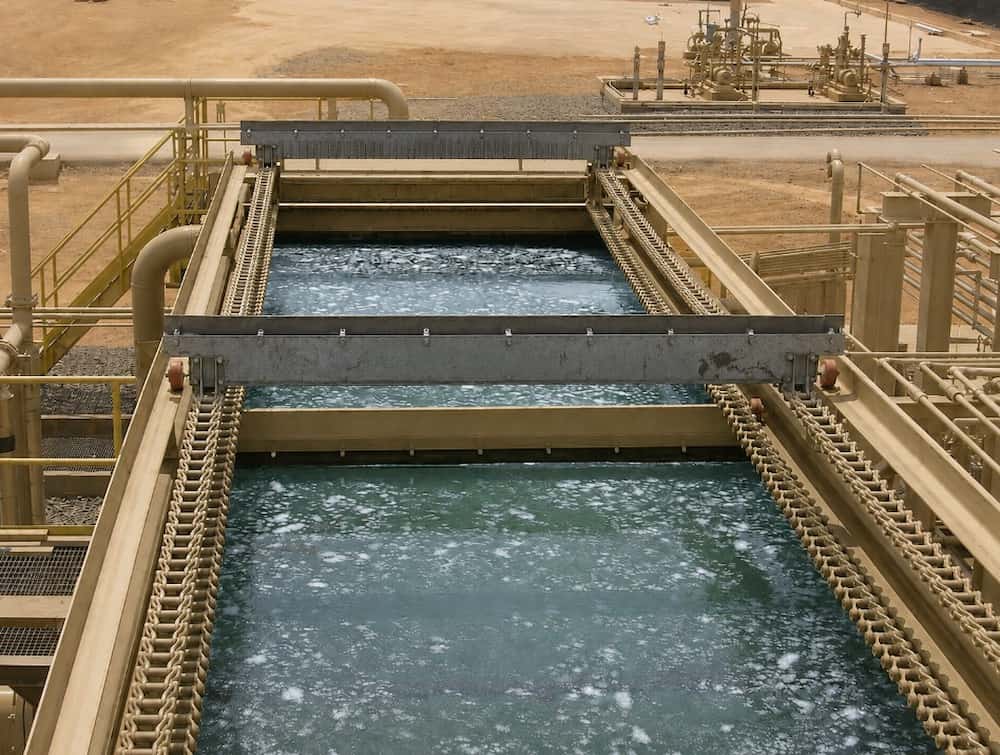
The separation physics, cost trade-offs, and feed characteristics that determine which technology wins — and where both fail
The choice between dissolved air flotation and a sedimentation clarifier is one of the most consequential decisions in wastewater treatment plant design. Get it right and you have a primary separation stage that reliably removes FOG, suspended solids, and chemical precipitates ahead of biological treatment. Get it wrong and you spend years trying to optimise a technology that was never suited to your feed characteristics in the first place. This comparison covers the physics of each technology and the feed conditions where each performs best. It also covers capital and operating cost differences, and the cases where the conventional industry choice is the wrong one.
The scope covers conventional sedimentation clarifiers — both radial flow and rectangular — and pressurised recycle DAF systems. Lamella settlers and dissolved air flotation thickeners are noted where relevant. The comparison applies primarily to primary clarification and industrial pretreatment applications, where the technology choice has the largest impact on downstream treatment performance.
For context on clarification technology selection within integrated treatment process design, the Water Environment Federation addresses both sedimentation and flotation in its design guidance, including performance benchmarks and loading rate criteria that provide a useful reference alongside the operational discussion here.
The Physics: Why One Technology Outperforms the Other
Understanding when DAF beats sedimentation — and when it does not — requires understanding what each technology actually does to the particles it is trying to separate.
Sedimentation: Gravity Pulls Particles Down
Sedimentation relies on particles being denser than water. Dense particles sink through the water column at a rate governed by Stokes’ Law. The rate is proportional to the square of particle diameter and the density difference between particle and water. Heavy, large particles settle quickly. Light, small particles settle slowly or not at all.
This is sedimentation’s fundamental constraint: it only works well when the target particles are reliably denser than water. Mineral suspended solids, heavy inorganic floc, and coagulated clay settle well. Fats, oils, greases, biological floc, algae, and light organic material settle poorly — some of these particles are actually less dense than water and float upward rather than settling. Trying to clarify a high-FOG feed in a sedimentation clarifier is working against the physics, not with it.
DAF: Bubbles Carry Particles Up
DAF attaches microbubbles to particles, reducing the effective density of the particle-bubble aggregate below that of water. The aggregate then rises to the surface under buoyancy. DAF works best for exactly the particles that sedimentation handles worst — low-density particles, FOG droplets, and light floc.
The critical insight is that DAF and sedimentation are not interchangeable technologies applied to the same separation problem. They solve different separation problems. DAF removes particles that are too light to settle. Sedimentation removes particles that are too heavy to float. When both technologies appear to suit the same application — turbid wastewater with mixed solids — the choice depends on which fraction of suspended solids dominates the treatment problem.
Feed Characteristics: Where Each Technology Wins
Feed characterisation is the most important — and most frequently skipped — step in technology selection. The following breakdown covers the feed types where each technology delivers its best performance.
Where DAF Consistently Outperforms Sedimentation
Food processing wastewater with significant FOG content is the clearest DAF application. Slaughterhouses, dairy plants, fish processing, edible oil refining, and rendering operations all generate wastewater where FOG represents 20–60% of the total pollutant load. A sedimentation clarifier on this feed accumulates floating FOG as a scum layer that defeats the separation mechanism. DAF removes 85–95% of FOG, 60–80% of suspended solids, and 40–60% of BOD in a single pass.
Activated sludge flotation thickening is another strong DAF application. Waste activated sludge (WAS) has a specific gravity of approximately 1.002–1.005 — barely denser than water. Gravity thickening of WAS achieves 1.5–2.5% dry solids. DAF thickening of the same sludge achieves 3.5–6% dry solids. The higher thickened concentration reduces downstream digestion or dewatering volume significantly.
DAF for Algae and Flotation Thickening
Algae-rich surface water is also better suited to DAF. Algae cells have specific gravities near 1.0 and are often less dense than water when gas vacuoles are present. Conventional sedimentation of algae-laden water produces poor removal — algae cells remain suspended or float. DAF achieves 90–99% algae removal in water treatment applications.
Where Sedimentation Consistently Outperforms DAF
Mineral-dominated suspended solids — heavy clay, silt, sand fines, metal hydroxide precipitates — settle readily under gravity. A correctly sized sedimentation clarifier handles these feeds at lower capital cost, lower energy consumption, and lower chemical demand than a DAF. Mining process water, quarry runoff, and inorganic chemical process effluents typically fall in this category.
High-volume, low-concentration municipal primary clarification is another natural sedimentation application. Primary settlers on municipal sewage remove 50–70% of suspended solids and 25–40% of BOD at hydraulic loading rates of 1.5–3.0 m³/m²/hour. The capital cost per unit of flow treated is significantly lower than DAF at the flow rates typical of municipal primary treatment. Moreover, primary settler sludge — at 1–5% dry solids — is suitable for direct digestion without further thickening.
Scale and Cost: When Sedimentation Wins on Economics
Flows above approximately 5,000–10,000 m³/day where FOG content is low tend to favour sedimentation on a cost basis. At large scale the capital cost premium of DAF over a sedimentation clarifier is typically 40–80%. This is difficult to justify when the feed characteristics do not require the flotation mechanism.
Cassava starch processing plant, 3,500 m³/day. The designer specified DAF as primary treatment based on industry familiarity — food processing plants in that consultant’s portfolio typically had high-FOG wastewater requiring flotation. Cassava starch wastewater, however, is dominated by starch particles with a specific gravity of approximately 1.5 — well above water and highly settleable. FOG content was below 50 mg/L.
The DAF operated with mediocre suspended solids removal — averaging 55% against the design target of 80% — because the target particles settled through the flotation zone rather than attaching to bubbles and floating. Chemical conditioning costs were high as the design team attempted to compensate. A lamella settler was added eighteen months after commissioning at approximately $85,000 additional capital cost. With the lamella settler handling the settleable starch fraction and the DAF remaining for the minor colloidal fraction, combined removal reached 87%. The DAF alone could have been avoided entirely had the feed characterisation been performed before technology selection.
Capital Cost Comparison
Capital cost differences between DAF and sedimentation clarifiers are significant and depend heavily on scale. At small scale, the gap narrows. At large scale, sedimentation becomes substantially more economical for equivalent duty on settleable solids feeds.
Equipment Cost at Different Scales
At 100–500 m³/day design flow, the capital cost difference between a packaged DAF unit and a small sedimentation clarifier is relatively small — often 20–40%. Packaged DAF units at this scale are competitively priced because the pressurisation system and flotation tank are compact and factory-assembled. A comparable clarifier requires civil works for the tank, sludge collection mechanism, and inlet/outlet structures.
At 2,000–10,000 m³/day design flow, the gap widens. A sedimentation clarifier at this scale is primarily a civil structure — a large concrete tank with a relatively simple mechanical sludge collector. The civil cost per unit of flow decreases as the tank scales up. DAF capital cost also scales, but the pressurisation system, recycle pump, and controls add cost that a sedimentation clarifier does not carry. The premium for DAF over sedimentation at this scale typically runs 50–80% for equivalent hydraulic capacity.
Civil Works and Footprint
DAF tanks are shallower than sedimentation clarifiers — typically 1.5–3.0 m water depth versus 3.0–5.0 m for a conventional settler. This reduces excavation depth and in some cases allows surface-mounted installation without deep civil works. However, DAF systems require additional civil works for the pressurisation skid, chemical dosing area, and recycle pipework that sedimentation clarifiers do not need.
Footprint comparison depends on hydraulic loading rate. DAF operates at 3–10 m³/m²/hour. Conventional sedimentation operates at 1.0–2.5 m³/m²/hour. For the same design flow, a DAF tank requires 30–60% less plan area than a conventional sedimentation clarifier. In constrained sites where land cost is high, this footprint advantage can offset the capital cost premium of DAF.
| Parameter | DAF | Sedimentation Clarifier |
|---|---|---|
| Hydraulic loading rate | 3–10 m³/m²/hour | 1.0–2.5 m³/m²/hour |
| Tank depth | 1.5–3.0 m | 3.0–5.0 m |
| Plan area (same flow) | Smaller (30–60% less) | Larger |
| Capital cost premium vs settler | 40–80% higher at large scale | Baseline |
| Energy consumption | 0.05–0.20 kWh/m³ | 0.01–0.05 kWh/m³ |
| Chemical demand | Coagulant + flocculant required | Optional (coagulant for enhanced removal) |
| FOG removal | 85–95% | 20–50% (highly variable) |
| SS removal (settleable solids) | 60–85% | 50–75% |
| Sludge concentration | 3–8% DS (float) | 0.5–5% DS (settled) |
| Flow range performance | Good with variable recycle | Good with fixed geometry |
| Maintenance complexity | Higher (pressurisation, controls) | Lower (sludge scraper, weir) |
Operating Cost Differences
Operating cost differences between DAF and sedimentation are dominated by energy and chemical consumption. Both vary with feed characteristics and design choices.
Energy
A sedimentation clarifier’s energy demand is low — primarily the sludge scraper motor and inlet/outlet pumping. Continuous power draw is typically 0.01–0.05 kWh per m³ treated. A DAF system adds the recycle pump, which runs continuously at 400–600 kPa — the dominant energy consumer. Total DAF energy is typically 0.05–0.20 kWh/m³. Over twenty years at $0.10/kWh, the energy cost difference for a 2,000 m³/day plant is roughly $50,000–130,000. This is a meaningful figure in an operating cost comparison but is often outweighed by the reduction in downstream biological treatment costs that effective primary separation enables.
Chemical Consumption
DAF requires chemical conditioning — coagulant and flocculant — for effective performance. A sedimentation clarifier can operate without chemicals for feeds with adequate settleable solids content, though chemical addition improves performance on difficult feeds. Chemical cost for DAF typically runs $0.05–0.30 per m³ treated depending on feed characteristics and chemical prices. For a 2,000 m³/day food processing plant, that is $36,000–219,000 per year — a significant operating cost item that must be in the lifecycle cost comparison.
Sludge Handling Cost
DAF float sludge from food processing applications is typically 3–6% dry solids — higher concentration than primary settler sludge at 0.5–2% dry solids. Higher concentration means lower volume for the same mass of solids removed. Less sludge volume reduces dewatering equipment size, dewatering chemical consumption, and transport cost. In some cases the sludge volume reduction from DAF versus sedimentation offsets the higher chemical and energy costs within the lifecycle analysis. Calculate the full sludge handling cost chain — not just the primary separation stage — before concluding that sedimentation is the cheaper option.
Operational Complexity Comparison
Sedimentation clarifiers are mechanically simple. The sludge scraper is the primary moving part. Weir levelling, sludge withdrawal rate, and inlet baffle condition are the main operational variables. An experienced operator can manage a sedimentation clarifier effectively with relatively limited process knowledge.
DAF Requires More Operational Engagement
DAF systems demand more active operational attention. Chemical conditioning must be monitored and adjusted as feed characteristics change. Recycle flow and saturation pressure require periodic verification. Release valve condition affects bubble size distribution in ways that are not directly visible. Float blanket depth and consistency respond to several variables simultaneously.
This does not make DAF a poor choice — it makes it a choice that requires an operations team with adequate process knowledge and discipline. At plants with high operator turnover or limited process knowledge, the simpler operational profile of a sedimentation clarifier is a genuine advantage. It should factor into the technology selection. Well-designed DAF systems can perform poorly for years simply because nobody on the operations team understood the recycle ratio or why it mattered. I have seen this more than once.
The food processing industry defaults to DAF for primary treatment so consistently that it has become reflex rather than decision. High-FOG feeds — slaughterhouse, dairy, edible oil — the reflex is correct. Medium-FOG feeds — beverages, fruit and vegetable processing, starch — the choice is less clear and deserves genuine analysis. With low-FOG food processing feeds — starch-dominated, carbohydrate-heavy — sedimentation is often more economical and equally effective. Feed characterisation before technology selection is not optional. It is the only way to make a defensible choice rather than a conventional one.
Hybrid Configurations: DAF After Sedimentation
Some treatment trains use sedimentation for primary clarification followed by DAF for secondary or tertiary polishing. This configuration makes sense in specific scenarios — it is not a hedge against uncertainty.
When the Combination Makes Sense
Municipal wastewater plants adding tertiary phosphorus removal use chemical precipitation followed by DAF to remove the precipitated phosphate floc — a low-density floc that settles poorly but floats well. The primary settler handles the settleable fraction. The DAF handles the chemically precipitated fraction. Each technology does what it does best.
Industrial plants with variable feed composition — where the FOG fraction varies significantly between production runs — sometimes use sedimentation as a buffer stage before DAF. The settler removes the coarse settleable fraction, reducing the solids load on the DAF and improving DAF performance consistency on the remaining lighter fraction. This configuration adds capital cost and is only justified where feed variability is genuinely high and unmanageable by chemical dosing adjustment alone.
Mixed beverage production facility — carbonated drinks, juices, and dairy-based beverages — 2,800 m³/day. Feed characteristics varied significantly between production runs: dairy beverage processing days generated high-FOG wastewater, while juice and carbonated drink days generated low-FOG, high-suspended-solids wastewater with good settleability.
The original design specified DAF as the sole primary separation stage, sized for the dairy production loading. On dairy days, DAF performance was excellent — 92% FOG removal, 75% SS removal. On juice and carbonated drink days, DAF performance was mediocre — 58% SS removal at high polymer cost, because the target particles were settleable rather than floatable. Retrofitting a lamella settler upstream of the DAF, sized for the non-dairy flow fraction, brought combined SS removal to above 80% on all production days. The retrofit cost was roughly $55,000. A combined technology design from the outset would have cost approximately $30,000 less than the DAF-only installation plus retrofit. Average performance across the full production range would also have been better.
Making the Selection: A Practical Framework
The following framework summarises the decision logic. It is not a substitute for feed characterisation and lifecycle cost analysis — but it provides a starting point that avoids the most common technology selection errors.
Step 1: Characterise the Feed
Measure FOG concentration, suspended solids concentration, and the settleable fraction of suspended solids. Run jar tests with candidate coagulants. Observe whether floc settles or floats under gentle agitation. If no feed data exists, take samples across a representative production period — not just from one process stream on one day.
Step 2: Apply the Density Screen
If FOG exceeds 100 mg/L, or if the floatable fraction exceeds 25% of total suspended solids, DAF is the primary candidate. If FOG is below 50 mg/L and the settleable fraction exceeds 75% of total suspended solids, sedimentation is the primary candidate. The grey zone between these thresholds requires lifecycle cost analysis to resolve.
Step 3: Calculate Lifecycle Cost
Include capital cost, energy, chemicals, sludge handling, and maintenance over a 20-year horizon. Do not compare only capital cost — the operating cost difference often reverses the apparent capital cost advantage. At small scale, DAF may be cost-competitive with sedimentation even on primarily settleable feeds, because the civil cost savings partially offset the equipment premium.
Step 4: Assess Operations Capability
If the plant will be operated by a team with limited process chemistry knowledge and high turnover, weight the operational simplicity of sedimentation more heavily than the lifecycle cost analysis alone suggests. A technology that theoretically performs better but is consistently mis-operated delivers worse real-world results than a simpler technology correctly operated.
FAQ
DAF vs Sedimentation FAQ: Selection
DAF vs Sedimentation FAQ: Operational Differences
DAF vs Sedimentation FAQ: Cost and Operations
Choosing Between DAF and Sedimentation for Your Plant?
Morvolous Engineering Team builds the feed characterisation, hydraulic sizing, and lifecycle cost analysis before technology selection — so the decision is based on your specific feed and site, not on industry convention. Reach out for a technical review.
Contact Morvolous →