
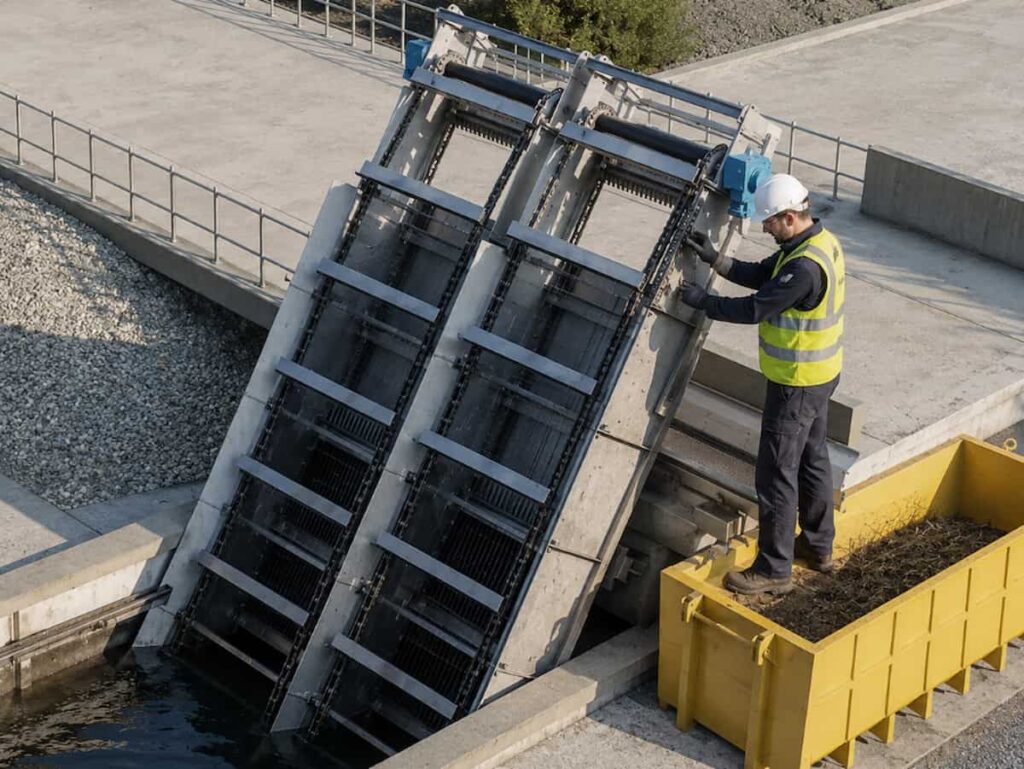
What actually breaks, when it breaks, and the maintenance discipline that keeps headworks running between major overhauls
Mechanical bar screen maintenance is the unglamorous work that determines whether a headworks runs reliably for twenty years or generates recurring failures and emergency callouts from year three onward. Most bar screens are robust equipment — the design is mature, the components are well-understood, and the failure modes are predictable. What goes wrong is not usually a design defect. Deferred lubrication, ignored headloss trends, worn tines nobody measured, and chain tension nobody adjusted — these are the actual causes of most bar screen failures. This guide covers the tasks that matter, the intervals that work in practice, and the indicators that warn of impending failure before it arrives.
The scope covers mechanically cleaned bar screens — front-raked and back-raked designs — in municipal and industrial headworks service. Step screens and band screens share some components but follow different maintenance schedules; they are not covered here.
For context on maintenance management within a broader plant operations framework, the Water Environment Federation addresses headworks operations and maintenance in its Manual of Practice series, including guidance on maintenance planning, record-keeping, and performance monitoring for preliminary treatment equipment.
Why Bar Screen Maintenance Gets Deferred — and What That Costs
Bar screen maintenance gets deferred for three reasons. Access is inconvenient — on front-raked screens especially, servicing the drive chain means working over an active wastewater channel. The consequences of deferral are not immediately visible — a screen with a worn chain and degraded tines still appears to operate normally until it jams or fails entirely. Additionally, operators inherit maintenance schedules written by vendors for average conditions that may not match the actual loading at their specific plant.
The cost of deferred maintenance accumulates in a characteristic pattern. Chain wear leads to sprocket wear. Sprocket wear leads to chain jumping. Chain jumping causes carriage misalignment. Carriage misalignment causes guide rail damage. Guide rail damage causes accelerating carriage wear. A chain replacement — a two-hour task — escalates into a full drive system overhaul. The cost multiplies ten to twenty times, and the screen goes offline for days.
Tracking this cost requires a maintenance record with component replacement dates and hours. Most plants do not keep this record consistently. Consequently, the cost accumulation is invisible until a major failure makes it undeniable. Start the record at commissioning and maintain it consistently — it is the single most useful tool for managing mechanical bar screen maintenance cost over the equipment life.
Daily and Weekly Maintenance Tasks
Daily maintenance on a mechanical bar screen takes five to ten minutes per unit. The tasks are simple. Doing them consistently separates plants that run reliably from those that do not.
Daily Visual Inspection
Walk the screen chamber each shift. Observe the rake completing a full cycle — carriage descends, tines engage, carriage ascends, screenings discharge, carriage returns. Any deviation from this smooth sequence is worth noting. Jerking during the lift stroke suggests chain tension or guide rail problems. Incomplete discharge — screenings falling back onto the bar frame — suggests chute blockage or worn tines. Unusual noise during the drive cycle indicates a mechanical problem developing.
Check the discharge chute visually. Accumulated screenings in the chute between rake cycles indicate either a blocked compactor inlet, an incorrect chute angle, or adhesive build-up on the chute surface. Left unaddressed, chute build-up causes the screen to lose discharge capacity during peak loading events.
Check the skip bin or compactor level. An overfull bin backs up into the discharge chute and eventually compromises screen operation. Bin level monitoring — a level switch with alarm, or simply a daily visual check — prevents this from developing unnoticed.
Weekly Checks
Check the control panel for alarms or fault logs since the last inspection. Many control systems log events silently. Torque protection trips that reset automatically, headloss spikes that cleared, and cycle count anomalies can all appear in the event log without anyone noticing during routine operation.
Observe the upstream and downstream water levels relative to the screen during normal flow conditions. Compare to the commissioning baseline headloss. A 20–30 mm rise in clean-screen headloss over several months indicates progressive tine wear or partial blockage in the lower bar section below the rake travel depth. Neither condition generates an alarm — only regular headloss comparison catches them early.
Monthly Maintenance Tasks
Monthly tasks involve physical contact with the screen components — checking, measuring, and lubricating. These tasks require the screen to cycle a few times for observation, then brief access to specific components. On most screens, monthly tasks do not require channel isolation.
Chain Tension Check
Drive chain tension degrades as the chain elongates with wear. Check tension by pressing on the chain mid-span between sprockets — the deflection should not exceed the manufacturer’s specification, typically 10–15 mm per 300 mm of span. A slack chain produces a characteristic slapping sound during the return stroke and may skip on the sprocket teeth during high-load lifting cycles.
Adjust chain tension at the tensioner sprocket — typically a bottom sprocket on an adjustable mounting. Record the adjustment date and the tensioner position. A chain requiring frequent tensioner adjustment has elongated beyond the adjustment range and needs replacement before the next tensioner bottoms out.
Lubrication
Lubrication intervals depend on the specific component and environment. As a general guide: lubricate the drive chain every 250–500 operating hours. Check the gearbox oil every 500 hours. Follow the manufacturer’s bearing schedule — typically 1,000–2,000 hours for sealed bearings, shorter for open bearings in wet environments.
On front-raked screens, applying chain lubricant requires access to the upstream face of the screen — the chain runs along the upstream face. Use a chain lubricant rated for wet and corrosive environments. Standard mineral oil-based lubricants wash off rapidly in the wet zone. Synthetic or wax-based chain lubricants with water resistance last significantly longer between applications. The cost difference is minor compared to the labour saving from less frequent reapplication.
Tine Visual Inspection
Inspect the rake tines at the end of a lifting stroke, when the tine assembly is accessible above the water surface. Look for missing tine tips — broken off on rag mats or foreign objects. Check for bent tines from stone or metal debris impact. Note visible wear on tine tips, where the sharp leading edge has dulled. Photograph the tines monthly — comparison across months reveals progressive wear more clearly than any single inspection.
A bent tine does not clean the bar gap it is supposed to cover. Bars in that section accumulate screenings faster than the surrounding bars. This creates an uneven blockage pattern that shows up as elevated headloss between rake cycles even when other tines are functioning correctly. Straightening a bent tine in situ is sometimes possible; replacing the tine tip is the preferred remedy when the geometry has been permanently deformed.
Quarterly and Annual Maintenance Tasks
Quarterly and annual tasks require either channel isolation or temporary offline operation of the screen. Plan these in advance — coordinate with plant operations to minimise disruption, and have spare parts on site before the work starts.
Quarterly: Full Drive System Inspection
Take the screen offline and isolate the channel. Inspect the drive chain over its full length. Measure chain elongation by counting a fixed number of links — typically 12 or 24 — and comparing the measured pitch length against the new-chain specification. Replace the chain when elongation exceeds 2–3% of nominal pitch, per the manufacturer’s specification. Do not wait for visible wear on individual links.
Sprocket, Rail and Seal Inspection
Inspect drive sprocket teeth for wear profile. New sprockets have a smooth, symmetric tooth profile. Worn sprockets show asymmetric or hooked profiles — the chain has been running on the same contact points and has deformed the tooth shape. Pairing a worn sprocket with a new chain is a poor combination: the pitch mismatch means the new chain wears rapidly. Replace chain and sprockets together when either shows significant wear.
Inspect guide rails along their full length. On UHMW-PE rails, check for grooving from carriage slide contact. Grooves deeper than 3–4 mm significantly increase carriage friction. Replace those rail sections before friction drives torque protection trips. On stainless steel rails, check for corrosion pitting, particularly at weld joints and fastener locations. Surface corrosion on stainless rails creates friction spikes that the drive must overcome — eventually triggering torque protection trips.
Annual: Component Measurement and Replacement Planning
Annual maintenance produces the data that drives replacement planning for the next 12 months. This is distinct from reactive maintenance. The goal is to identify components approaching failure and schedule replacement during a planned shutdown — not an emergency one.
Tine Depth Measurement
Measure tine depth. Most manufacturers specify a minimum tine depth below which cleaning effectiveness is significantly reduced. Record actual tine depth at multiple positions along the rake. When tines wear to within 10% of the minimum specification, order replacements before the next inspection cycle. Not after the first cleaning performance complaint.
Shaft Seal and Motor Inspection
Inspect and test the shaft seal on vortex chamber paddles and on any submerged drive shafts. A seal showing early weeping — slight moisture on the dry side of the seal — has not yet failed but will fail. Schedule replacement at the next planned maintenance window. An emergency seal replacement requires the same channel isolation and pump-out as a planned replacement, but with the additional cost of urgency and the consequential disruption of unplanned downtime.
| Task | Interval | Channel Isolation Required? | Key Measurement / Output |
|---|---|---|---|
| Visual inspection + headloss check | Daily | No | Headloss vs. baseline, discharge quality |
| Control panel alarm log review | Weekly | No | Event log entries since last check |
| Chain tension check and adjustment | Monthly | No (screen offline briefly) | Chain deflection vs. spec, tensioner position |
| Lubrication — chain and bearings | Monthly / per hours | No | Lubricant applied, component condition noted |
| Tine visual inspection + photography | Monthly | No | Tip condition, bent tines identified |
| Full drive chain inspection + elongation measurement | Quarterly | Yes | Elongation %, sprocket tooth profile |
| Guide rail inspection | Quarterly | Yes | Groove depth, corrosion assessment |
| Tine depth measurement | Annual | Yes | Depth vs. minimum specification |
| Shaft seal inspection (vortex/submerged drives) | Annual | Yes | Weeping, replacement decision |
| Motor and gearbox inspection | Annual | No | Temperature, vibration, oil level |
| Bar frame weld inspection (corrosion) | Annual | Yes | Corrosion initiation at welds |
The Discharge System: Maintenance the Screen Vendor Does Not Own
Discharge chute, screenings compactor, and skip bin form the downstream extension of the bar screen system. Maintenance on these components falls outside the screen vendor’s scope — and often outside the maintenance schedule entirely, because nobody specifically owns them.
Discharge Chute Maintenance
Clean the discharge chute interior monthly. Moist screenings adhere to any surface roughness and build up progressively. The build-up reduces effective chute width, causes intermittent blockages, and generates persistent odour from decomposing organic material. Use high-pressure water for routine cleaning. Confirm that the wash-down water drains to the treatment process, not to the building floor.
Inspect the chute surface at the quarterly screen inspection. UHMW-PE lining develops surface grooving that harbours bacterial growth and accelerates adhesion. Replace lining panels showing deep grooving — do not attempt to smooth them with abrasive tools, as this increases surface area and makes adhesion worse. Stainless steel chutes develop weld bead roughness and eventually corrosion pits — both adhesion points that periodic cleaning cannot fully address. Plan for chute lining replacement at 5–8 year intervals in high-throughput service.
Spray Nozzle Maintenance on Washing Systems
Where the screen discharge includes spray washing of screenings — either at the chute or in an integrated washer-compactor — inspect and clean spray nozzles monthly. Blocked nozzles reduce washing effectiveness immediately and invisibly. The compacted output looks normal. Organic content rises. Odour increases at the skip. Dispose of a hinged nozzle arrangement that allows each nozzle to swing out for cleaning without decommissioning the unit.
Troubleshooting Common Failures
Most bar screen failures present with recognisable symptoms before complete breakdown. Understanding the symptom-cause relationship allows targeted diagnosis rather than speculative component replacement.
Torque Protection Tripping Repeatedly
The drive motor stops and an alarm triggers. After reset, the motor runs briefly and trips again. The immediate cause is excessive resistance on the drive system — the motor cannot develop enough torque to complete the rake cycle. Possible causes include a foreign object wedged in the bar gaps, or grit accumulation at the frame base. A derailed chain causes the same symptom, as does severe guide rail friction from corrosion or worn carriage slides.
Do not repeatedly reset and restart after torque protection trips. Each reset attempt risks damaging the drive motor windings from thermal overload. Isolate the channel, dewater if necessary, and physically inspect the tine path before resuming operation. Most jams clear in 20–30 minutes with manual access. Damage from repeated forced restarts takes hours to assess and potentially requires motor rewinding.
Rising Headloss Despite Normal Rake Cycling
The screen cycles at normal frequency but headloss does not return to baseline after each cycle. Several distinct causes produce this pattern: tines worn below effective cleaning depth, leaving a residual screenings layer after each pass; grit accumulation in the lower bar section below the rake travel depth; discharge blockage causing screenings to fall back onto the bars during the return stroke; and bar frame corrosion or deformation narrowing the effective bar spacing and reducing open area.
Diagnose by isolating the channel during a low-flow period and inspecting the bar frame directly. Residual screenings after a manual rake cycle indicate tine wear. Dense material at the frame base indicates grit accumulation. Material falling from the chute onto the bars during the return stroke indicates a discharge system problem. Each cause has a different remedy — visual inspection distinguishes them clearly.
Unusual Noise During Operation
Banging or clicking during the lift stroke: chain skipping on sprocket teeth — caused by chain elongation beyond the elongation limit, or sprocket tooth wear. The chain periodically loses engagement and re-engages with an impact load. This accelerates sprocket wear rapidly once it starts. Measure chain elongation and inspect sprocket profile immediately.
Grinding and Elevated Motor Current
Grinding during carriage travel: guide rail surface damage or contamination — grit particles embedded in the rail surface or carriage slide material. This is more common after high-grit loading events. Clean the rail surface and inspect for scoring. Scoring on UHMW-PE rails creates a rough contact surface that holds grit and propagates the damage. Replace scored rail sections before the carriage slide material follows.
Motor Whine: Early Warning Sign
High-pitched whine from the drive motor: the motor is operating at elevated load — chain tension too high, guide rail friction excessive, or carriage binding from misalignment. Log motor current and compare to the commissioning baseline. Elevated current at the same flow conditions confirms excessive mechanical resistance. Do not ignore elevated motor current — it is an early warning that is easy to dismiss and expensive to ignore.
30,000 m³/day plant, front-raked screens on two channels. Four years had passed without a formal maintenance schedule. The vendor had provided one at commissioning, but staff turnover meant nobody followed it consistently after the first year. Drive chain lubrication had been performed approximately twice in four years rather than the specified monthly interval.
During a routine headworks inspection, the maintenance manager noticed that one screen was drawing 40% more motor current than the other at similar flow conditions. Channel isolation revealed chain elongation of 4.1% — well beyond the 2.5% replacement threshold — combined with significant corrosion pitting on the stainless steel guide rails. The elevated current reflected the drive motor working against both the slack chain friction and the rail pitting resistance. Both channels had the same maintenance history. The second channel showed only 2.8% elongation — apparently running less frequently due to a flow control arrangement that directed more flow through the first. Full drive system replacement on the first channel cost roughly $14,000 and took the screen offline for three days. Had the chain been replaced at the 2.5% elongation threshold — likely around eighteen months earlier — the replacement cost would have been under $2,000 with a four-hour shutdown.
Spare Parts: What to Stock and Why
Bar screen spare parts fall into two categories: wear items with predictable replacement intervals, and insurance items that rarely fail but cause extended downtime if not available on site when needed.
Wear Items — Stock Continuously
Drive chain: one full replacement set. Chain is the highest-wear consumable on most screens. Lead time from overseas suppliers can run 4–8 weeks. Running out of chain means the screen operates on an elongated chain until the replacement arrives — compounding sprocket wear throughout that period. Tine tips or full tine assemblies: one full set. Tine wear is gradual and predictable. Having replacement tines available means a worn set can be changed during a planned quarterly maintenance window rather than deferred to the next convenient procurement cycle. Lubricants: sufficient stock for six months of scheduled lubrication. This sounds obvious — but lubricant stockouts are remarkably common at plants with inconsistent procurement processes.
Insurance Items — Stock One Set
Insurance Spares: Stock Before You Need Them
Drive motor: one spare motor, pre-wired to match the installed motor. Motor failure stops the screen entirely. A spare motor on site means a two-hour replacement rather than a two-week lead time. Gearbox output seal: two sets. Seal failure allows wastewater ingress into the gearbox. Replacement seals are low cost and compact — there is no reason not to stock them. Carriage slide assemblies: one replacement set. Carriage slides wear gradually on the guide rails. When they fail suddenly — typically a slide block fracturing — the carriage jams mid-stroke. Having replacement slides on site allows same-day repair rather than an extended offline period while parts arrive.
The spare parts argument meets resistance at procurement stage. Stocking a spare motor for a bar screen feels like over-engineering — the screen is simple equipment, motors rarely fail, and the capital is better deployed elsewhere. The counterargument is simple arithmetic: a spare motor costs $800–2,500. Three weeks of mobile screening unit rental while waiting for a motor costs significantly more. That is before accounting for the regulatory and operational consequences of running headworks without a functioning screen. Stock the spare motor. It will not be needed often, but when it is needed, the difference between having it and not having it is measured in weeks, not hours.
Maintenance Records and Performance Trending
A maintenance record that goes beyond a simple log of tasks completed is the foundation of proactive rather than reactive maintenance. The most valuable data points to capture are those that reveal trends — not just current condition, but direction of change over time.
What to Record at Every Maintenance Event
Date, screen identifier, flow conditions at the time of inspection, and headloss reading at those conditions. Component condition ratings — chain elongation percentage, tine depth in millimetres, guide rail groove depth, motor current draw. Tasks performed and consumables used. Any abnormal findings, even minor ones. Predicted next action — “monitor” or “replace by next quarterly inspection” — based on the current condition.
This record, maintained consistently, allows a trend to be identified when it matters most: before failure rather than after it. A record showing 1.2% elongation at annual inspection, 1.8% six months later, and 2.4% at the next inspection predicts threshold breach within one more cycle. Order the replacement chain before the next inspection, not after the threshold trip.
Headloss Trending
Plot clean-screen headloss against time on a simple chart. Headloss rising from the commissioning baseline at consistent flow conditions is almost always a signal worth investigating. Common causes include tine wear, grit accumulation in the lower frame, bar frame corrosion reducing the effective opening size, and discharge system partial blockage. None of these generates an alarm. All of them respond to early intervention more cheaply than to late diagnosis.
FAQ
Mechanical Bar Screen Maintenance FAQ
Mechanical Bar Screen FAQ: Maintenance Procedures
Bar Screen FAQ: Chain Life and Maintenance Cost
Developing a Bar Screen Maintenance Programme?
Morvolous Engineering Team reviews maintenance schedules, spare parts planning, and condition monitoring approaches for headworks screening equipment. Reach out for a technical review of your maintenance programme before the next inspection cycle.
Contact Morvolous →