Why the Rotating Drum Screen Has Become a Standard Pretreatment Solution
Removing suspended solids at the beginning of a wastewater treatment process protects downstream equipment and improves overall plant performance. Among many screening technologies, the rotating drum screen has become one of the most widely used mechanical filtration systems.
Its popularity comes from a simple principle. Instead of allowing debris to accumulate on a stationary screen, the drum rotates continuously while an automatic cleaning system removes captured solids. This process minimizes clogging, maintains stable hydraulic capacity, and reduces manual maintenance.
Many industries—including municipal wastewater, food processing, paper manufacturing, textile production, aquaculture, and recycling facilities—use rotating drum screens because they combine reliable filtration with continuous self-cleaning operation. Selecting the correct drum screen also requires understanding how the internal cleaning mechanism works. Organizations such as the Water Environment Federation (WEF) provide additional technical resources about mechanical screening and preliminary treatment.
Quick Reference — Rotating Drum Screen Self-Cleaning Mechanism
| Item | Typical Value |
|---|---|
| Filtration Type | Mechanical Micro-Screen |
| Drum Rotation | Continuous |
| Screen Material | Stainless Steel 304 / 316 |
| Opening Size | 10 μm–6 mm |
| Cleaning Method | High-pressure Backwash |
| Solids Removal | Automatic |
| Typical Industries | Municipal & Industrial |
| Maintenance | Low |
| Water Recovery | High |
| Operation | Continuous 24/7 |
What Is a Rotating Drum Screen?
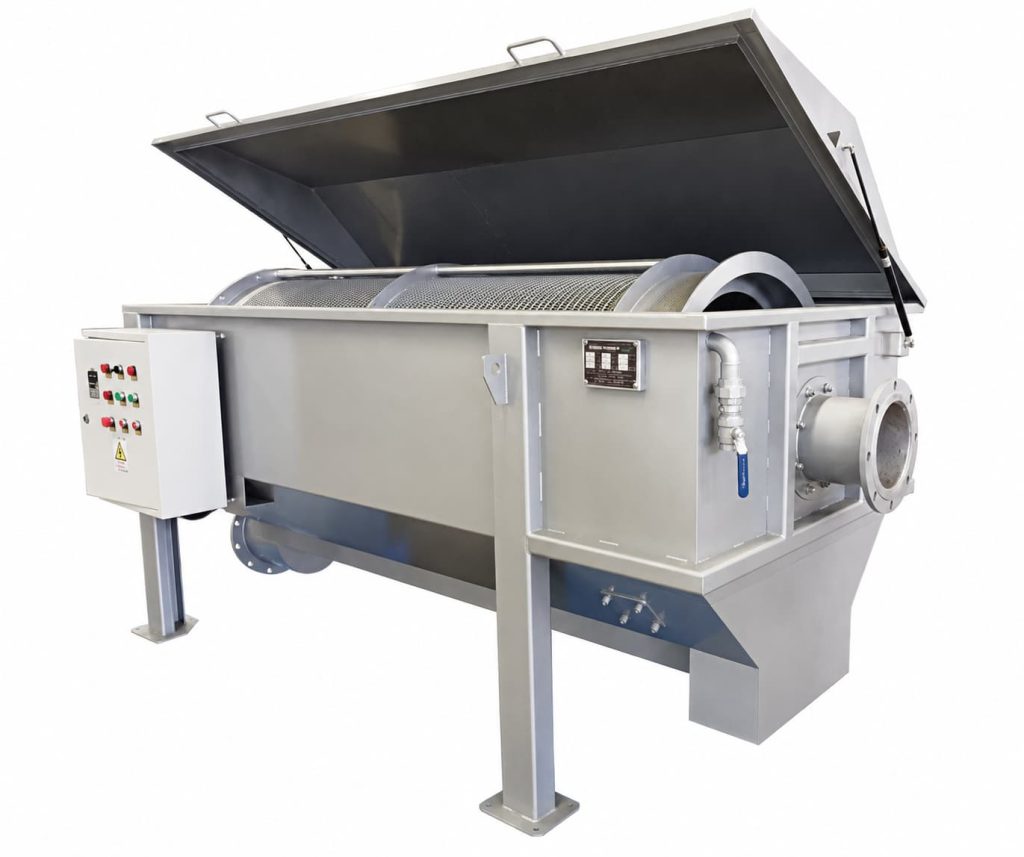
A rotating drum screen is a mechanical filtration device that separates suspended solids from wastewater using a cylindrical screen that rotates slowly during operation.
Wastewater flows into or onto the rotating drum. Water passes through the screen openings, while larger particles remain on the screen surface.
Instead of stopping production for cleaning, the drum rotates continuously until the accumulated solids reach the cleaning zone. High-pressure spray nozzles then remove the solids automatically.
This continuous process allows the equipment to maintain a stable filtration capacity with minimal operator intervention.
Main Components of a Rotating Drum Screen
Although manufacturers offer different designs, most rotating drum screens include the same major components.
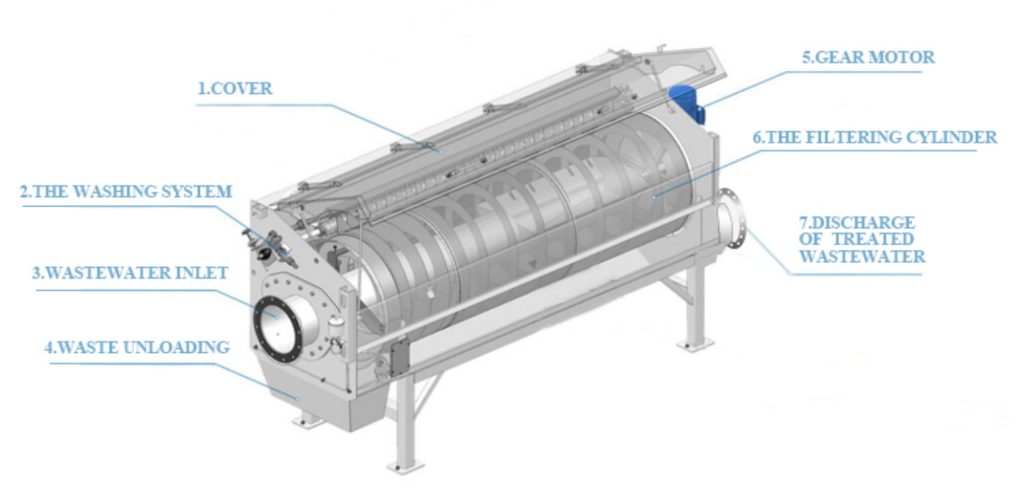
Stainless Steel Drum
The rotating drum provides the filtration surface.
The screen may use wedge wire, perforated plate, or woven mesh depending on the application.
Different aperture sizes allow the screen to capture different particle sizes.
Drive System
An electric motor rotates the drum at a controlled speed.
Variable frequency drives (VFDs) are often used to optimize cleaning frequency and reduce energy consumption.
A stable rotation speed also minimizes mechanical wear.
Backwash Spray System
The spray system performs automatic cleaning.
High-pressure water sprays from inside the drum toward the outside surface.
Captured solids are washed into the solids collection trough.
This process prevents excessive screen blockage.
Solids Collection Hopper
Removed solids fall into a collection hopper.
The solids can then enter:
- Screw conveyors
- Belt conveyors
- Compactors
- Sludge containers
Automatic discharge reduces labor requirements.
Control Panel
Modern systems include PLC-based controls.
Operators can monitor:
- Drum rotation
- Differential water level
- Motor status
- Alarm conditions
- Backwash operation
Remote monitoring is increasingly common.
How the Rotating Drum Screen Self-Cleaning Mechanism Works
The self-cleaning process follows a continuous operating cycle.
Step 1 – Wastewater Enters the Drum
Influent enters the screening chamber.
Depending on the design, water flows either from the inside outward or from the outside inward.
Large suspended solids remain on the screen surface.
Clean water passes through the openings.
Step 2 – Solids Build Up on the Screen
As filtration continues, solids gradually cover part of the screen.
Instead of immediately reducing flow capacity, the rotating drum distributes solids across a much larger filtration area.
This increases operating time before cleaning becomes necessary.
Step 3 – Water Level Increases
As more solids accumulate, hydraulic resistance increases.
Water level sensors or differential pressure sensors detect this change.
Once the preset value is reached, automatic cleaning begins.
Step 4 – Drum Rotates Toward the Cleaning Zone
The drum slowly rotates.
The dirty section moves upward until it reaches the backwash area.
Only a small section requires cleaning at one time.
The remaining screen continues filtering wastewater.
Step 5 – High-Pressure Backwash Removes Solids
Clean water enters the spray manifold.
Multiple nozzles produce concentrated water jets.
The jets remove trapped solids from the screen openings.
The debris falls into the discharge hopper.
This entire cleaning process usually lasts only a few seconds.
Step 6 – Clean Screen Returns to Filtration
After cleaning, the drum continues rotating.
The cleaned section returns to the filtration zone.
Continuous operation resumes without interrupting plant flow.
Why Continuous Rotation Improves Performance
A stationary screen gradually loses filtration capacity as solids accumulate.
A rotating drum screen avoids this problem through automatic cleaning.
Key benefits include:
- Stable hydraulic capacity
- Lower head loss
- Reduced clogging
- Less manual cleaning
- Longer operating cycles
- Better filtration efficiency
These advantages explain why rotating drum screens are widely used in continuous industrial processes.
Comparison of Self-Cleaning and Manual Cleaning Systems
| Feature | Rotating Drum Screen | Static Screen |
|---|---|---|
| Automatic Cleaning | Yes | No |
| Continuous Operation | Yes | Limited |
| Labor Requirement | Low | High |
| Head Loss | Low | Increases Quickly |
| Maintenance Frequency | Low | High |
| Water Recovery | Excellent | Moderate |
| Suitable for 24/7 Plants | Yes | Not Ideal |
| Operating Stability | High | Medium |
Factors That Influence Cleaning Efficiency
Several operating conditions determine how effectively the self-cleaning mechanism performs.
Screen Opening Size
Smaller openings remove finer particles.
However, they require more frequent cleaning.
Proper sizing balances filtration efficiency with operating cost.
Drum Rotation Speed
Higher rotation speeds clean more frequently.
Lower speeds reduce energy consumption.
The optimal setting depends on solids loading.
Spray Water Pressure
Backwash pressure directly affects cleaning quality.
Insufficient pressure leaves particles inside the screen openings.
Excessive pressure increases water consumption and equipment wear.
Wastewater Characteristics
Different wastewater types behave differently.
Examples include:
| Industry | Typical Characteristics |
|---|---|
| Municipal | Organic solids, hair, plastics |
| Food Processing | Grease, food particles |
| Paper Mills | Fiber, pulp |
| Textile | Fibers, lint |
| Aquaculture | Fish waste, feed residue |
| Recycling | Plastic fragments |
Common Rotating Drum Screen Configurations
Rotating drum screens can be designed in several structural configurations depending on application requirements.
Internal Feed Type
Wastewater enters inside the drum.
Water flows outward through the screen.
Solids remain inside and are discharged at the end.
This design is common in compact systems.
External Feed Type
Wastewater flows over the outer surface of the drum.
Solids are trapped on the outer screen.
Cleaning occurs from inside the drum outward.
This structure is often used in large flow systems.
Inclined Drum Design
The drum is installed at an angle.
Gravity assists solids movement.
This reduces energy consumption.
It also improves solids discharge efficiency.
Maintenance Requirements and Operating Stability
Rotating drum screens are designed for low maintenance operation, but regular inspection is still important.
Daily Checks
Operators should monitor:
- Spray nozzle condition
- Drum rotation stability
- Water flow consistency
- Solids discharge performance
Weekly Inspection
Check:
- Screen clogging patterns
- Drive motor temperature
- Bearing lubrication
- Control system alarms
Long-Term Maintenance
Every 3–6 months:
- Clean spray system pipeline
- Inspect screen wear
- Replace damaged nozzles
- Check structural alignment
Proper maintenance ensures stable long-term operation.
Callout — Why Self-Cleaning Matters
<div class=”callout”> Rotating drum screens reduce manual cleaning requirements by more than 80%. Continuous backwash ensures stable hydraulic performance even under high solids loading. This makes them ideal for 24/7 industrial wastewater systems. </div>
Warning — Incorrect Sizing Risks System Failure
<div class=”warning”> Improper drum screen sizing can lead to hydraulic overload, frequent clogging, and premature equipment wear. Always evaluate peak flow rate and solids concentration before selection. </div>
Green Box — Energy and Water Efficiency
<div class=”green-box”> Modern rotating drum screens use optimized backwash systems that reduce water consumption. Variable speed drives also help lower energy use during low-load conditions. This improves both operational cost and environmental performance. </div>
Comparison of Drum Screen Types
| Type | Filtration Area | Cleaning Method | Energy Use | Maintenance | Application |
|---|---|---|---|---|---|
| Internal Feed Drum | Medium | Internal Backwash | Low | Low | Compact systems |
| External Feed Drum | Large | External Spray | Medium | Medium | Industrial plants |
| Inclined Drum | High | Gravity + Spray | Very Low | Low | High solids load |
Project Anchors (Real Application Scenarios)
Project Anchor 1 — Municipal Wastewater Plant Upgrade
A 120,000 m³/day municipal plant in Southeast Asia replaced bar screens with rotating drum screens.
The system reduced clogging frequency by 70%.
Operator maintenance time dropped significantly.
Effluent quality entering secondary treatment became more stable.
Project Anchor 2 — Seafood Processing Facility
A coastal seafood plant faced high organic solids and shell waste.
A rotating drum screen was installed before dissolved air flotation.
The system improved DAF efficiency by reducing inlet solids load.
Downtime caused by clogging was eliminated.
Project Anchor 3 — Paper Mill Fiber Recovery Line
A paper mill in Europe installed fine mesh drum screens.
The system recovered reusable fibers from process water.
Recovered material was returned to production.
This reduced raw material cost and wastewater load simultaneously.
Opinion — Why Drum Screens Are Replacing Static Screens
Rotating drum screens are increasingly replacing traditional static screens in modern wastewater plants.
The main reason is operational stability.
Static screens depend heavily on manual cleaning and are sensitive to flow variation.
Rotating systems maintain consistent performance even under fluctuating loads.
In long-term operation, automation significantly reduces total lifecycle cost.
FAQ Group 1 — Basic Understanding
What is the main function of a rotating drum screen?
It removes suspended solids from wastewater using a rotating cylindrical mesh with automatic cleaning.
How often does the drum screen need cleaning?
Cleaning is continuous and automatic during operation.
No manual cleaning is required during normal use.
Can it handle high solids concentration?
Yes, but proper sizing is required to avoid overload.
What is the typical screen opening size?
It ranges from 10 microns to several millimeters depending on application.
FAQ Group 2 — Engineering & Selection
How do I choose the right drum screen size?
Selection depends on flow rate, solids concentration, and required filtration level.
Is backwash water consumption high?
Modern systems are optimized and use relatively low water volumes.
Can it run 24/7?
Yes, it is designed for continuous industrial operation.
What industries use drum screens most?
Municipal wastewater, food processing, paper mills, textile plants, and aquaculture.