Learn how tertiary filtration improves wastewater quality, supports water reuse, and helps treatment plants meet increasingly stringent discharge standards.
As wastewater discharge regulations become stricter worldwide, tertiary filtration has become an essential step in many municipal and industrial wastewater treatment plants.
Primary and secondary treatment remove most suspended solids and biodegradable pollutants. However, fine particles, residual suspended solids, phosphorus, algae, and microorganisms often remain in the treated effluent.
Tertiary filtration provides the final polishing stage before water discharge, reuse, or advanced treatment processes.
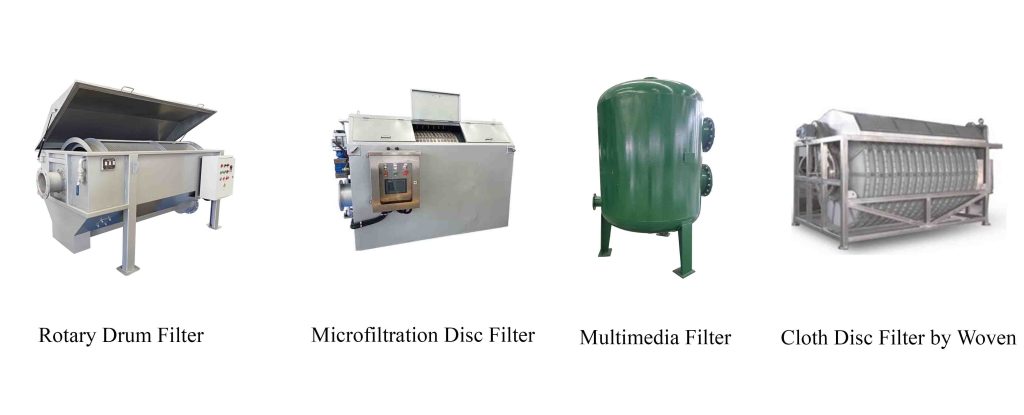
Today, technologies such as drum filters, disc filters, cloth media filters, sand filters, and membrane filtration are widely used to improve final effluent quality.
This guide explains how tertiary filtration works, compares different filtration technologies, and provides practical guidance for selecting the right system.
For additional engineering resources, wastewater professionals can refer to the Water Environment Federation at https://www.wef.org.
Quick Reference — Tertiary Filtration
| Parameter | Typical Value |
|---|---|
| Typical influent TSS | 10–40 mg/L |
| Typical effluent TSS | <5–10 mg/L |
| Suspended solids removal | 70–95% |
| Hydraulic loading rate | 5–20 m³/m²·h |
| Common filter media | Mesh, Cloth, Sand |
| Typical filtration accuracy | 10–100 μm |
| Backwash water consumption | 1–5% |
| Automation | Fully Automatic |
| Typical operating pressure | Gravity or Low Pressure |
| Typical application | Municipal & Industrial |
| Water reuse suitability | Excellent |
| Service life | 10–20 Years |
What Is Tertiary Filtration?
Tertiary filtration is the final solid-liquid separation process after biological treatment.
Its primary objective is to remove fine suspended solids that remain after secondary clarification.
These remaining particles may include:
- Fine sludge particles
- Biological flocs
- Algae
- Fiber
- Organic debris
- Residual phosphorus flocs
Without tertiary filtration, these contaminants can reduce disinfection efficiency and prevent wastewater reuse.
Why Tertiary Filtration Is Important
Modern discharge regulations continue to tighten.
Many wastewater treatment plants must now meet very low limits for:
- Suspended solids (TSS)
- Total phosphorus (TP)
- Turbidity
- Pathogen reduction
Secondary clarifiers alone often cannot consistently achieve these targets.
Tertiary filtration provides stable effluent quality even during flow fluctuations.
Improved UV Disinfection
Suspended solids shield microorganisms from ultraviolet light.
Removing fine particles greatly improves UV disinfection efficiency.
Many UV systems are designed assuming low TSS concentrations.
Better Water Reuse Quality
Water reuse projects require much cleaner water.
Tertiary filtration removes particles that would otherwise foul:
- Reverse osmosis membranes
- Ultrafiltration membranes
- Activated carbon systems
- Cooling towers
Reduced Environmental Impact
Cleaner effluent improves receiving water quality.
Lower suspended solids reduce sediment accumulation and improve aquatic ecosystems.
Common Tertiary Filtration Technologies
Drum Filters
Rotary drum filters use stainless steel mesh screens to remove suspended solids.
Advantages
- Compact footprint
- Automatic operation
- Low maintenance
- Suitable for municipal and industrial plants
Limitations
- Moderate filtration area
- Limited for ultra-low turbidity requirements
Disc Filters
Disc filters use multiple rotating filter discs.
This design greatly increases filtration area.
Advantages
- High hydraulic capacity
- Excellent tertiary treatment
- Small footprint
- Ideal for water reuse
Limitations
- Higher equipment cost
- More filter segments
Cloth Media Filters
Cloth media filters utilize synthetic filter fabric.
The fabric captures extremely fine particles.
These systems have become increasingly popular for phosphorus removal projects.
Typical Applications
- Municipal tertiary treatment
- Nutrient removal
- Water reclamation
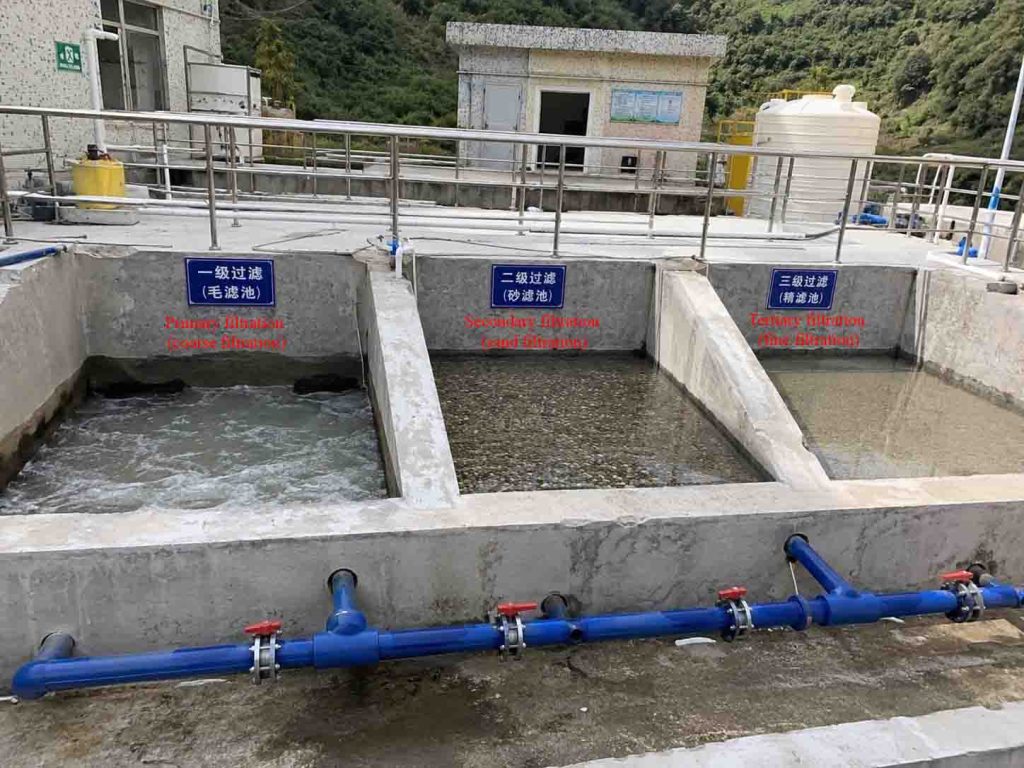
Sand Filters
Rapid sand filters have been used for decades.
Water passes downward through granular media.
Particles become trapped within the filter bed.
Advantages
- Proven technology
- Stable operation
- Good polishing performance
Limitations
- Larger footprint
- Higher backwash water usage
- More civil construction
Membrane Filtration
Membrane systems provide the highest filtration performance.
Typical technologies include:
- Microfiltration (MF)
- Ultrafiltration (UF)
Membranes can remove particles much smaller than conventional mechanical filters.
However, investment and operating costs are significantly higher.
Technology Comparison
| Technology | Filtration Accuracy | Footprint | Capital Cost | Maintenance | Water Reuse |
|---|---|---|---|---|---|
| Drum Filter | Good | Small | Moderate | Low | Good |
| Disc Filter | Excellent | Very Small | Higher | Low | Excellent |
| Cloth Media Filter | Excellent | Small | Moderate | Low | Excellent |
| Sand Filter | Good | Large | Moderate | Moderate | Good |
| Ultrafiltration | Outstanding | Small | Very High | High | Outstanding |
Municipal Wastewater Applications
Municipal wastewater treatment plants commonly install tertiary filtration for:
- Final effluent polishing
- Phosphorus removal
- Water reuse
- River discharge compliance
- UV pretreatment
Project Example – Northern Europe
A municipal wastewater treatment plant required effluent TSS below 5 mg/L before UV disinfection.
Engineers selected disc filters after evaluating drum filters and rapid sand filters.
The plant consistently achieved discharge requirements while reducing overall installation space.
Industrial Wastewater Applications
Industrial facilities frequently use tertiary filtration before:
- Water recycling
- Boiler feed treatment
- Cooling water reuse
- Reverse osmosis systems
Common industries include:
- Food processing
- Textile manufacturing
- Chemical production
- Electronics
- Pulp and paper
Food Processing
Food factories often install tertiary filtration after dissolved air flotation and biological treatment.
The filtration system removes remaining suspended solids before discharge.
Textile Industry
Textile wastewater frequently contains fine fibers.
Mechanical tertiary filtration effectively removes these materials before reuse systems.
Chemical Manufacturing
Chemical plants often require high-quality process water.
Tertiary filtration reduces suspended solids before advanced treatment.
Selecting the Right Filtration Technology
Several factors influence equipment selection.
Effluent Quality Requirements
The lower the required TSS concentration, the more advanced the filtration technology may need to be.
Available Installation Space
Compact treatment plants often favor:
- Disc filters
- Cloth media filters
- Drum filters
Plants with abundant land may still use sand filtration.
Operating Costs
Lifecycle cost should include:
- Energy consumption
- Backwash water
- Spare parts
- Maintenance
- Labor
Selecting equipment based solely on purchase price often increases long-term costs.
Future Expansion
Many municipal plants expect future capacity increases.
Expandable filtration systems simplify future upgrades.
Common Design Mistakes
Overspecifying Filtration Accuracy
Extremely fine filtration increases equipment cost.
Many projects specify lower TSS than regulations actually require.
A practical design often delivers better economics.
Ignoring Peak Flow
Average flow is rarely sufficient for equipment selection.
Storm events frequently determine final filter size.
Underestimating Backwash Requirements
Every filtration system requires cleaning.
Proper backwash design prevents performance deterioration.
Project Example – Southeast Asia
A municipal reuse project selected rapid sand filters based on initial equipment cost.
Later expansion became difficult because additional filter cells required major civil construction.
Engineers eventually replaced the system with modular disc filters, allowing future expansion with minimal structural modifications.
Engineering Perspective
Many wastewater projects begin by comparing filtration accuracy.
Accuracy is important.
However, hydraulic loading, maintenance requirements, and long-term operating costs often determine project success.
In municipal tertiary treatment, disc filters and cloth media filters have become increasingly popular because they combine high treatment performance with compact installation.
For industrial wastewater, drum filters remain attractive because of their simple construction and lower investment.
Successful projects balance effluent quality with practical operating requirements.
Tertiary Filtration Selection Checklist
Process Evaluation
- Determine required effluent quality
- Measure secondary effluent TSS
- Evaluate peak hydraulic loading
- Review discharge regulations
- Assess future expansion
Equipment Selection
- Select filtration technology
- Determine filtration area
- Verify hydraulic loading
- Review automation functions
- Confirm backwash system
Procurement Review
- Compare lifecycle cost
- Evaluate spare parts availability
- Verify local technical support
- Review installation requirements
- Confirm warranty coverage
Frequently Asked Questions
What is tertiary filtration?
Tertiary filtration is the final polishing stage after secondary treatment that removes fine suspended solids before discharge or reuse.
Which filtration technology is best?
The answer depends on treatment objectives.
Disc filters and cloth media filters are excellent for municipal reuse, while drum filters often perform well in industrial wastewater applications.
Can tertiary filtration remove phosphorus?
Indirectly, yes.
Chemical phosphorus removal forms particulate phosphorus that can then be removed by tertiary filtration.
Is tertiary filtration required for water reuse?
In most reuse projects, yes.
Filtration protects downstream UV systems, membranes, and advanced treatment equipment.
Conclusion
Tertiary filtration has become a critical component of modern wastewater treatment.
By removing fine suspended solids after biological treatment, these systems improve discharge quality, enhance disinfection, and support sustainable water reuse.
Whether using drum filters, disc filters, cloth media filters, or sand filters, successful projects depend on matching the filtration technology to wastewater characteristics, regulatory requirements, and long-term operating goals.
Need Help Selecting a Tertiary Filtration System?
Morvolous supplies drum filters, disc filters, cloth media filters, and complete tertiary wastewater treatment systems for municipal and industrial applications.
Our engineering team can evaluate your treatment objectives and recommend the most suitable filtration technology for your project.
About the Author
Morvolous Engineering Team
Morvolous specializes in advanced wastewater filtration, sludge treatment, and water reuse technologies. Our engineers support customers worldwide with equipment selection, process optimization, and turnkey wastewater treatment solutions.